

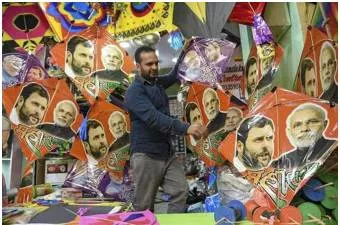
Lok sabha elections 2019 the contours of contest ahead
In the Lok Sabha election, voters will assess whether they are better off today than they were five years ago.This summer will see a carnival of democracy in the general election. Much has changed in just five years. The elan of Narendra Modi’s party is more muted this time. Last weekend, key opponents, the Samajwadi Party and the Bahujan Samaj Party, joined forces in Uttar Pradesh, making the contest real and not a walkover. The Index of Opposition Unity cannot predict outcomes but no one can afford to ignore it.
The Congress’s victories in the Assembly elections in three north Indian States have given it a shot in the arm. Equally important, the older party is firming up alliances in the southern States. The 131 Lok Sabha seats in five States (Andhra Pradesh, Karnataka, Kerala, Tamil Nadu and Telangana) and two Union Territories (Lakshadweep and Puducherry) have been critical to it in times of trouble.
The Telangana poll outcome was sobering for both the large national parties. Regional nationalism is not new to Indian politics: Jammu and Kashmir and Tamil Nadu were precursors. Regional formations have long governed West Bengal, Odisha and now Telangana. They may well hold the keys to power in New Delhi.
In 2014, it was the Bharatiya Janata Party (BJP) that led in securing allies. Between then and now, BJP president Amit Shah has helped expand its footprint. Not only does it have more MLAs than the Congress, but its cadre fights every election like there is no tomorrow.
The challenge lies elsewhere. The Congress may have lost in 2014 and come down to a historic low of less than one in five votes cast. Yet, only a decade age, in May 2009, the roles had been in reverse. It was Congress that had then polled 29% and the BJP just 19% of the popular vote.
Pages of political history
This time is different. It is 1971 that will be the textbook case for the ruling party. When the Grand Alliance said it would oust Indira Gandhi, she replied she wished to banish poverty. She won hands down.
Mrs. Gandhi did not have to contend with a powerful Dalit-led formation in the Ganga valley which commands 20% of the vote. Many of today’s regional parties were yet to be formed. She captured the public imagination. It was a gamble and she won hands down. Mr. Modi too will fight to the last voter. He will try to be the issue. He has sounded the tocsin against dynasty, caste and corruption. Hence the record in getting visible benefits to the individual and the family. The gas cylinder, the light bulb, that rural road: each will, he hopes, add to his appeal.
History has another instance too. The 2004 general election was held early. Atal Bihari Vajpayee was confident that ‘India was Shining’. The dream came apart on counting day. Rather than a unified Opposition (for there was none in the all-important State of Uttar Pradesh), ground-level discontent denied the ruling alliance another chance.
And yet, there is the cloud of the horizon. Even in 2004, the Congress was only a whisker ahead of the BJP — just seven seats more in the Lok Sabha. The Congress had 145 seats to the BJP’s 138. The key was on the ground, where the mood had shifted. The economic upturn began in 2003, but voters did not see gains early enough for the ruling bloc to reap an electoral harvest.
The poll planks
In 2014, the challenger drew on the tiredness with a decade of a Congress-led government and promised a fresh start. Runaway inflation and the spectre of corruption undercut the appeal of the Congress. This time the issues have changed. It is the squeeze on farm incomes and rural debt that are the key poll planks. Similarly, the issue of jobs is more pressing than ever. Cultivators across all strata and young people seeking productive employment want answers.
Two States are key. Maharashtra, a State critical in the histories of both the Congress and the BJP, is not only seeing a coming together of Opposition forces; it is undergoing drought and rural distress. Ominously, key farmer-led allies have walked across. Uttar Pradesh, a bastion (A structure or place from which one can resist attack) of the BJP, has rival Dalit- and Mandal-led parties coalesce for the first time in a quarter century. Both States have something in common. In both, sugarcane cultivation is a determinant of electoral fortunes.
Cane (not caste) and jobs (not community slogans) may hold the key. Ganna and Naukri, not reservations or the emotive Mandir issue. What matters more: bread or identity? Even when both count what takes precedence?
Government policy has had a key role in this denouement (The final part of something (such as a book, a play, or a series of events).) . By according priority to consumers in cities (who want low prices for cereals, oil seeds and pulses), the government did not have to pay heed to rural residents who need to earn more. The latter, as producers, are larger in number and percentage than in any other democracy.
India still lives and votes in its villages. Under Mr. Shah, the cadre, organisation and outreach have made the BJP a vastly larger party than any other. But economic policies can strain such organisational gains.
Democracy is about more than development. In a polity where people can throw their rulers out, it is centrally about politics. Since 1999, there has been a bi-nodal system, and the choice is not simply between Mr. Modi and Congress president Rahul Gandhi.
The battlelines
We have effectively a one-party government with a firm hand on the wheel (but with the danger of an over-centralisation of power). Against this, is ranged a looser coalition in which regional forces and rural interests have more play. Needless to add, the latter will be rockier, more contentious and tough to manage in a coherent ((of an argument, theory, or policy) logical and consistent) fashion.
The Modi government is driven by ideology and not pragmatism on a range of issues. This is the first ever BJP government with a view of culture, history and politics that seeks to remake history as much as the future. Is this the party’s agenda or the country’s? This is a question in the background: if the Ram temple issue comes to the fore, it will be a major choice for the voter.
The pluralism and Hindutva debate have another dimension more so than ever, namely the federal question. Across the Northeast (including Sikkim), far more important to the country than its 25 Lok Sabha seats indicate, the idea of citizenship is at variance with the new Citizenship Bill passed by the Lok Sabha. Across the country, State-level parties see an accretion (Growth or increase by the gradual accumulation of additional layers or matter.) of powers in the federal government unseen since the 1980s.
True, Mr. Modi has a wider mass appeal than any one since Mrs. Gandhi. But history is witness that such appeal can also have limits if voters decide that enough is enough. Has that point been reached? We simply do not know.
More central is the question of questions. Are you better off than you were five years ago, and if not, why not? If so, and even if not, do you think we are moving in the right direction?
In 2014, The Economist observed that if India had the per capita wealth of Gujarat, the country would rank with Spain. Has that dream come true or it is unravelling and fast? How voters answer that will show who they stand with.



Top court quashes FIRs against Gen Z protesters
Sep 04, 2026






Stay updated with The Hindu Editorial Vocab24 app, your definitive source for breaking news and comprehensive coverage from India and around the globe. Whether it's political developments, business updates, sports highlights, the latest technology trends, or current events, The Hindu brings live, accurate, and reliable news directly to your device.
Don’t fall for sensationalized or fake news shared online. Read and share accurate updates with friends and family through The Hindu Editorial Vocab24 app. Download it today!
News Coverage in The Hindu Editorial Vocab24 App
Breaking News: Receive instant notifications on breaking news stories as they unfold. Stay informed about major events and developments in India and around the world with live blogs, news in shorts videos, and concise articles.
Politics: Get the latest updates on Indian politics, including elections, policy changes, government decisions, and political events that shape the nation.
Business and Economy: Stay ahead in the economic landscape with detailed business news and market analysis. Learn about stock market trends, financial reports, corporate news, and economic developments to make informed investment decisions.
Current Events: Follow stories on social issues, policy changes, global events, and daily current affairs, tailored for UPSC and other competitive exam preparations.
Technology: Keep up with the latest gadgets, innovations, and tech trends. Read expert reviews and analyses in short, concise updates on cutting-edge technology from India and beyond.
Sports: Never miss a moment of your favorite sports. Get live scores, match reports, and expert analysis on cricket, football, tennis, and more.
International News: Stay informed about global events and geopolitical developments, including the Russia-Ukraine war, Israel-Palestine conflict, and other key international stories.
Local News: Stay connected to your community with the latest updates on city events, issues, and local news. Coverage includes hyperlocal updates from cities like Bangalore, Chennai, Delhi, Hyderabad, Mumbai, Kolkata, and more.
Trending Topics: Discover what's trending today with the most talked-about stories and hot topics across India and the world.
Experience journalism that values integrity, accuracy, and reliability. Download The Hindu Editorial Vocab24 app today and stay connected with the world.
Subscribe to our newsletter!







