

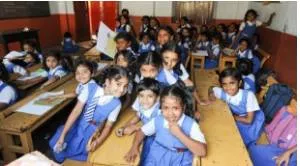
It’s elementary
The recent findings of a survey commissioned by the Union HRD ministry indicates that a large number of under-qualified teachers are teaching in schools throughout the country. This is incredible and appalling. It reaffirms the malaise (a general feeling of discomfort, illness, or unease whose exact cause is difficult to identify.) in education.It is astonishing too that nearly four lakh teachers in Bihar and Madhya Pradesh have failed to secure the 50 per cent benchmark in the Class 12 exam and almost 45,000 teachers have not studied beyond the Higher Secondary level. The state of primary education in West Bengal is no less distressing due to the recruitment of a large number of untrained teachers on the basis of the Teachers’ Eligibility Test.
Despite the Calcutta High Court order to abide by the RTE Act, the situation has been aggravated by the state government’s indifference (lack of interest, concern, or sympathy.) . Qualified teachers are absolutely necessary for quality education, most particularly at the elementary level. Recruitment of primary teachers with suitable qualifications and training is the fundamental imperative, one that has consciously been violated by the administration.
If teachers are not qualified enough, how they will teach? What impression are they going to convey to young minds? How will the concept of a digital and skilled India materialise without adequate literacy? The ratio of student and teacher is also a major problem which needs to be addressed immediately. The one-teacher school is a mockery (derision) of the education system. Some time ago, Parliament amended the Right to Education (RTE) bill.
It gave 8.5 lakh untrained teachers a time-frame till 2019 to get themselves qualified and to secure a professional degree from a recognised academic body. When the Right to Education Act was introduced in 2010, many new schools were set up, but untrained teachers were recruited. They were given five years to get themselves qualified.
The striking feature of the Bill is its emphasis on quality education. It envisaged that the evaluation of teachers would be conducted periodically. Teachers without the required qualifications would be given five years’ time to qualify. However, an evaluation of the RTE Act, after seven years, has exposed its shortcomings. The recent CAG report substantiates this appalling state of affairs. The problems are non-utilisation of funds by several states, decrepit (worn out or ruined because of age or neglect.) infrastructure, midday meal scam, dearth of qualified teachers, one-teacher dominated schools and little or no supervision. The Right to Education Act was promulgated after six decades of independence.
During this period, many experiments on children’s education were made both by the Centre and the states. The collaboration with Britain’s Department for International Development (DFID), Unicef, and Unesco for the improvement of elementary education has yielded nothing tangible. The recent Unicef report mentions about 450 million illiterates in our country. The RTE Act envisages the relaxation of bureaucratic control and a conducive environment for people’s participation in the overall development of primary education.
At present 4.6 per cent of 22 crore children in the 6-14 age-group are out of school, i.e. about one crore. The figure is extremely dismal, to say the least. Basic education or Buniadi Siksha, as formulated by Mahatma Gandhi, was both remarkable and challenging.
Cooperation, harmony rather than competition was given due importance in this scheme for overall development of the child. Community programmes, play, dignity of labour, work education, creativity and imagination enhanced the child’s psychological attitude and personality. The effectiveness of the Right to Education Act will depend mainly on the quality of teachers. It is necessary to create an “All India Teachers Service” and to recruit meritorious candidates through a central selection board.
Qualified teachers should be paid suitably in the interest of good education. There is no substitute for good teachers. Technology can act as a catalyst in the mind of the child. We have enough young minds in our country with the propensity (an inclination or natural tendency to behave in a particular way.) to learn, but few qualified teachers to teach them with care and affection.
If we recognise education in the 21st century as a valuable commodity that is monopolized (obtain exclusive possession or control of) and marketed ruthlessly (without pity or compassion for others.) by the school, it will be more expensive in the days to come. Throughout the country, the cost of educating a child is increasing enormously, and the time has come to acknowledge the role of teachers in society, their background, outlook, and professional ability. The news that a teacher can beat up a student to death simply because of his failure to complete homework is horrifying. This suggests that some teachers do not even possess the basic human qualities of tolerance and affection.
School education, particularly at the elementary level, is in a sordid (involving immoral or dishonourable actions and motives; arousing moral distaste and contempt.) state. Despite recommendations by several commissions before and after independence (like Sadler’s, JP Naik, Mudaliar, Radhakrishnan, Kothari etc), there has been little or no improvement. Governments both at the Centre and in the states are incurring a huge expenditure to bring about (to cause something to happen) qualitative improvement and expansion of elementary education, but with little success. Elementary education has virtually collapsed. There was a time when schools were regarded as temples of learning. The teachers, if poorly paid, were regarded as the backbone of society, and respected and honoured. Good teachers were well-organised, firm and fair with a sense of humour.
The environment of schools with its strict discipline, rules and regulations, was congenial (pleasant or agreeable because suited to one's taste or inclination.) . Barring few exceptions, most of the schools today are a prison-house with a heavily-loaded curriculum, which is evident in the size and weight of the school bags. The child’s daily routine is marked by joyless learning which affords no time for play. The education system has two facets ~ its administrative component and the academic.
Training of teachers is the responsibility of the school management. NCERT has been doing commendable work for half a century in the development of pedagogy (the method and practice of teaching, especially as an academic subject or theoretical concept.) , educational technology, preparation, publication of text books and teacher manuals. The National University of Educational Planning and Administration (NUEPA) must monitor the quality of education through continuous evaluation and research. The NUEPA must also assess whether the child has acquired the cognitive skills of ‘knowledge economy’.
The education system showcases organized anarchy (disorder) and corruption. It was dismal during the 34 years of Left rule in West Bengal. In the Education Development Index (EDI), West Bengal’s rank was at 33, only ahead of Jharkhand and Bihar. A radical change and reform in elementary education is absolutely necessary. The formal education system should be given due importance and funds ought to be provided to this segment only rather than non-formal education.
The school examination system should not be done away with. Examination and evaluation can help children to know their strength and weakness in a particular subject. Happily, the HRD ministry has very recently scrapped the no-detention proposal.
Mahatma Gandhi’s buniadi education, Swami Vivekananda’s overall development of humanity and educational epistemology (the theory of knowledge, especially with regard to its methods, validity, and scope, and the distinction between justified belief and opinion.) as perceived by Rabindranath Tagore should be blended. Above all, we require qualified and devoted teachers with a sense of morality, values and ethics.


Philippines president rodrigo duterte slams unhcr
Apr 06, 2018
Oli to take up currency ban issue with pm modi
Apr 02, 2018
Curbing the khaps
Apr 01, 2018





Stay updated with The Hindu Editorial Vocab24 app, your definitive source for breaking news and comprehensive coverage from India and around the globe. Whether it's political developments, business updates, sports highlights, the latest technology trends, or current events, The Hindu brings live, accurate, and reliable news directly to your device.
Don’t fall for sensationalized or fake news shared online. Read and share accurate updates with friends and family through The Hindu Editorial Vocab24 app. Download it today!
News Coverage in The Hindu Editorial Vocab24 App
Breaking News: Receive instant notifications on breaking news stories as they unfold. Stay informed about major events and developments in India and around the world with live blogs, news in shorts videos, and concise articles.
Politics: Get the latest updates on Indian politics, including elections, policy changes, government decisions, and political events that shape the nation.
Business and Economy: Stay ahead in the economic landscape with detailed business news and market analysis. Learn about stock market trends, financial reports, corporate news, and economic developments to make informed investment decisions.
Current Events: Follow stories on social issues, policy changes, global events, and daily current affairs, tailored for UPSC and other competitive exam preparations.
Technology: Keep up with the latest gadgets, innovations, and tech trends. Read expert reviews and analyses in short, concise updates on cutting-edge technology from India and beyond.
Sports: Never miss a moment of your favorite sports. Get live scores, match reports, and expert analysis on cricket, football, tennis, and more.
International News: Stay informed about global events and geopolitical developments, including the Russia-Ukraine war, Israel-Palestine conflict, and other key international stories.
Local News: Stay connected to your community with the latest updates on city events, issues, and local news. Coverage includes hyperlocal updates from cities like Bangalore, Chennai, Delhi, Hyderabad, Mumbai, Kolkata, and more.
Trending Topics: Discover what's trending today with the most talked-about stories and hot topics across India and the world.
Experience journalism that values integrity, accuracy, and reliability. Download The Hindu Editorial Vocab24 app today and stay connected with the world.
Subscribe to our newsletter!







