

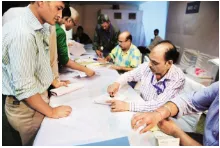
Is a progressive gst possible
India has one of the lowest direct tax to GDP (gross domestic product) ratios in the world. This was documented in last year’s Economic Survey. When it comes to taxing income, we have a very generous threshold for exemption. As Praveen Chakravarty pointed out in a BloombergQuint column, India is the second-most generous country, among 20 major countries, when it comes to granting exemption from income tax. Tax liability kicks in only when your income exceeds 2.4 times the national per capita income. So, a lot of income earners legitimately escape the income-tax net. For instance, if the income exemption limit had been kept at Rs1.5 lakh in in 2012-13, then tax collection would have increased by Rs31,500 crore and we would have had 16.5 million new taxpayers. Those are automatic additions to the tax net, since incomes rise with GDP, and taxable brackets need not.In these days of demonetization post-mortems, it is claimed that 2.2 million entities, mostly consisting of individuals, but a few trusts and companies as well, deposited a total of Rs2 trillion. All these 2.2 million entities have never paid income tax. Since the average deposited amount is Rs9 lakh, much more than the annual exemption limit, it is possible that a significant number of individuals may have to pay tax. Of course, it is entirely possible that the entire amount that was deposited was savings accumulated over several years.
The process of determining if there has been tax evasion involves inquiry, investigation, scrutiny, charges, judicial decision, appeals and tribunals. This can take a lot of time. If a handful of the cases revealed by the Panama Papers leaks have still not reached their logical conclusion, one can only speculate how long it will take to pursue hundreds of thousands of cases thrown up by suspiciously high deposits in the aftermath of demonetization.
In short, it is easier to get people into the income-tax net simply by avoiding exemption-bracket generosity every year. The total exemption granted to capital gains is another glaring loophole. It was recently extended even to gains made on sale of real estate, by reducing the holding period to two years. Last year’s Economic Survey gave extensive details of the loss to the exchequer due to exemptions to long- term capital gains in the past few years. For instance, in assessment year 2014-15, the capital gains that went tax free were Rs64,521 crore. In later years, this figure could be much higher.
The prime minister is on record urging the capital markets (where much of the tax-free capital gains are made) to bear their fair share of the tax burden in the economy. He hinted that the tax burden on stock market profit should be higher than it is.
This leads us to the other big anomaly of India’s tax revenue. It is that the share of direct taxes in total tax revenue (both state and Centre) is only 35%. Indirect taxes, now made up chiefly of the nationwide goods and services tax (GST), are inherently regressive. They hurt the poor more than the rich. GST is a consumption tax. For the poor, almost their entire income (or more) is spent on consumption, and is hence subject to the tax. The rich have a big share of their income go into savings, which is not taxed (or even subsidized). With the widening of GST, and higher tax slabs, the unfairness of the indirect system becomes more acute. The global average rate for consumption taxes is 16%. Most Asian countries have rates of 10-15%. But India’s modal rate is 18%. This hurts the poor much more.
To reduce the regressivity inherent in GST, most items consumed by the poor are taxed at a low 5% or 12%. It is claimed that most of the CPI (consumer price index) basket is taxed at these lower rates, or some items are completely exempt (e.g. foodgrain). This nobly intended classification brings its own distortions, disputes, lobbying and corruption. The ultimate aim of converging to a single GST rate becomes a distant dream.
Consumption taxes are less distortionary, easier to administer and monitor, are applicable to every transaction, and can be buoyant even with slight tweaks. Consumption cannot be hidden, unlike income or savings. Hence despite being unfair and regressive, they have become more popular worldwide. Renowned tax expert John Kay recently observed that the share of income tax in OECD (Organisation for Economic Co-operation and Development) governments’ revenue had fallen, whereas consumption tax share had gone up. This is a matter of great joy and success for the tax collector, but a matter of great dismay to the economist. We even have strident demands for reduction in income-tax rates, as a supply-side stimulus for pushing up GDP growth rates.
What is to be done then? The initial collection figures for GST in India already show higher than expected revenue. As implementation gets streamlined, and registration becomes complete, with interlocking incentives and completely computerized returns, GST revenue will grow handsomely. In fact, GST will race ahead of income taxes. How then to make it more fair? Is it possible to have a progressive GST?
The short answer is no. The long answer then is to focus on correcting the unfairness and skew, with greater redistribution. This could be through greater spending on public goods, including primary health and education. Or it could be through larger redistributive transfers aided by superior targeting through Aadhaar, or as universal transfers. Without these antidotes, the skew will only get worse.

Addressing india’s income inequality
Sep 12, 2017
Why do you do what you do mr raghuram rajan
Sep 11, 2017

Repairing the house that mahalanobis built
May 15, 2017
The currency swap initiative’s gdp surprise
Mar 05, 2017




Stay updated with The Hindu Editorial Vocab24 app, your definitive source for breaking news and comprehensive coverage from India and around the globe. Whether it's political developments, business updates, sports highlights, the latest technology trends, or current events, The Hindu brings live, accurate, and reliable news directly to your device.
Don’t fall for sensationalized or fake news shared online. Read and share accurate updates with friends and family through The Hindu Editorial Vocab24 app. Download it today!
News Coverage in The Hindu Editorial Vocab24 App
Breaking News: Receive instant notifications on breaking news stories as they unfold. Stay informed about major events and developments in India and around the world with live blogs, news in shorts videos, and concise articles.
Politics: Get the latest updates on Indian politics, including elections, policy changes, government decisions, and political events that shape the nation.
Business and Economy: Stay ahead in the economic landscape with detailed business news and market analysis. Learn about stock market trends, financial reports, corporate news, and economic developments to make informed investment decisions.
Current Events: Follow stories on social issues, policy changes, global events, and daily current affairs, tailored for UPSC and other competitive exam preparations.
Technology: Keep up with the latest gadgets, innovations, and tech trends. Read expert reviews and analyses in short, concise updates on cutting-edge technology from India and beyond.
Sports: Never miss a moment of your favorite sports. Get live scores, match reports, and expert analysis on cricket, football, tennis, and more.
International News: Stay informed about global events and geopolitical developments, including the Russia-Ukraine war, Israel-Palestine conflict, and other key international stories.
Local News: Stay connected to your community with the latest updates on city events, issues, and local news. Coverage includes hyperlocal updates from cities like Bangalore, Chennai, Delhi, Hyderabad, Mumbai, Kolkata, and more.
Trending Topics: Discover what's trending today with the most talked-about stories and hot topics across India and the world.
Experience journalism that values integrity, accuracy, and reliability. Download The Hindu Editorial Vocab24 app today and stay connected with the world.
Subscribe to our newsletter!







