

India france space alliance key to delhi’s ambitions but it must deepen ties with quad too
The IAF's revised doctrine aims to transition India from an air power to an aerospace power. But can India do it by itself in time and cost-effectively?India’s space policy has strived to achieve a fine balance between capabilities, entrepreneurship, and innovation. The question is how to move ahead in spacefaring in the prevailing geopolitical circumstances.
The Indian Air Force (IAF) recently published its revised and rather ambitious doctrine that aims to transition India from an air power to an aerospace power. Clearly, it implies a paradigm shift in outlook and capabilities.
But can India achieve it alone? The answer by itself would be affirmative but loses significance when time and cost are taken into consideration. A better question to ask is: Can India do it by itself in time and cost-effectively? Here, nothing underscores the critical importance of technical collaboration as does the India-France strategic partnership on space.
As India embarks upon attaining a new, robust personality as a spacefaring nation and an aerospace power, it looks to build mutually beneficial partnerships with other spacefarers, especially those with whom India has had a history of reliability, mutual understanding, and good faith. And one of the most preeminent partnerships that India has built in terms of space collaboration is with France.
Three-pronged strategic cooperation
France and India have essentially a three-pronged cooperation in defence, space, and nuclear energy. There are also overlapping areas like convergence on climate change and triangular cooperation in third countries, which has strengthened this relationship even further. Collaboration in the defence sector, which has seen unprecedented growth in recent times, is also thematically related to the second prong — space cooperation.
Stargazing starts from the waters of the Indo-Pacific: Counting on its tremendous strategic convergence with India is a key desideratum for France as well. What is referred to as the Indo-Pacific Theatre comprises the Indian and Pacific Oceans. While the latter is already home to US manoeuvres, when it comes to the Indian Ocean region, France is the only country with physical territory.
Therefore, it is in the best mutual interests of India and France to collaborate in the Indian Ocean region and uphold a rule-based order and freedom of navigation. The underlying objective is to uphold a multipolar order so that the region doesn’t fall prey to China’s wolf warriorism. In the same spirit, India and France are the only two countries that have a joint vision for the Indian Ocean region that focuses rightly on developing Maritime Domain Awareness (MDA) capabilities to ensure effective security architecture in the region. For the uninitiated, MDA capabilities are directly linked with Space Situational Awareness capabilities (SSA).
The tenacity rooted in solid history
The history of the India-France bilateral cooperation goes all the way back to the ’60s. One of the key legacies is the development of propulsion technology, which has stood the test of time. The Indian film Rocketry: The Nambi Effect (2022) based on the life of maverick ISRO scientist Nambi Narayanan shows his journey of travelling to France with his group of researchers to learn the complexities of liquid engines, a technology that France pioneered.
The collaboration between the two countries continued well into the 1980s, as France started launching those Indian satellites from Ariane at the French Guiana Space Center that were not put in orbit by ISRO’s Polar Satellite Launch Vehicles (PSLVs) or Geosynchronous Satellite Launch Vehicles (GSLVs).
The 2010s saw this cooperation grow by leaps and bounds. In 2013, the CNES (France’s National Centre for Space Studies) established a permanent liaison office in India at the Consulate General of France in Bengaluru.
Moreover, in April 2015, the relationship got a further fillip when the two space agencies signed a memorandum of understanding for space cooperation. This was followed by the release of a joint vision for space cooperation in various areas of space exploration in March 2018.
The year 2019 again was an important year for France. Just as the country formally published its Indo-Pacific strategy and emphasised the role of India as a partner in the seas, it took the Paris-Delhi space collaboration several notches up.
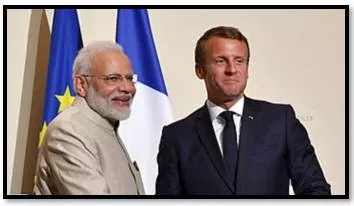
There was refurbished enthusiasm in Indo-France space undertakings. Following President Emmanuel Macron’s state visit to India, CNES and ISRO announced the creation of an Indo-French working group on India’s human spaceflight mission which was developed further in 2019.
Another landmark agreement inked in 2019 formalised the development of a maritime surveillance centre in India to detect, identify, and track ships in the Indian Ocean. Besides boosting MDA, joint development of advanced capabilities for climate monitoring as well as lending support to India’s ambitious mission to Mars, Venus, and asteroids were also announced. For CNES, in terms of the volume of engagement, ISRO is second only to NASA.
The big challenge
Just three months after Russia invaded Ukraine in February 2022, India and France signed a key pact that formalised a bilateral strategic dialogue to enhance coordination and jointness between their space and defence agencies. With this pact, France became the third country after the US and Japan to set up a space security dialogue with India. However, the relationship is even more special to Paris as New Delhi happens to be the first in Asia with whom France has set up such a mechanism.
Another key focus of this bilateral dialogue was the strategy to protect space assets. As in the Indo-Pacific, China is the principal violator of norms in outer space too. The irresponsible anti-satellite (ASAT) test of 2007 and uncontrolled re-entries by China has cautioned other spacefaring states.
The impact of the Ukraine war
Joint scientific research had, till now, remained unfettered by unconducive developments on Earth. The International Space system (ISS) has been a symbol of genuine cooperation where different modules were taken care of by different spacefaring nations. However, the Ukraine war has fragmented the geopolitical system, and its impact on the space domain is un-missable. Sanctions are most likely to impact Russia’s spacefaring capabilities because of its critical dependence on microchips. Just like on Earth, Russia is likely to get pushed with China in flannel skies too.
In a widening wedge between Europe and Russia, a European Union (EU) report showed that Moscow’s Roscosmos had withdrawn its engineers from a joint space centre in Kourou in French Guiana. Russia also announced to halt deliveries of rocket engines for launching satellites. On the flip side, this situation provides an opportunity for India to increase its satellite launching capacity, counting on its collaboration with France, which has already been helping India with launches.
It Is also the right time for India to encourage participation by the private sector, which will not only make the system more competitive but also ensure better efficiency.
India’s venture into more satellite launches will be a safe zone because it is the least affected by sanctions on Russia. Experts say that in the case of satellites, it is Europe, and not Russia, which exports about 60 per cent of cost components to India.
However, the same cannot be said of the physical damage to the Indian facilities in Ukraine where Delhi was to test its semi-cryogenic engine. While the exact details about the extent of damage are not known yet, the facilities remain vulnerable as air attacks by Russia intensify. If there is any truth in such claims, this is going to impede ISRO’s space manoeuvres.
While boosting collaboration with France is key, India must strive to diversify space partnerships in a way that doesn’t land us in vulnerable dependencies that become detrimental to our ambitions to be an aerospace power. Therefore, alongside France, India must also develop the expanse and depth of space collaboration with the Quad countries — the US, Japan, and Australia.











Stay updated with The Hindu Editorial Vocab24 app, your definitive source for breaking news and comprehensive coverage from India and around the globe. Whether it's political developments, business updates, sports highlights, the latest technology trends, or current events, The Hindu brings live, accurate, and reliable news directly to your device.
Don’t fall for sensationalized or fake news shared online. Read and share accurate updates with friends and family through The Hindu Editorial Vocab24 app. Download it today!
News Coverage in The Hindu Editorial Vocab24 App
Breaking News: Receive instant notifications on breaking news stories as they unfold. Stay informed about major events and developments in India and around the world with live blogs, news in shorts videos, and concise articles.
Politics: Get the latest updates on Indian politics, including elections, policy changes, government decisions, and political events that shape the nation.
Business and Economy: Stay ahead in the economic landscape with detailed business news and market analysis. Learn about stock market trends, financial reports, corporate news, and economic developments to make informed investment decisions.
Current Events: Follow stories on social issues, policy changes, global events, and daily current affairs, tailored for UPSC and other competitive exam preparations.
Technology: Keep up with the latest gadgets, innovations, and tech trends. Read expert reviews and analyses in short, concise updates on cutting-edge technology from India and beyond.
Sports: Never miss a moment of your favorite sports. Get live scores, match reports, and expert analysis on cricket, football, tennis, and more.
International News: Stay informed about global events and geopolitical developments, including the Russia-Ukraine war, Israel-Palestine conflict, and other key international stories.
Local News: Stay connected to your community with the latest updates on city events, issues, and local news. Coverage includes hyperlocal updates from cities like Bangalore, Chennai, Delhi, Hyderabad, Mumbai, Kolkata, and more.
Trending Topics: Discover what's trending today with the most talked-about stories and hot topics across India and the world.
Experience journalism that values integrity, accuracy, and reliability. Download The Hindu Editorial Vocab24 app today and stay connected with the world.
Subscribe to our newsletter!







