

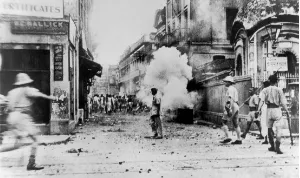
India’s muslims and the price of partition
Seventy years after independence, India’s Muslim population has begun to fear that the dark fantasies of the Muslims led by Muhammad Ali Jinnah and the Muslim League in the 1930s and 1940s — who fought for the partition of India and the creation of Pakistan as a homeland for the subcontinent’s Muslims — could well be coming true. The Muslim League, a party established by Muslim landlords and the educated middle class, claimed that it alone had the right to represent Muslims and their interests. This brought it into conflict with the Indian National Congress of Mahatma Gandhi and Jawaharlal Nehru, who argued that they represented all Indians. In 1936-7, the British decided to conduct elections to 11 provincial legislatures. A large measure of administrative powers was to be transferred to the governments thus elected. The Congress, the League and a slew of provincial parties participated in the polls. Despite its claim of representing Muslims’ aspirations, the Muslim League polled less than 5 percent of their votes, which inspired fantasies and fears. The League began to argue that the Hindu majority of undivided India would swamp Muslims and suppress their religion and culture. As evidence, the League pointed to Hindu-Muslim riots in the northern states of Bihar and the United Provinces (now Uttar Pradesh), both ruled by the Congress, as an ominous portent. They argued that the movement to ban the slaughter of cows, led by an assortment of religious leaders, Hindu nationalist groups and some members of the Congress, was aimed at subverting Muslim culture. Unlike Muslims, Christians, Jews and animists, a segment of Hindus worship the cow and don’t eat its meat. In 1937, Congress adopted as the national song of India some verses from “Vande Mataram,” or “I praise you, Mother,” a poem written in the 1870s by Bankim Chandra Chattopadhyay, a Bengali poet and novelist, as an ode to the Hindu goddess Durga. The League objected to its singing as it depicted India as Mother Goddess, which the League construed to promote idolatry, anathema to Muslims. Continue reading the main story Over the last three years, under Prime Minister Narendra Modi’s Bharatiya Janata Party government, some of the League’s fears in the 1930s and ’40s have returned to haunt India’s Muslims — who acount for 172 million of India’s 1.3 billion citizens. Punishment for cow slaughter, which is proscribed in most states of India, has become more severe. A conviction can lead to sentences ranging from five years to life imprisonment. The foot soldiers of Mr. Modi’s party and its affiliates have run aggressive campaigns demanding that, apart from giving up beef, India’s Muslims must not date or marry Hindu girls or women. They should reconvert to Hinduism, the B.J.P. and like-minded others say, because their ancestors were Hindus who were forcibly converted by medieval Muslim rulers. They must sing “Vande Mataram,” the national song, these proponents say, to prove their loyalty to India, and their children must perform yoga in schools to show respect for India’s culture. Since some medieval Muslim kings demolished temples to build mosques, the B.J.P. and affiliates say, Muslims in modern, democratic India should voluntarily hand over various mosques and shrines to the Hindus. The most alarming trend has been the lynching of Muslims suspected of possessing beef, for ferrying home cattle purchased legitimately from cattle markets elsewhere. The markers of Muslim identity — beards, skullcaps and head scarves — invite frowns, even violence, in India. On a late June afternoon, Junaid Khan, a 15-year-old Muslim boy, was stabbed to death on a train near New Delhi. Mr. Khan was traveling with his older brother and two friends. They were identified as Muslim because of their clothes and skullcaps. After an argument over a train seat, their fellow passengers threw religious slurs at them, killed Mr. Khan and injured the other boys. Hindu nationalists haven’t forgiven Muslims for the partition of India, but their fury is a little misguided. Despite the mass violence and displacement of the partition, around 35 million Muslims stayed in India after the creation of Pakistan, which was carved out of Muslim majority provinces. Some of them might have subscribed to Pakistan but chose India because they didn’t wish to forfeit properties or sever ties with their extended families. Many might not have had any political opinion whatsoever. Many Indian Muslims, including religious scholars, ferociously opposed the Muslim League’s demand for Pakistan. Hindu nationalist ideologues have argued that Muslims can’t be loyal to India, as it might be their motherland, but it is not their holy land. India’s Muslims have evolved their own survival strategy since 1989 and the rise of the Hindu nationalist politics under the banner of the B.J.P. They combined with other social groups to vote for the party best placed to defeat the B.J.P., but this strategy has yielded diminishing returns. Mr. Modi’s B.J.P. won the national elections in 2014 despite being mostly rejected by Muslim voters. In an unconscious imitation of the strategy that is the obverse of what the Muslim League adopted between 1937 and 1947, the B.J.P. has propagated fictitious ideas of Muslim assertion. These ideas have acquired traction because of widespread Islamophobia and the insurgency in Muslim-majority Kashmir. Although Muslims outside Kashmir do not identify with the demand for independence that their culturally different co-religionists are waging, these factors have fanned the insecurities of a substantial number of Hindus. They perceive the B.J.P. as their savior, which was how a large segment of Muslims saw the Muslim League in 1946. India’s Muslims didn’t feel secure and weren’t flourishing before the B.J.P.’s rise. There were Hindu-Muslim riots then as well; Muslims were targeted and discriminated against. Their representation in elite government services has been less than 5 percent, according to the Indian government report in 2006. Today India’s Muslims are apprehensive. Before sectarian violence was often orchestrated to win elections in a clutch of seats, almost always followed by a process of reconciliation. The Hindu-Muslim rivalry never constituted the political language of the Congress Party, the principal recipient of Muslim votes for much of India’s 70 years. The B.J.P. seeks to permanently consolidate Hindus against Muslims and keep the social caldron simmering. For India’s Muslims, their recompense is that their status is better than that of Hindus and Christians in Pakistan and Bangladesh. That is no consolation for Muslims whose ancestors did not succumb to the Muslim League’s fears and fantasies, which seem to be slowly spinning their way into the orbit of Indian reality.





Stay updated with The Hindu Editorial Vocab24 app, your definitive source for breaking news and comprehensive coverage from India and around the globe. Whether it's political developments, business updates, sports highlights, the latest technology trends, or current events, The Hindu brings live, accurate, and reliable news directly to your device.
Don’t fall for sensationalized or fake news shared online. Read and share accurate updates with friends and family through The Hindu Editorial Vocab24 app. Download it today!
News Coverage in The Hindu Editorial Vocab24 App
Breaking News: Receive instant notifications on breaking news stories as they unfold. Stay informed about major events and developments in India and around the world with live blogs, news in shorts videos, and concise articles.
Politics: Get the latest updates on Indian politics, including elections, policy changes, government decisions, and political events that shape the nation.
Business and Economy: Stay ahead in the economic landscape with detailed business news and market analysis. Learn about stock market trends, financial reports, corporate news, and economic developments to make informed investment decisions.
Current Events: Follow stories on social issues, policy changes, global events, and daily current affairs, tailored for UPSC and other competitive exam preparations.
Technology: Keep up with the latest gadgets, innovations, and tech trends. Read expert reviews and analyses in short, concise updates on cutting-edge technology from India and beyond.
Sports: Never miss a moment of your favorite sports. Get live scores, match reports, and expert analysis on cricket, football, tennis, and more.
International News: Stay informed about global events and geopolitical developments, including the Russia-Ukraine war, Israel-Palestine conflict, and other key international stories.
Local News: Stay connected to your community with the latest updates on city events, issues, and local news. Coverage includes hyperlocal updates from cities like Bangalore, Chennai, Delhi, Hyderabad, Mumbai, Kolkata, and more.
Trending Topics: Discover what's trending today with the most talked-about stories and hot topics across India and the world.
Experience journalism that values integrity, accuracy, and reliability. Download The Hindu Editorial Vocab24 app today and stay connected with the world.
Subscribe to our newsletter!







