

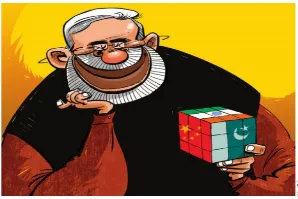
Handling pakistan and china
This year, India recalibrated its relationship with its two biggest foreign policy worries.Can Pakistan's release of Indian fishermen as a `goodwill' gesture on Christmas day be the first, faint signs of a thaw at the end of a year that began with a jihadi attack on the Pathankot Indian air force base and later saw India carry out surgical strikes on terror launch pads across the line of control?
Instability being the norm in India-Pakistan ties, diplomatic gains can evaporate in a jiffy . So it was par for the course when the Pakistan army responded to PM Narendra Modi's Lahore diplomacy in December last year with Pathankot followed by a string of attacks on Indian military camps.
Yet there might be some evidence that the surgical strikes after 18 soldiers died in a fidayeen attack on the Indian army camp at Uri is yielding results.Defence minister Manohar Parrikar was perhaps his usual impolitic self when he revealed Pakistan pleaded with India to halt retaliatory fire after weeks of cross LoC shelling, but there has been relative calm since mid-November.
The fierce heat of protests in Kashmir triggered by the killing of Hizbul leader Burhan Wani has ebbed though the embers simmer and crackle. The appointment of Gen Qamar Bajwa as Pakistan army chief in place of India baiter Raheel Sharif and a significant change of guard at ISI have created some wriggle room for PM Nawaz Sharif.
Military appointments are unlikely to change the nature of the Pakistani state and its use of terrorism. But 2016 has sobering lessons for Pakistan as its frenetic bid to fan violence in Kashmir and internationalise the dispute only resulted in humiliating isolation within Saarc. India paid a cost too with a loss of civilian and military lives, but made it plain that it can and will bear the pain.
Surgical strikes mark a new normal with Pakistan which will weigh options in terms of a nascent opening to Russia, deepening economic ties with China and the advantage of its political geography. A thaw in US-Russia ties under Donald Trump could blunt an emerging China-Russia-Pakistan axis though Moscow's moves warrant close scrutiny. But a fresh détente depends on Pakistan's readiness ¬ and capability ¬ to act on new realities.
Apart from Pakistan the year saw a significant, but subtler recalibration with China. Modi and Xi Jinping met thrice in 2016 and the Indian PM's direct manner in raising China's opposition to India's membership of the nuclear suppliers group and its block on UN sanctions against Jaish-e-Mohammad chief Maulana Masood Azhar was novel for the Chinese, who expect `lesser' powers to follow a more deferential routine.
Chinese commentators occasionally admire Modi's `decisiveness' but an assertive and confident leader can be disconcertingly at odds with a disparaging view of India as a chaotic and ineffective democracy ¬ and by implication ¬ the superiority of party rule in China.Neighbours, even larger ones like India, are expected to have limited aspirations.
It can be fairly argued that the Chinese wall has not yielded. In fact postures seem to have hardened, leading to concern that an overly muscular approach might attract a military and economic backlash.This criticism is similar to the view that a military response has not halted terrorism sourced from Pakistan. The challenge lies in ensuring matters don't slip into open hostility. As China relentlessly pursues strategic goals like the economic corridor in Pakistan, the view that India needs to `manage' relations with Beijing while building border infrastructure and defensive capabilities apace makes eminent sense. In a bid to signal dissatisfaction with status quo, India brought Tibet back onto the conversation with the Dalai Lama set to visit to Arunachal Pradesh and stood by Mongolia after China imposed sanctions on it for hosting the leader.
The decision to resume testing India's inter-continental Agni V missile, defence cooperation with Vietnam, a civil nuclear deal with Japan, renewal of ties with Indonesia and references to the South China sea in bilateral statements indicate India will not continue tiptoeing around China's corns even as it does not jeopardise the relationship.
China seems to realise the need to remain engaged even as it uses its enormous economic clout to smother Asian and African countries with dollops of aid. Its massive reserves meant it could spend $ 1 trillion to stabilise its stock market in 2015. India's hunt for partners in Asia mimics, in a strategic context, China's use of military patrols to nibble away at the line of actual control to alter its contours.
A recent Foreign Policy article suggests India has been chipping away since 2010 at China's hegemonistic claims without ruining the relationship.Modi seems to have accelerated the process without abandoning the gains of a growing economic relationship that China also remains keen to sustain.Symbolic as some of these actions may seem, they constitute a message that relations require reciprocity.
Donald Trump's presidency offers some opportunities for India though there might be limits to his capacity, or even preparedness, to confront Pakistan and China despite his stated desire to do so. India's ability to retain economic momentum and improve its credentials as investment destination are a key factor in ensuring its concerns find due resonance in Washington and other capitals.
Delhi's colombo hug
May 14, 2017
Alt centre chakravyuh we made
Mar 04, 2017





Stay updated with The Hindu Editorial Vocab24 app, your definitive source for breaking news and comprehensive coverage from India and around the globe. Whether it's political developments, business updates, sports highlights, the latest technology trends, or current events, The Hindu brings live, accurate, and reliable news directly to your device.
Don’t fall for sensationalized or fake news shared online. Read and share accurate updates with friends and family through The Hindu Editorial Vocab24 app. Download it today!
News Coverage in The Hindu Editorial Vocab24 App
Breaking News: Receive instant notifications on breaking news stories as they unfold. Stay informed about major events and developments in India and around the world with live blogs, news in shorts videos, and concise articles.
Politics: Get the latest updates on Indian politics, including elections, policy changes, government decisions, and political events that shape the nation.
Business and Economy: Stay ahead in the economic landscape with detailed business news and market analysis. Learn about stock market trends, financial reports, corporate news, and economic developments to make informed investment decisions.
Current Events: Follow stories on social issues, policy changes, global events, and daily current affairs, tailored for UPSC and other competitive exam preparations.
Technology: Keep up with the latest gadgets, innovations, and tech trends. Read expert reviews and analyses in short, concise updates on cutting-edge technology from India and beyond.
Sports: Never miss a moment of your favorite sports. Get live scores, match reports, and expert analysis on cricket, football, tennis, and more.
International News: Stay informed about global events and geopolitical developments, including the Russia-Ukraine war, Israel-Palestine conflict, and other key international stories.
Local News: Stay connected to your community with the latest updates on city events, issues, and local news. Coverage includes hyperlocal updates from cities like Bangalore, Chennai, Delhi, Hyderabad, Mumbai, Kolkata, and more.
Trending Topics: Discover what's trending today with the most talked-about stories and hot topics across India and the world.
Experience journalism that values integrity, accuracy, and reliability. Download The Hindu Editorial Vocab24 app today and stay connected with the world.
Subscribe to our newsletter!







