

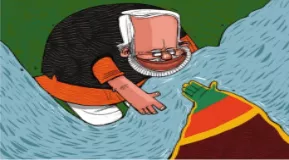
Delhi's colombo hug
PM Modi's Sri Lanka diplomacy is a vital test case for his neighbourhood first policy. While a penchant for Hindu symbolism is a leitmotifof Prime Minister Narendra Modi's unique brand of politics domestically, one of the more interesting and underreported aspects of his international diplomacy has been a focus on the cultural power of Buddhism and India's special identity as its birthplace. Today , for instance, he begins a visit to Sri Lanka for UN's `Vesak Day' celebrations to commemorate the day millions of Buddhists around the world mark as the day the Buddha was born in 623 BC, the day he attained enlightenment and day he passed away in his 80th year. Even as the rich cultural tapestry of Buddhism frames the backdrop of this visit to Colombo, also on the agenda are crucial bilateral meetings with President Maithripala Sirisena, who just this week harked back to India and Sri Lanka's old Buddhist linkages to question opposition leaders who are protesting a deal for India to jointly operate strategic oil tanks in the eastern port of Trincomalee. “Are they Buddhists?“ Sirisena famously asked. In a week in which India launched its South Asia satellite, Modi's Sri Lanka diplomacy is also a crucial test case for his `Neighbourhood First' policy. The trajectory of Delhi's Colombo relationship is instructive in this regard. In political terms, the sheer volume of bilateral visits at the highest levels of government on both sides over the last couple of years speaks for itself. President Sirisena first visited India in February 2015, within a month of being elected to office, and has been to India thrice more since then.Prime Minister Ranil Wickremesing he has also been to Delhi thrice, most recently in April this year. Modi is going to Colombo for the second time now. After the previous Rajapakse government's tilt towards China as a weapons and credit supplier, sharply focussed in the public eye with the docking of a Chinese submarine in Colombo harbour in 2014, there has certainly been a rebalancing in Sri Lanka. As former Sri Lankan naval chief and director of Colombo's Centre for India-Lanka Initiatives Admiral Jayanath Colombage says, “at the leadership level the relationship hasn't been better ever“. Yet quite often, when it comes to leveraging high aspirations and implementing real changes on the ground, joint initiatives end up being seen on the one hand in Delhi, from the lens of China's deepening footprint on the island, and on the other hand in Colombo, from a perspective of resistance to `Big Brother' India, as evidenced by the recent anti-India strike by Colombo Petroleum Corporation Trade Union collective against the Trincomalee deal. Both are legitimate political concerns. For Delhi, to invoke former NSA Shivshankar Menon, Sri Lanka is also an aircraft carrier 14 kilometres off the coast of India. For Colombo, the old legacy of Tamil politics and its civil war still hangs heavy when selling new initiatives publicly. So, while leaders from both sides keep talking the talk, their real challenge is to break out of the binaries of history. At a time when China is trying to weld (cause to combine and form a harmonious or effective whole.) India's wider neighbourhood and beyond in an ambitious web of connectivity through its Belt and Road initiative on a scale that has never been done before, for India to build and strengthen economic connectivity becomes even more vital.Delhi cannot match Beijing as a moneybag but it can certainly leverage its traditional strengths. It has long been Sri Lanka's biggest trade partner, has a development portfolio worth $2.6 billion and has played a vital role in rebuilding northern and eastern Sri Lanka road and rail links over the past few years. A few clear opportunities present themselves. First, a long-pending proposal for inter-connecting the Indian and Lankan power grids. Sri Lanka currently accounts for only 56% of its energy demand from indigenous sources with an energy demand growing annually at 6%. The result is that fossil fuel imports are 25% of Sri Lanka's import expenditure and nearly 50% of export income. The economic argument for cross-border electricity trade is clear. India already has such arrangements in place with Nepal, Bangladesh and Bhutan and technical details of such an arrangement with Colombo, through under-sea HDVC cables, have been discussed in detail between experts. If the costing works out, it is a win-win for both India and Sri Lanka. Second, shipping data shows that while the Chinese may have built the international container terminal at Colombo, 70% of its freight is from India. Colombo, in that sense, may already be India's second largest port and, according to Suren Ratwatte, CEO of Sri Lankan Airlines, one of its biggest airports in terms of passenger traffic. It makes sense to build on these economic linkages by working out an easier visa regime; even to think, as Ratwatte suggests, of pre-visa clearance arrangements in the manner the US has with several airports in say Canada or even Abu Dhabi. Third, while transport minister Nitin Gadkari has for some time been talking about a proposed 26-kilometre rail link connecting Dhanushkodi and Talaimannar, this is yet to be negotiated seriously. A good step would be to at least start ferry services across the sea link.Tuticorin-Colombo ferry services commenced in 2011 but were suspended.A Rameswaram-Talaimannar ferry has been talked about for almost a decade. At a time when Indian companies are vying to build the east terminal of Colombo port, starting boat services would be a welcome connecting step.
Alt centre chakravyuh we made
Mar 04, 2017
Handling pakistan and china
Dec 30, 2016





Stay updated with The Hindu Editorial Vocab24 app, your definitive source for breaking news and comprehensive coverage from India and around the globe. Whether it's political developments, business updates, sports highlights, the latest technology trends, or current events, The Hindu brings live, accurate, and reliable news directly to your device.
Don’t fall for sensationalized or fake news shared online. Read and share accurate updates with friends and family through The Hindu Editorial Vocab24 app. Download it today!
News Coverage in The Hindu Editorial Vocab24 App
Breaking News: Receive instant notifications on breaking news stories as they unfold. Stay informed about major events and developments in India and around the world with live blogs, news in shorts videos, and concise articles.
Politics: Get the latest updates on Indian politics, including elections, policy changes, government decisions, and political events that shape the nation.
Business and Economy: Stay ahead in the economic landscape with detailed business news and market analysis. Learn about stock market trends, financial reports, corporate news, and economic developments to make informed investment decisions.
Current Events: Follow stories on social issues, policy changes, global events, and daily current affairs, tailored for UPSC and other competitive exam preparations.
Technology: Keep up with the latest gadgets, innovations, and tech trends. Read expert reviews and analyses in short, concise updates on cutting-edge technology from India and beyond.
Sports: Never miss a moment of your favorite sports. Get live scores, match reports, and expert analysis on cricket, football, tennis, and more.
International News: Stay informed about global events and geopolitical developments, including the Russia-Ukraine war, Israel-Palestine conflict, and other key international stories.
Local News: Stay connected to your community with the latest updates on city events, issues, and local news. Coverage includes hyperlocal updates from cities like Bangalore, Chennai, Delhi, Hyderabad, Mumbai, Kolkata, and more.
Trending Topics: Discover what's trending today with the most talked-about stories and hot topics across India and the world.
Experience journalism that values integrity, accuracy, and reliability. Download The Hindu Editorial Vocab24 app today and stay connected with the world.
Subscribe to our newsletter!







