

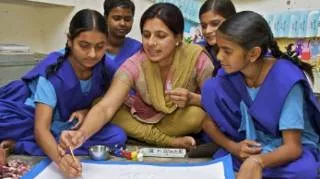
Girl in search of learning
Peace in every home, every street, every village, every country ~ this is my dream. Education for every boy and every girl in the world.~ Malala Yousafzai
In her autobiographical memoir (a historical account or biography written from personal knowledge.), I am Malala, Malala Yousafzai initiates her journey on a rather perturbing (concerning or disturbing) note. In the chapter ‘A Daughter is Born’, she doesn’t forget to mention: ‘When I was born, people in our village commiserated (feel or express pity for (someone).) with my mother and nobody congratulated my father.’ She goes on to add: ‘I was a girl in a land where rifles are fired in celebration of a son, while daughters are hidden away behind a curtain, their role in life simply to prepare food and give birth to children.’
Malala’s observation is not only an issue of concern in the circumstance of Pakistan, but it also rings true in the context of the entire Indian subcontinent as well. Sadly though, even today, in most parts of the country, the birth of the girl child is not welcome. Malala’s candid (upfront) observation is symptomatic of a greater socio-cultural malady in the subcontinent that needs to be redressed with utmost urgency.
The exigency (an urgent need or demand.) is a desperate one, more so, as there seems to be an inherent social resistance that thwarts the successful implementation of various social welfare schemes specifically directed towards women’s welfare and empowerment of the girl child. In stray cases of success of certain schemes, the overall bleak ((of a situation) not hopeful or encouraging; unlikely to have a favourable outcome.) scenario seems to drown and obscure the silver lining (Use the term silver lining when you want to emphasize the hopeful side of a situation that might seem gloomy on the surface.). Yet one has to be an incorrigible ((of a person or their behaviour) not able to be changed or reformed.) optimist and strive for the turn of the tide.
As Malala laments in her autobiography, right from her birth, she had been perceived as a liability, being subject to inequity, prejudice and subjugation at each and every stage of her early life. The instance of Malala underlines the enormity of the problem both in the rural and the urban sector of the Indian subcontinent.
Inevitably, it cannot be denied that gender prejudice lies at the root of neglect of the girl child, especially as regards crucial issues like education, health care and financial empowerment. Reversal of this deep rooted social bias is of strategic significance in the state’s fight for empowerment of the girl child. Her overall security and upbringing is precious; not only for today but for the future as well. To take care of the future of women’s empowerment it is imperative to ensure the security and upbringing of the girl child of today. Against the onslaught of the predominantly all male set-up, there is very little choice for the hapless ((especially of a person) unfortunate.) victim except to haplessly surrender to its whims and fancies of the patriarchal society. Along with the scourge of abject neglect and apathy, comes the looming ((of an event regarded as threatening) seem about to happen.) spectre (something widely feared as a possible unpleasant or dangerous occurrence.) of abuse and exploitation of the girl child in her growing-up period.
Discrimination against the girl child, an integral part of Indian society, operates in a vicious manner in multiple ways. Be it urban or rural, the birth of a girl child is not only unwelcome, but unfortunately seen as a burden. As a consequence of such a flawed perception, cases of female infanticide continue to be reported from different parts of the country on a regular basis, even today. This has a direct bearing on the sex ratio. The shocking condition of the sex ratio can be easily perceived from observations made on the census of India website: ‘Like the sex composition of the total population, the sex composition by age groups is vital for studying the demographic trends of the young population, its future patterns and particularly the status of the girl child.’
The report further states that ‘at the census 2001, sex ratio of the population in the age group 0-6 years has been registered as 927 in India, declining from 945 in 1991 and 962 in 1981’. ‘The decreasing sex ratio in this age group’ as the report adds, ‘has a cascading effect (an inevitable and sometimes unforeseen chain of events due to an act affecting a system.) on population over a period of time leading to diminishing sex ratio in the country.’ The website warns in its report that ‘one thing is clear ~ the imbalance that has set in at this early age group is difficult to be removed and would remain to haunt the population for a long time to come.’ An alarming ratio reflects a host of other social maladies which further exacerbates (make worse) the plight of the Indian girl child in the short term and frustrates the much cherished distant dream of women’s empowerment in the long run.
With due candour (the quality of being open and honest;), it must be admitted that the central and the state governments are leaving no stone unturned to improve and recover the situation. Besides the resounding recent success of the West Bengal government’s Kanyashree Prakalpo, the nation has witnessed a spate of several other social welfare schemes to alleviate the position of the girl child. Most notable among these include but are not necessarily limited to Beti Padho, Beti Bachao or the BPBB scheme, the Kasturba Gandhi Balika Vidyalaya project, the Ladli Laxmi Yojana of the Madhya Pradesh government, the Sabla, Dhanalakshmi, Kishori Shakti Yojana, and the Sukanaya Samriddhi Yojana among several others.
For a definite change for the better, the society requires a paradigm shift in its attitude that underlines the needs of the girl child. In this context, the key to success lies in systematically breaking the myths and typecasts that revolve around gender issues. Education in itself has a key role to play. One should understand that the importance of educating the girl child is not only confined to long-term financial empowerment and autonomy, but that it paves the way for better empowered homemakers, sisters, mothers and grandmothers.
Education, irrespective of age, would aid women in increasing their self-esteem, carving out an affirmative, positive self-worth that would definitely go a long way in augmenting their confidence levels in life, making them conscious that they are entitled to equal participation and share in all issues of life.
In her memoir, Malala Yousafzai describes her conversation with Barack Obama in the White House: ‘It was quite a serious meeting. We talked about the importance of education…I told him that instead of focusing on eradicating (expunge) terrorism through war, he should focus on eradicating it through education.’



Philippines president rodrigo duterte slams unhcr
Apr 06, 2018
Oli to take up currency ban issue with pm modi
Apr 02, 2018
Curbing the khaps
Apr 01, 2018





Stay updated with The Hindu Editorial Vocab24 app, your definitive source for breaking news and comprehensive coverage from India and around the globe. Whether it's political developments, business updates, sports highlights, the latest technology trends, or current events, The Hindu brings live, accurate, and reliable news directly to your device.
Don’t fall for sensationalized or fake news shared online. Read and share accurate updates with friends and family through The Hindu Editorial Vocab24 app. Download it today!
News Coverage in The Hindu Editorial Vocab24 App
Breaking News: Receive instant notifications on breaking news stories as they unfold. Stay informed about major events and developments in India and around the world with live blogs, news in shorts videos, and concise articles.
Politics: Get the latest updates on Indian politics, including elections, policy changes, government decisions, and political events that shape the nation.
Business and Economy: Stay ahead in the economic landscape with detailed business news and market analysis. Learn about stock market trends, financial reports, corporate news, and economic developments to make informed investment decisions.
Current Events: Follow stories on social issues, policy changes, global events, and daily current affairs, tailored for UPSC and other competitive exam preparations.
Technology: Keep up with the latest gadgets, innovations, and tech trends. Read expert reviews and analyses in short, concise updates on cutting-edge technology from India and beyond.
Sports: Never miss a moment of your favorite sports. Get live scores, match reports, and expert analysis on cricket, football, tennis, and more.
International News: Stay informed about global events and geopolitical developments, including the Russia-Ukraine war, Israel-Palestine conflict, and other key international stories.
Local News: Stay connected to your community with the latest updates on city events, issues, and local news. Coverage includes hyperlocal updates from cities like Bangalore, Chennai, Delhi, Hyderabad, Mumbai, Kolkata, and more.
Trending Topics: Discover what's trending today with the most talked-about stories and hot topics across India and the world.
Experience journalism that values integrity, accuracy, and reliability. Download The Hindu Editorial Vocab24 app today and stay connected with the world.
Subscribe to our newsletter!







