

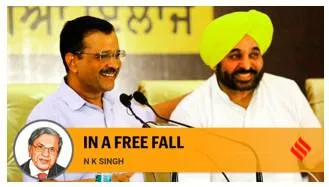
Freebies are a passport to fiscal disaster
India is a Union of states. It is not a confederation of states. It is not a question of holding together but of coming together. The Union is indestructible. The configuration of the states which constitute the Union can change. The Union, therefore, is integral to both the Centre and the states. The strength of the Centre lies in the strength of the states.Therefore, the macroeconomic stability of the Union is contingent on the macroeconomic stability of both the Centre and states. That is why in grappling with the complex issues of the Fifteenth Finance Commission, of which I was the chairman, we devoted the entire Volume-IV to the states. Each state in this volume of the report has been analysed at great length. So have their individual deficits, debts and macroeconomic stability, which includes the developmental challenges each of the states face.
The political dialogue built around freebies is fraught with danger. There is great ambiguity in what “freebies” mean. We need to distinguish between the concept of merit goods and public goods on which expenditure outlays have overall benefits. Examples of this are the strengthening and deepening of the public distribution system, employment guarantee schemes, support to education and enhanced outlays for health, particularly during the pandemic. All over the world, these are considered to be desirable expenditures.
Therefore, it’s not about how cheap the freebies are but how expensive they are for the economy, life quality and social cohesion in the long run. We must dread the thought of replicating the culture of competitive freebie politics. We must go the route of achieving higher rates of economic growth. The race to efficiency is the race to prosperity.
There are seven reasons why. First, freebies undercut the basic framework of macroeconomic stability. The politics of freebies distorts expenditure priorities. Outlays are being concentrated on subsidies of one kind or the other. What, therefore, does this mean to fiscal sustainability for states which are already debt-stressed?
Illustratively, in the case of Punjab, while estimates vary, some have speculated that the promise of freebies might cost around Rs 17,000 crore for their implementation. If we take everything impacting the debt ratio of Punjab into account, there is going to be an additional impact of 3 per cent of GSDP. As we know, the debt-to-GDP ratio of Punjab is already at 53.3 per cent for 2021-22, which would worsen on account of these new measures.
Second is the issue of the distortion of expenditure priority. Take, for instance, the change to the new contributory pension scheme from the old scheme, which had a fixed return. Rajasthan announced that it would revert to the old pension scheme. This decision is regressive as the move away from the old scheme was based on the fact that it was inherently inequitable. The pension and salary revenues of Rajasthan amount to 56 per cent of its tax and non-tax revenues. Thus, 6 per cent of the population, which is made up of civil servants, stands to benefit from 56 per cent of the state’s revenues. This is fraught with dangers not only of intergenerational inequality, but also affects the broader principles of equity and morality.
Third, the issue of intergenerational equity leads to greater social inequalities because of expenditure priorities being distorted away from growth-enhancing items.
Fourth, movement away from the environment. When we talk of freebies, it is in the context of providing, for example, free power, or a certain quantum of free power, water and other kinds of consumption goods. This distracts outlays from environmental and sustainable growth, renewable energy and more efficient public transport systems.
Fifth, the distortion of agricultural priorities. This affects agricultural practices which do not depend on extensive use of water and fertilisers. The depleting supply of groundwater is an important issue to consider when speaking of freebies pertaining to free consumption goods and resources.
Sixth, its debilitating effect on the future of manufacturing. Freebies lower the quality and competitiveness of the manufacturing sector by detracting from efficient and competitive infrastructure enabling high-factor efficiencies in the manufacturing sector.
Seventh, this raises the question of whether the time has come to consider recourse mechanisms like subnational bankruptcy. Freebies bring into question market differentiation between profligate and non-profligate states and whether we can have a recourse mechanism for subnational bankruptcy.
The race to the bottom implies government deregulation of markets and business. This means eventually that states compete to underbid each other in lowering taxes, expenditure and regulation. We must strive instead for a race to efficiency through laboratories of democracy and sanguine federalism where states use their authority to harness innovative ideas and solutions to common problems which other states can emulate.
The economics of freebies is invariably wrong. John Maynard Keynes said, “There is no harm in being sometimes wrong — especially if one is promptly found out.” In this case, it has been promptly found out that both the economics and politics of freebies are deeply flawed. It is a race to the bottom. Indeed, it is not the road to efficiency or prosperity, but a quick passport to fiscal disaster.












Stay updated with The Hindu Editorial Vocab24 app, your definitive source for breaking news and comprehensive coverage from India and around the globe. Whether it's political developments, business updates, sports highlights, the latest technology trends, or current events, The Hindu brings live, accurate, and reliable news directly to your device.
Don’t fall for sensationalized or fake news shared online. Read and share accurate updates with friends and family through The Hindu Editorial Vocab24 app. Download it today!
News Coverage in The Hindu Editorial Vocab24 App
Breaking News: Receive instant notifications on breaking news stories as they unfold. Stay informed about major events and developments in India and around the world with live blogs, news in shorts videos, and concise articles.
Politics: Get the latest updates on Indian politics, including elections, policy changes, government decisions, and political events that shape the nation.
Business and Economy: Stay ahead in the economic landscape with detailed business news and market analysis. Learn about stock market trends, financial reports, corporate news, and economic developments to make informed investment decisions.
Current Events: Follow stories on social issues, policy changes, global events, and daily current affairs, tailored for UPSC and other competitive exam preparations.
Technology: Keep up with the latest gadgets, innovations, and tech trends. Read expert reviews and analyses in short, concise updates on cutting-edge technology from India and beyond.
Sports: Never miss a moment of your favorite sports. Get live scores, match reports, and expert analysis on cricket, football, tennis, and more.
International News: Stay informed about global events and geopolitical developments, including the Russia-Ukraine war, Israel-Palestine conflict, and other key international stories.
Local News: Stay connected to your community with the latest updates on city events, issues, and local news. Coverage includes hyperlocal updates from cities like Bangalore, Chennai, Delhi, Hyderabad, Mumbai, Kolkata, and more.
Trending Topics: Discover what's trending today with the most talked-about stories and hot topics across India and the world.
Experience journalism that values integrity, accuracy, and reliability. Download The Hindu Editorial Vocab24 app today and stay connected with the world.
Subscribe to our newsletter!







