

Explaining india’s un vote on jerusalem
In a major diplomatic setback to the United States and President Donald Trump, 128 countries voted in favor of a UN General Assembly resolution rejecting U.S. recognition of Jerusalem as the capital of Israel. This included India, which voted against the United States and carried forward New Delhi’s principled position on the issue – a month before Israeli Prime Minister Benjamin Netanyahu’s scheduled visit to India.India’s vote is significant and interesting for a number of reasons.
India, in line with its Nehruvian-era foreign policy principles of Third World Solidarity and non-violence, has historically been an ardent supporter of the Palestinian cause. Despite recognizing the state of Israel in 1950, India only established diplomatic relations with Israel in 1992, notwithstanding Israel’s fervent courting of India over the years. However, despite India’s reticence in embracing Israel owing to its strong links with Arab states and its large domestic Muslim population, covert cooperation, especially in the realms of security and defense, continued on a large scale.
Given India’s emergence on the global stage as a powerful international actor, Indian foreign policy has shifted from normative posturing in favor of pragmatism and self-interest-based action. The changing international landscape following the end of the Cold War, and India’s shift from the periphery to the center of the international system, have been instrumental in this. India’s careful and delicate balancing act is nowhere more evident than in the theater of the volatile Middle East.
The Middle East is an important region for India’s commercial, security, energy, and diplomatic interests. India’s 2016-2017 trade with Arab countries, at $121 billion, accounts for 18.25 percent of India’s total trade, while its trade with Israel, at $5 billion, accounts for less than 1 percent of total trade. India has robust commercial, security, and defense ties with Israel, while Arab states are important sources of remittances, employment, and energy.
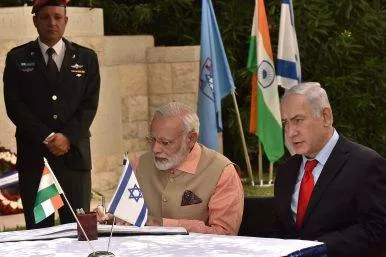
Recent context — including India’s bonhomie with Israel, its U.S. pivot, and an NDA government, led by the BJP, that often panders to Hindutva designs — meant that there was a high possibility of India abstaining from the UNGA vote. In fact, while traditionally voting in favor of Palestine at the UN, India had abstained from the UNHRC vote against Israel in 2015, marking the first official signs of a shift in policy. India has also recently attempted to moderate the Non-Aligned Movement’s (NAM) anti-Israel resolutions. Moreover, during Palestinian President Mahmoud Abbas’ recent visit to India, Indian Prime Minister Narendra Modi reiterated India’s support to the Palestinian cause, stating that “there should be a sovereign, independent, united and viable Palestine, co-existing peacefully with Israel” but crucially omitting “with East Jerusalem as its capital” – a phrase that always trailed any Indian statement on the issue in the past. Meanwhile, Modi’s vigorous and confident diplomacy saw in July 2017 the first-ever visit by an Indian prime minister to Israel.
However, India has been equally active in ensuring its diplomatic impression in the Arab world. Preceding his Israel visit, Modi pragmatically pursued a thorough engagement with the Arab world by visiting Qatar, the United Arab Emirates, and Saudi Arabia, inviting the Crown Prince of Abu Dhabi as the chief guest for Republic Day celebrations, and warmly receiving Abbas. This laid the groundwork for his Israel visit, while alleviating possible damage and making the visit less controversial both within India and the region.
India’s vote in favor of the UNGA resolution espouses that, while it has shed its inhibitions in publicly engaging Israel, it has not abandoned its support for the Palestinian cause and the two-state solution. India’s principled and independent position on the Israel-Palestine issue was reiterated by External Affairs Minister Sushma Swaraj in the NAM Ministerial Meeting on Palestine during this year’s UNGA session in New York. Preceding the vote, Arab ambassadors in New Delhi met with officials in the Ministry of External Affairs to convince India to vote in their favor, where India again echoed its independent position. Indeed, Modi, by visiting Israel and not Ramallah on his trip, like most world leaders, has de-hyphenated India’s relations with Israel and Palestine. Through its actions, India has indicated that it deals with its foreign relations in their own right, without worrying about a third party.
While there are those within the country that are opposed to the way India voted on the grounds that India’s pro-Palestinian policy has not garnered a quid pro quo from the Arab world, whereas Israel has often sided with India. Others like Professor P.R. Kumaraswamy believe that India should have “stayed away from the voting to display its opposition to the ‘exclusivist’ approach adopted by both the Israelis and Palestinians.” Either way, considering the broad global consensus surrounding the vote and the “sky is the limit” bonhomie, it is highly unlikely that India’s vote will hamper Indo-Israeli relations, which will continue on an upward swing. Political and sectarian issues within the region have even led countries like Jordan and Saudi Arabia to collude with Israel strategically, whilst maintaining their positions on Palestine. Israel’s patience in courting India reveals that it recognizes India’s calculations, regional compulsions, and domestic scenario.
India’s vote also reveals another important message: that an anti-Islamic ideology is not the cornerstone of the India-Israeli bonhomie. Pragmatism, rather than blind Hindutva designs, is guiding the present government in its approach to the region.
Despite its shift from idealism to pragmatism, India’s erstwhile tradition of following an autonomous foreign policy free from the interference of external powers continues to underpin present day decision making. Unlike staunch American allies — such as Australia, which depends on the United States for its security, and Canada, which is in the process of re-negotiating the North American Free Trade Agreement (NAFTA) deal with the U.S. – that abstained from the vote, India is on more of an equal footing with Washington and thus less likely to be coerced.
India’s principled vote emphasizes its commitment to multilateralism and its consistent opposition to institutionalized discrimination by powers. India has stood its moral ground by not kowtowing to American pressure, thus exhibiting itself as a strong responsible actor within the international system that retains its principled position on international issues. India, with its unique position in terms of its strong ties with Israel, Iran, and Saudi Arabia, can carve out a greater role in overseeing the regional order in West Asia, especially in the context of dwindling American dominance and its efforts to gain its long-coveted permanent seat on the UN Security Council. India must continue to tread this path – expanding its ties with Israel in accordance with its strategic interests, while extending its genuine support for the Palestinian cause – thereby walking a nuanced line on Israel-Palestine and upholding its benign international image. Author : Shairee Malhotra

The coming india russia split
Jan 10, 2018


The achilles heel of china's air force
Dec 06, 2017






Stay updated with The Hindu Editorial Vocab24 app, your definitive source for breaking news and comprehensive coverage from India and around the globe. Whether it's political developments, business updates, sports highlights, the latest technology trends, or current events, The Hindu brings live, accurate, and reliable news directly to your device.
Don’t fall for sensationalized or fake news shared online. Read and share accurate updates with friends and family through The Hindu Editorial Vocab24 app. Download it today!
News Coverage in The Hindu Editorial Vocab24 App
Breaking News: Receive instant notifications on breaking news stories as they unfold. Stay informed about major events and developments in India and around the world with live blogs, news in shorts videos, and concise articles.
Politics: Get the latest updates on Indian politics, including elections, policy changes, government decisions, and political events that shape the nation.
Business and Economy: Stay ahead in the economic landscape with detailed business news and market analysis. Learn about stock market trends, financial reports, corporate news, and economic developments to make informed investment decisions.
Current Events: Follow stories on social issues, policy changes, global events, and daily current affairs, tailored for UPSC and other competitive exam preparations.
Technology: Keep up with the latest gadgets, innovations, and tech trends. Read expert reviews and analyses in short, concise updates on cutting-edge technology from India and beyond.
Sports: Never miss a moment of your favorite sports. Get live scores, match reports, and expert analysis on cricket, football, tennis, and more.
International News: Stay informed about global events and geopolitical developments, including the Russia-Ukraine war, Israel-Palestine conflict, and other key international stories.
Local News: Stay connected to your community with the latest updates on city events, issues, and local news. Coverage includes hyperlocal updates from cities like Bangalore, Chennai, Delhi, Hyderabad, Mumbai, Kolkata, and more.
Trending Topics: Discover what's trending today with the most talked-about stories and hot topics across India and the world.
Experience journalism that values integrity, accuracy, and reliability. Download The Hindu Editorial Vocab24 app today and stay connected with the world.
Subscribe to our newsletter!







