

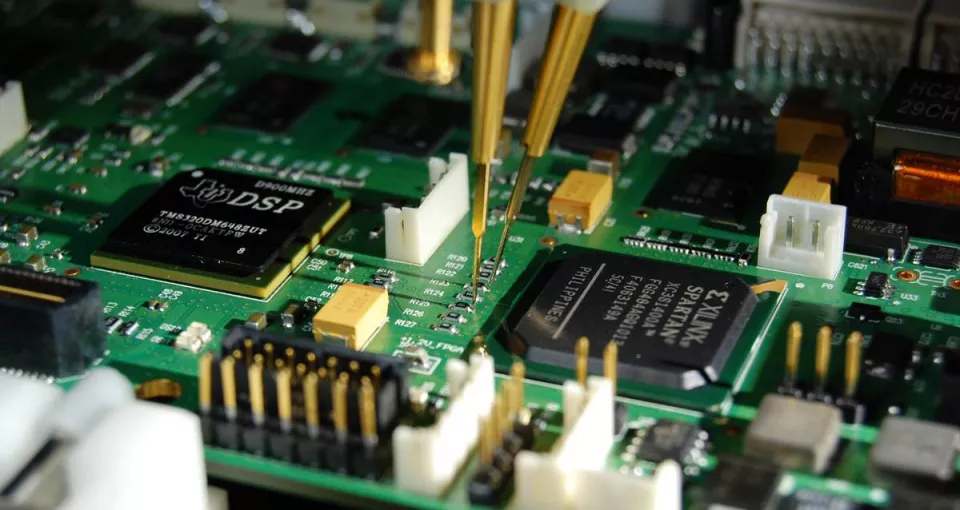
Electronics manufacturing needs a policy push
A growing middle class, rising disposable incomes, declining prices of electronics and a number of government initiatives have led to a fast-growing market for electronics and hardware products. However, India’s weak manufacturing base has not been able to respond to this increasing demand, leading to a growing trade deficit.Of the country’s total demand for electronics, between 50-60% of the products and 70-80% of the components are imported. India’s imports of electronic goods grew 31% between April and October 2017 to $29.8 billion. Meanwhile, the trade deficit reached close to $100 billion during the April-November period of 2017, against $67 billion in the same eight-month period a year ago.
This is an ominous sign. If the situation doesn’t change, a report by Deloitte Touche Tohmatsu states, expenses on electronics imports could surpass those on oil imports by 2020. Moreover, the industry has the potential to provide millions of jobs, directly and indirectly.
In order to deal with the problem, the government has listed the electronics industry as a priority sector under its Make In India campaign. There are various government schemes to encourage domestic manufacturing which provide tax and tariff concessions, investment subsidies, preferential market access in government procurement and export subsidy. In fact, as recently as December, the government increased the import duty on various electronic items like smartphones, LED bulbs and microwave ovens—for most products, the rate increased from 10% to either 15% or 20%.
But, as this paper has often argued, the way forward is to increase the country’s general competitiveness in the export market instead of pursuing sectoral policies. India’s share in the global electronics market was a minuscule 1.6% of the market in 2015 that is currently valued over $1.75 trillion. With a large domestic market and a number of trained engineers, India’s absence in the electronics manufacturing supply chain is an anomaly that better policies can correct. Instead of preserving our market for domestic manufacturers, the goal should be to capture a larger piece of this global market. There are various factors that have kept these goals from being met.
First is the inverted tax structure for electronic goods. Due to a limited base of local component suppliers, manufacturers are dependent on importing parts. Under the World Trade Organisation’s information technology agreement of 1995 (ITA-1), tariffs on 217 IT products were set at zero. However, the positive custom duties on the components (or parts) used in electronic products make it expensive for domestic manufacturers to compete with foreign competitors who can access the components at lower prices. The solution is to bring the duties on components down to the level of the product. Some parts might be used for multiple products that may have different duties, but it’s important to rule in favour of simple rules and apply the rate-cut regardless of use. It’s not difficult to imagine a rule for assessing the eligibility for the duty-concession depending on the use to which a component is put—it is precisely this kind of paperwork that needs to be avoided.
Second, foreign direct investment (FDI) in electronics is less than 1% of the total FDI inflow because of onerous labour laws, delays in land-acquisition and the uncertain tax regime have kept investors at bay. While the labour laws may be reformed in 2018, and we might be past the times of retrospective taxation, the memory of the Vodafone and Nokia cases is still fresh in investors’ memory. In order to inspire confidence, laws need to be liberal and predictable. In the case of taxation, it is important to clearly establish the tax liabilities under different circumstances in full detail. A possible experiment could be special economic zones like the Dubai International Financial Centre—Dubai’s normal civil and commercial laws do not apply in this area and a British chief justice ensures the practice of British common law.
Third, the procedures for cross-border trade work against the competitiveness of Indian producers as shown by the Doing Business rankings—India ranks 146 in the category of trading across borders due to the high costs of compliance. The numerous forms, fees, inspections and the associated time discourage domestic producers from exporting and keep them out of the international supply chain.
Between 2000 and 2015, hardware production in India increased from Rs31,100 crore to Rs1.02 trillion. Meanwhile, information technology (IT) services revenue increased from Rs37,750 crore to Rs8.4 trillion. This shows that India is capable of producing globally competitive products. But while the non-material nature of IT services has constrained the state’s grabbing hand, the electronics manufacturing industry did not have that privilege.
China, with its rising labour costs, will soon not be the global manufacturing hub it is today. This is an opportunity for countries like India, the Philippines, Thailand, etc., to attract companies to move their plants to their country. Despite its low costs of labour, India might lose this race if it doesn’t reform the key sectors of the economy.
This is not to suggest that the government is oblivious to these challenges. In fact, much has been done in the past couple of years to suggest that we are moving in the right direction. Introduction of the landmark goods and services tax (GST) has increased the distance that trucks are travelling by about 30%. GST has also reduced the confusion associated with various state and local taxes. And the government seems determined to improve the condition of highways and ports.
Yet, much needs to be done towards removing barriers that discourage exports and creating a reputation for stable and predictable rules.
Courtesy : Livemint Editorial


The non trivial costs of a slow judiciary
Jan 31, 2018
Very important the economic survey an overview
Jan 30, 2018
The conflict between equity and efficiency
Jan 29, 2018
Judicial primacy is not the same as exclusivity
Jan 25, 2018
Global monetary policy enters a decisive phase
Jan 25, 2018





Stay updated with The Hindu Editorial Vocab24 app, your definitive source for breaking news and comprehensive coverage from India and around the globe. Whether it's political developments, business updates, sports highlights, the latest technology trends, or current events, The Hindu brings live, accurate, and reliable news directly to your device.
Don’t fall for sensationalized or fake news shared online. Read and share accurate updates with friends and family through The Hindu Editorial Vocab24 app. Download it today!
News Coverage in The Hindu Editorial Vocab24 App
Breaking News: Receive instant notifications on breaking news stories as they unfold. Stay informed about major events and developments in India and around the world with live blogs, news in shorts videos, and concise articles.
Politics: Get the latest updates on Indian politics, including elections, policy changes, government decisions, and political events that shape the nation.
Business and Economy: Stay ahead in the economic landscape with detailed business news and market analysis. Learn about stock market trends, financial reports, corporate news, and economic developments to make informed investment decisions.
Current Events: Follow stories on social issues, policy changes, global events, and daily current affairs, tailored for UPSC and other competitive exam preparations.
Technology: Keep up with the latest gadgets, innovations, and tech trends. Read expert reviews and analyses in short, concise updates on cutting-edge technology from India and beyond.
Sports: Never miss a moment of your favorite sports. Get live scores, match reports, and expert analysis on cricket, football, tennis, and more.
International News: Stay informed about global events and geopolitical developments, including the Russia-Ukraine war, Israel-Palestine conflict, and other key international stories.
Local News: Stay connected to your community with the latest updates on city events, issues, and local news. Coverage includes hyperlocal updates from cities like Bangalore, Chennai, Delhi, Hyderabad, Mumbai, Kolkata, and more.
Trending Topics: Discover what's trending today with the most talked-about stories and hot topics across India and the world.
Experience journalism that values integrity, accuracy, and reliability. Download The Hindu Editorial Vocab24 app today and stay connected with the world.
Subscribe to our newsletter!







