

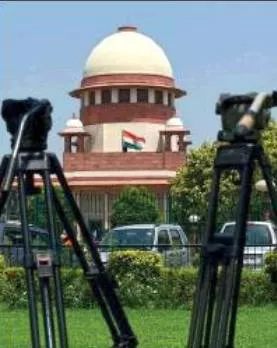
Controlling centre court chaos
Last week, the Supreme Court allowed the live streaming of court functioning. This opens up the courtroom proceedings to the public at large — unless, in certain rare cases, the court goes ‘in camera’, that is, without camera and the public. The general rule is that civil and criminal proceedings will be ‘open’, and the public will have access as is convenient to contain them.On this, there is room for dispute. Courts can’t sit in private, hear cases in private, and pronounce judgments in private. Equally, the media are allowed to be present in courts to make notes, but not to record or audio tape, photograph or film. They are the eyes and ears of the public and their presence in the court is necessary. In the 2012 Sahara vs Sebi case verdict, the Supreme Court laid down conditions to refrain any ‘media trial’. In the latest case against five activists accused of ‘harbouring Maoist links’, there was concern that the police were using the media to queer an unbiased pitch. Justice D Y Chandrachud’s dissension in the case elaborates how the Maharashtra Police went on a publicity spree leaking confidential documents.
True, live proceedings and reportage are different from ‘trial by media’. But in live proceedings, lawyers as well as judges do play to the gallery. Live proceedings should not interfere with the candour between the bar and the bench and direct media reportage.
In this case, the Supreme Court took its usual route of examining existing global practices in countries like Australia, Brazil, Canada, China, New Zealand and Germany — excepting the US Supreme Court. The US Supreme Court does not allow ‘live proceedings’ for many reasons including that “it could adversely affect the character and dialogue between attorneys and justices”. Ireland has a permit approach, but has so far allowed live transmission only when final judgments are delivered, which is unexceptional. China is very careful in denying broadcast in death sentences or politically live cases.
India has something to learn from this: some permit live proceedings with exclusions, while some require prior permission, with some control of the proceedings. Some countries are indiscriminate with ‘in camera’ cases. This is wrong.
The majority judgment conceives a Supreme Court pilot project of some cases, subject to two broad conditions: one, that the court permission can be revoked any time; two, the consent of all parties. Where there are many petitioners in a constitutional case, all have a no-consent veto that can be examined by the court for reasons. This will create a case within a case before any broadcasting.
The minority (Justice D Y Chandrachud) verdict takes an incremental approach that allows live streaming to be conducted in some cases under conditions and supervision. While the majority envisages a 10-minute lag in broadcast, the minority prefers 2 minutes. Publicity-seeking clients and lawyers and PIL petitioners will love the latter.
Are we ready for such live streaming in the Supreme Court? Even in constitutional cases, instead of sitting in an orderly manner, the court is often overcrowded. Lawyers speak at the same time. They contradict each other instantly. Judges ask questions — as they must — and are either strict or indulgent to the surrounding chaos. Some lawyers want to be noticed publicly. Judges ask some lawyers whether
they are making their argument for the judges or for their clients in the visitor’s gallery. Will broadcasting court proceedings change things?
There is the matter of the architecture of the court. Here, a conscious decision has been taken to reduce the sitting space. Few listen to the printed notice not to stand in the gallery. Despite this, it is a credit to the judges that they are able to deliver well-reasoned judgments and to the lawyers who make such fine arguments.
India has a strong bar that renews itself generationally. But while arguments in court are theatre, they cannot be mass entertainment. Cases last for days. We are not ready for this until the very style of argument and functioning in the court radically changes. It is pointless to compare the Supreme Court with Parliament, where (at least) the seating arrangement is organised. Parliament breaks down when people go to the well of the House. But parliamentary broadcasts are for different considerations.
Drafts are exchanged between judges, but not thoroughly discussed. Deadlines are imposed by retirements. Yet, one can’t fault the acumen and industry of the Supreme Court, and its move to reinforce ‘open justice’ further. But uneven ‘cosmopolitan’ practice can’t be blindly followed.











Stay updated with The Hindu Editorial Vocab24 app, your definitive source for breaking news and comprehensive coverage from India and around the globe. Whether it's political developments, business updates, sports highlights, the latest technology trends, or current events, The Hindu brings live, accurate, and reliable news directly to your device.
Don’t fall for sensationalized or fake news shared online. Read and share accurate updates with friends and family through The Hindu Editorial Vocab24 app. Download it today!
News Coverage in The Hindu Editorial Vocab24 App
Breaking News: Receive instant notifications on breaking news stories as they unfold. Stay informed about major events and developments in India and around the world with live blogs, news in shorts videos, and concise articles.
Politics: Get the latest updates on Indian politics, including elections, policy changes, government decisions, and political events that shape the nation.
Business and Economy: Stay ahead in the economic landscape with detailed business news and market analysis. Learn about stock market trends, financial reports, corporate news, and economic developments to make informed investment decisions.
Current Events: Follow stories on social issues, policy changes, global events, and daily current affairs, tailored for UPSC and other competitive exam preparations.
Technology: Keep up with the latest gadgets, innovations, and tech trends. Read expert reviews and analyses in short, concise updates on cutting-edge technology from India and beyond.
Sports: Never miss a moment of your favorite sports. Get live scores, match reports, and expert analysis on cricket, football, tennis, and more.
International News: Stay informed about global events and geopolitical developments, including the Russia-Ukraine war, Israel-Palestine conflict, and other key international stories.
Local News: Stay connected to your community with the latest updates on city events, issues, and local news. Coverage includes hyperlocal updates from cities like Bangalore, Chennai, Delhi, Hyderabad, Mumbai, Kolkata, and more.
Trending Topics: Discover what's trending today with the most talked-about stories and hot topics across India and the world.
Experience journalism that values integrity, accuracy, and reliability. Download The Hindu Editorial Vocab24 app today and stay connected with the world.
Subscribe to our newsletter!







