

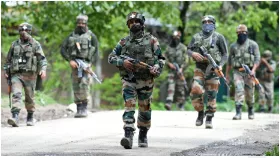
Chinks in our armour
As many as 26 CRPF personnel from the 74th battalion, deployed to oversee an under-construction road project at Sukma in Chhattisgarh, died recently in an ambush (एकाएक आक्रमण) by some 300-400 Maoists. While the failure of Intelligence is palpable (स्पष्ट/साफ़) , an explosive situation prevails in several areas of the state, notably Bastar, Bijapur, Sukma and Dantewada. There is an inherent danger in the ubiquitous (देशव्यापी/सर्वगत) presence of central forces. Which is one major reason why police and paramilitary forces are targeted in Kashmir. The Maoist commander, who allegedly masterminded the massacre in Sukma, operated a network of dedicated informers across the region and was perhaps privy (मर्मभेदी) to the movement of the forces. In Kashmir, Chhattisgarh, or any other volatile region, it is the security forces who are the victims despite their training in the use of sophisticated weapons and guerrilla warfare. In an interesting book titled The New Face of War: How War Will Be Fought in the 21st Century Bruce Berkowitz has argued that the ability to gather, process and protect information is the most important factor defining military power ~ “Stealth trumps armour, precision trumps explosive force, and being able to react faster than your opponent trumps speed”. Berkowitz’s prescription is simple ~ If you want to defeat your opponent, you must first win the information war. Prakash Singh, former Director-General, BSF and an expert in tackling Left-wing extremism, mentioned multiple factors ~ “from leadership failure to loopholes in the functioning of the security forces”, thus leading to the recent Sukma ambush. “The most unfortunate part is that despite repeated incidents, no lessons are being learned,” he was quoted as saying. A decade ago, Moloy Krishna Dhar, a former Joint Director, Intelligence Bureau, pointed out that the government’s “cutting edge internal security tool” is not prepared to combat the aggressive operations of Pakistan’s ISI or Islamist tanzeems. There is a lack of trained manpower at the operative level, lacunae (अन्तराल/अभाव) in training to combat acts of terrorism and insurgency, and lack of electronic and technical intelligence equipment. Even if the problem of poor technology can be addressed, intelligence failure is difficult to be condoned (छोड़ देना/अनदेखी करना) as it involves the loss of precious lives, be it in Mumbai, Uri, Pathankot, Pampore or Sukma. Intelligence reform is direly imperative. But the government responds only after an offensive. For instance, the Directorate-General of Security (DGS) was set up only after the war with China in 1962. R&AW was entrusted with the responsibility to collect external intelligence ~ formerly a remit of the Intelligence Bureau (IB) ~ following the IndoPak war of 1965 and the Mizo revolt in 1966. In the aftermath (परिणाम) of the Kargil operations in 1999, an enquiry by Kargil Review Committee led to the setting up of the GC Saxena Special Task Force which recommended the creation of the Defence Intelligence Agency (DIA) as the nodal point for processing all military related intelligence. A Group of Ministers (GoM) was formed on 17 April 2000 to re-examine the issues of security and intelligence. Accordingly Task Forces were set up for intelligence, internal security, border management and defence. Though the GoM forwarded its recommendations to the Prime Minister on 19 February 2001, it is now evident that followthrough action was not taken either by the NDA or the UPA dispensations... till the Mumbai outrage on 26 November 2008 jolted the nation to its foundations. There was talk of a National Counter Terrorism Centre (NCTC). Within the bureaucracy, there was little or coordination. According to a paper crafted by the Institute for Defence Studies and Analyses (IDSA), near-total ignorance about Chinese intentions and capabilities in Tibet and their designs against India in the 1950s led to serial disasters. Notably, the alienation (अलगाव) of Kashmiris through repeated changes in state governments since the early 1950s and, more specifically, during 1986-87; Pakistani subversion plans in the name of religion in the 70s, and the proselytizing (धर्म प्रचार करना/धर्मांतरण करवाना) activities of the Deobandi/Wahabi sect in the Valley in the mid-80s, recruitment of Kashmiri youth for arms training in Pakistan and their infiltration into the Valley to launch the ‘Kashmiri jihad’ in the late 80s, and terrorist attacks within India either directly by Pakistani players or their Indian proxies, especially the Mumbai attack of 26/11. Intelligence failures continue to rattle India. The Henderson Brooks report on the massive intelligence failures in 1962 underlines the lack of coordination among the agencies concerned, fragile credibility of sources, and inconsistent feedback. All this resulted in India’s humiliating defeat against China. There appears to be a distressing continuity in India’s track record. Take the instance of the Kargil misadventure. Experts have pointed out how India was ‘clueless’ about briefings and authorisations made in Islamabad and Rawalpindi months in advance, about field officers recruited to train the force in the Baltistan heights of Pakistan Occupied Kashmir (POK), about equipment and supplies being stocked in Pakistan army garrisons at Skardu and Astor before being sent to camps close to the Line of Control (LoC). The government failed to foresee the scale of intrusion because of several factors, most importantly the fact that the Pakistan Army made excellent use of stealth and deception in the run-up to the operation. The Uri attack is believed to have been facilitated by one of the various agents who the Indian forces had been using to collect information on the Pakistan Army’s logistics. Apart from the need for international cooperation, crossborder intelligence cooperation guided by persuasive diplomacy with friendly neighbours is essential in the fight against international terrorism. At least five states ~ West Bengal, Assam, Meghalaya, Tripura and Mizoram ~ and five ministries, namely External Affairs, Home, Water Resources, Commerce and Development of Northeast Region; and four security and intelligence organizations ~ Intelligence Bureau (IB), Research and Analysis Wing (RAW), Defence Intelligence Agency (DIA) and Border Security Force (BSF) ~ are pivotal (मुख्य) in dealings with Bangladesh. Nepal is an important centre for intelligence and subversive operations by foreign powers as well as nonstate actors against India.Ambush (noun)
A surprise attack by people lying in wait in a concealed position. एकाएक आक्रमण
Synonyms: Surprise Attack, Ambuscade, Pitfall
Example: A suicide bomber waited in ambush for the right opportunity to detonate his bomb, but was tackled before he had the opportunity.
Palpable (adjective)
Capable of being perceive./ comprehensible with ease. स्पष्ट/साफ़
Synonyms: Evident, Apparent, Noticeable, Seeming, Clear, Visible, Sure
Example: Video technology has made it so that even people who are a continent apart can seem palpable to each other.
Ubiquitous (adjective)
Existing or being everywhere at the same time. देशव्यापी/सर्वगत
Synonyms: Omnipresent, Everywhere, All-Over, Pervasive
Example: People believe that god is ubiquitous.
Privy (adjective)
Allowed to share in confidential information मर्मभेदी
Synonyms: Behind-The-Scenes, Confidential, Nonpublic, Private
Example: A psychologist should be privy to his patient’s thoughts and emotions.
Lacuna (noun)
An unfilled space; a gap. अन्तराल/अभाव
Synonyms: Break, Cavity, Gap, Interim, Hiatus
Example: As a critic it my duty to find the lacunae in the published books.
Condone (verb)
Accept (behaviour that is considered morally wrong or offensive). छोड़ देना/अनदेखी करना
Synonyms: Deliberately Ignore, Not Take Into Consideration, Take No Notice Of, Take No Account Of
Example: The police does not condone any behaviour of violence.
Aftermath (noun)
The aftereffects or consequences of an unpleasant or destructive event परिणाम
Synonyms: Repercussions, After-Effects, Impact, Outcome, Backwash, Corollary
Example: The building has been outfitted with a new alarm system in the aftermath of the fire.
Alienation (noun)
The state or experience of being isolation. अलगाव
Synonyms: Isolation, Detachment, Estrangement, Distance, Separation
Example: The restaurant owner hesitates to change his menu because he does not want to alienate his regular customers.
Proselytize (verb)
Convert or attempt to convert (someone) from one religion, belief, or opinion to another. धर्म प्रचार करना/धर्मांतरण करवाना
Synonyms: Evangelize, Convert, Proselyte
Example: The efforts of early missionaries to proselytize the Native Americans of Minnesota were largely unproductive
Pivotal (adjective)
Of crucial importance in relation to the development or success of something else. मुख्य
Synonyms: Central, Crucial, Vital, Critical, Focal, Essential, Key, Significant, Important, Determining, Decisive
Example: The fighter planes gave pivotal assistance to the ground forces that were surrounded by the enemy.
Successful operations raise hopes in kashmir
Aug 08, 2017
Mining penalty
Aug 07, 2017
Let asean nations use the hague ruling
Aug 07, 2017
Did you say privacy it has already been violated
Jul 28, 2017
Pilgrimage that builds bridges
Jul 21, 2017
Aadhaar ambivalence
Jul 02, 2017





Stay updated with The Hindu Editorial Vocab24 app, your definitive source for breaking news and comprehensive coverage from India and around the globe. Whether it's political developments, business updates, sports highlights, the latest technology trends, or current events, The Hindu brings live, accurate, and reliable news directly to your device.
Don’t fall for sensationalized or fake news shared online. Read and share accurate updates with friends and family through The Hindu Editorial Vocab24 app. Download it today!
News Coverage in The Hindu Editorial Vocab24 App
Breaking News: Receive instant notifications on breaking news stories as they unfold. Stay informed about major events and developments in India and around the world with live blogs, news in shorts videos, and concise articles.
Politics: Get the latest updates on Indian politics, including elections, policy changes, government decisions, and political events that shape the nation.
Business and Economy: Stay ahead in the economic landscape with detailed business news and market analysis. Learn about stock market trends, financial reports, corporate news, and economic developments to make informed investment decisions.
Current Events: Follow stories on social issues, policy changes, global events, and daily current affairs, tailored for UPSC and other competitive exam preparations.
Technology: Keep up with the latest gadgets, innovations, and tech trends. Read expert reviews and analyses in short, concise updates on cutting-edge technology from India and beyond.
Sports: Never miss a moment of your favorite sports. Get live scores, match reports, and expert analysis on cricket, football, tennis, and more.
International News: Stay informed about global events and geopolitical developments, including the Russia-Ukraine war, Israel-Palestine conflict, and other key international stories.
Local News: Stay connected to your community with the latest updates on city events, issues, and local news. Coverage includes hyperlocal updates from cities like Bangalore, Chennai, Delhi, Hyderabad, Mumbai, Kolkata, and more.
Trending Topics: Discover what's trending today with the most talked-about stories and hot topics across India and the world.
Experience journalism that values integrity, accuracy, and reliability. Download The Hindu Editorial Vocab24 app today and stay connected with the world.
Subscribe to our newsletter!







