

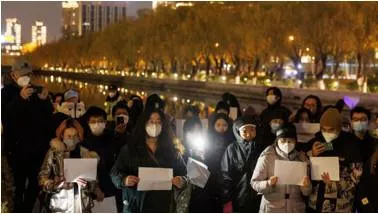
China protests a ‘grey rhino’ moment for xi jinping and it will only get stronger
Chinese agitators aren’t shying away from connecting demands to lift Covid restrictions with broader political appeals.When Chinese President Xi Jinping referred to ‘black swan’ or ‘grey rhino’ events in his recent speeches, he was referring to the internal and external challenges Beijing faces. We don’t know how Xi views the ongoing nationwide protests against his ‘zero Covid’ policy, but he knows that the factors for a ‘grey rhino’ event have been building up for a while.
The Chinese State’s relative silence to the protests reveals that Beijing doesn’t want to elevate the agitation to a ‘grey rhino’ incident by clamping down harshly. The protests are no longer about Covid-19 restrictions and have been directly linked to political demands for greater freedom of movement and freedom of expression—all taboo topics in China.
The Apple factory workers’ protest in Zhengzhou and the protest over Urumqi fire accident that claimed 10 lives didn’t start this wave of dissent. Activist Peng Lifa had already inspired Chinese citizens to raise their voice during the Sitong bridge protest in response to Xi assuming greater power at the 20th Party Congress.
‘Grey Rhino’ attacks Xi
For a long time, raising your voice to make political demands during mass gatherings was unheard of in China. Protests would focus on issues such as labour rights and access to good baby formula – leaving out politics-heavy topics.
But the Sitong bridge unrest in October has left an important mark on the psyche of Chinese youth. It has become a blueprint for the current wave of protests—agitators aren’t shying away from connecting demands to lift Covid restrictions with broader political appeals. Their white A4 sheet symbolises their unspoken desire for freedom of expression and political change.
The rhino Xi Jinping has been trying to avoid for a while has charged at him in the form of an information outflow coupled with the youth’s desire to break the quarantine cycle.
Xi’s Covid policy – a legalistic tool for discipline – has scarred the youth. It takes a lot to bring students from elite universities such as Tsinghua to a street protest. But Xi has accomplished that.
Some students have spent weeks in arbitrary quarantine after testing positive or coming into close contact with someone who tested positive for the Omicron variant of the coronavirus. People have been in quarantine so often that the combined time spent in isolation amounts to even months. Remember that it was student movements at leading universities that led to the famous Tiananmen Square protest in 1989.
A gripping aspect of these protests has been the growing discontent among young Chinese international students with the country’s politics. Students outside of China have played a pivotal role in helping youth living in China organise their protest.
International Chinese students have been unable to return to China because of the stringent Covid policy and sky-high flight prices. Travel restrictions have turned many apolitical students into political dissenters concerned about their country’s future. These movements are proof that Chinese citizens—whether living in the country or not—hold diverse opinions on the State’s functioning.
Bots countering protests
With the current protests, Beijing has discovered that its citizens are posting videos of their agitation on Twitter—a platform banned in China. Twitter has become the primary mode to consume as well as disseminate news about the movement. Using the micro-blogging site for anti-government protests was the ‘grey rhino’ event Beijing had expected and swiftly rolled out a playbook to counter.
To distract people from the protest videos being shared on Twitter, bots likely originating from China have deployed the classic strategy of blurring news with irrelevant, explicit advertisements and clothing brands going on sale.
The search results promoted by these bots pop up when one tries to search city names in Chinese, such as Beijing, Shanghai, Nanjing, Zhengzhou and Lanzhou.
“I looked at the number of tweets by each account over time. Interestingly, more than 70% of these spam accounts only started tweeting like crazy recently,” wrote a Twitter account named ‘Air-moving Device’, which regularly posts data-driven analyses on China.
Data analysis reveals that 95 per cent accounts on Chinese Twitter were spam that shared explicit images and videos when users searched for Chinese cities on the site.
Beijing has started to target protesters to slowly put an end to the agitation.
In Shanghai, police stopped people to check if their phones have Telegram, Twitter or other social media or messaging apps. In Beijing, some protesters received phone calls from police enquiring about the time they attended protests and the number of participants.
Demonstrations were seen in at least 10 locations in Beijing, where the public security apparatus is the most sprawling of all major urban areas. On Sunday, police showed up at protest sites in Beijing, Shanghai and Hangzhou to stop people from gathering.
“The police stressed that last night’s protest was an illegal assembly, and if we had demands, then we could submit them through the regular channels,” an agitator told AFP in an interview.
It was unclear how protesters were identified since many didn’t have their IDs checked by the police during the Sunday protest in Beijing.
China is known to rely on facial recognition technology for policing. Beijing will likely carry out one such campaign to dissuade people from protesting by targeting small groups.
Sensing growing frustration in Zhongnanhai, local governments are making further adjustments to end protests. The economic powerhouse of Guangzhou has announced that residents will no longer need to undergo mass testing.
Xi is going to rely on internal policing machinery to quell the protest without using excessive force. The Ministry of Public Security held a press conference Monday to promote the work underscored during the 20th Party Congress.
“Efforts should be made to ensure a new development pattern with a new security pattern, high-quality development with a high level of security, and better escort for the comprehensive construction of a socialist modern country,” said a Weibo post by Anshun Public Security Department about the Monday press conference, which didn’t even mention the nationwide protests.












Stay updated with The Hindu Editorial Vocab24 app, your definitive source for breaking news and comprehensive coverage from India and around the globe. Whether it's political developments, business updates, sports highlights, the latest technology trends, or current events, The Hindu brings live, accurate, and reliable news directly to your device.
Don’t fall for sensationalized or fake news shared online. Read and share accurate updates with friends and family through The Hindu Editorial Vocab24 app. Download it today!
News Coverage in The Hindu Editorial Vocab24 App
Breaking News: Receive instant notifications on breaking news stories as they unfold. Stay informed about major events and developments in India and around the world with live blogs, news in shorts videos, and concise articles.
Politics: Get the latest updates on Indian politics, including elections, policy changes, government decisions, and political events that shape the nation.
Business and Economy: Stay ahead in the economic landscape with detailed business news and market analysis. Learn about stock market trends, financial reports, corporate news, and economic developments to make informed investment decisions.
Current Events: Follow stories on social issues, policy changes, global events, and daily current affairs, tailored for UPSC and other competitive exam preparations.
Technology: Keep up with the latest gadgets, innovations, and tech trends. Read expert reviews and analyses in short, concise updates on cutting-edge technology from India and beyond.
Sports: Never miss a moment of your favorite sports. Get live scores, match reports, and expert analysis on cricket, football, tennis, and more.
International News: Stay informed about global events and geopolitical developments, including the Russia-Ukraine war, Israel-Palestine conflict, and other key international stories.
Local News: Stay connected to your community with the latest updates on city events, issues, and local news. Coverage includes hyperlocal updates from cities like Bangalore, Chennai, Delhi, Hyderabad, Mumbai, Kolkata, and more.
Trending Topics: Discover what's trending today with the most talked-about stories and hot topics across India and the world.
Experience journalism that values integrity, accuracy, and reliability. Download The Hindu Editorial Vocab24 app today and stay connected with the world.
Subscribe to our newsletter!







