

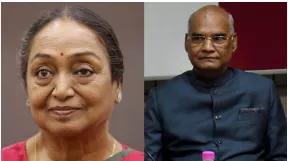
Beyond rashtrapati bhawan
The new president of India will be a Dalit, but not an Ambedkarite. That was also the case when K.R. Narayanan was elected head of state in 1997. But at that time, the BSP was on the rise. The BSP had governed Uttar Pradesh as a coalition partner and initiated major schemes such as the “Ambedkar village”. Today, the situation is very different. The BSP is in crisis, after winning only 19 seats in the UP elections and failing to have even one MP in the Lok Sabha. More importantly, Dalits are at the receiving end.Certainly, there is the legacy of a long history of oppression and disposession. The 2016 report of the Centre for Equity Studies (CES) showed that the rate of landlessness was highest among Dalits, at 57.3 per cent, against 52.6 per cent for Muslims. And those who had land had very little: 2.08 per cent of the Dalit households own more than two hectares of land. Another indication of the Dalits’ condition is reflected in their over representation in Indian jails — next to Muslims, at 21.6 per cent (compared to 16.6 per cent in the population). In some states, the over-representation is even more striking: In Madhya Pradesh, where the Dalits account for 15.6 per cent of the population, they form 22.2 per cent of the jail inmates. In Gujarat, the gap is even more significant, with, respectively, 6.7 per cent and 17 per cent.
Scheduled Caste members benefit from reservations and tend to join, therefore, the neo middle class in the metropolis, but these quotas represent a very small proportion of the total Dalit population, partly because they remain unfulfilled and partly because they are shrinking in the era of liberalisation. In any case, a few jatis corner most of the reserved jobs (there is no creamy layer system for the SCs) and these “winners” continue to be affected by stigma (a mark of disgrace associated with a particular circumstance, quality, or person.), evident from the processes of ghettoisation (सीमा बंधन/परिरोध) .
But these structural issues have been accentuated (जोर देना) by a series of events over the last three years. First, the suicide of Rohith Vemula and the subsequent controversy about his caste identity has shaken Dalits across the country. Second, the flogging (पीटना) of Dalits in Una has made a significant impact, evident from the mass mobilisation in Gujarat and beyond. Third, the cow protection movement and correlative laws have badly affected the leather industry, in which crores of Dalits work. Fourth, “atrocities” continue to hit the headlines, as even a random sample of reports from 2017 will show: “MP: Well used by Dalits contaminated with kerosene for playing ‘band baaja’ at wedding”, “Dalit beaten up in Rajasthan for riding mare on his wedding day”, “90-yr old Dalit man burnt alive for trying to enter temple in UP” etc. Fifth, the government has alienated (दूर करना) sections of the Dalit intelligentsia by stopping funding of “centres for the study of social exclusion and inclusive policy” established in 35 universities in the course of the 11th and 12th five-year plans.
Last but not least, the UP elections have been a trauma for many Dalits. Not only has the BSP been defeated, but the new assembly, as shown by the Trivedi Centre for Political Data, consists of more than 44 per cent upper castes, 12 percentage points more than in 2012 and the highest proportion since the early 1980s. The government of Yogi Adityanath appears to represent this upper caste ethos (spirit or character) . Yogi Adityanath ordered for “shuddhikaran (purification)” of the chief minister’s office in Lucknow. Subsequently, Dalits made a point to offer him soaps, as protest. He made the cow protection movement stricter by closing down illegal slaughterhouses and encouraging gau rakshaks.
The Saharanpur violence broke out in May, when Dalits objected to the procession of Maharana Pratap through the temple of Ravidas. The Rajputs conducting the procession allegedly attacked Dalits, burning their houses. In May, three people died, casualties (जनहानि) being on both sides. About 5,000 Dalits demonstrated peacefully at Jantar Mantar in reaction to this violence, and some of them converted to Buddhism.
The organisation sponsoring this mobilisation, Bhim Army, was created in 2015, in Saharanpur by a Dalit lawyer, Chandrashekhar Azad, 30, who was accused by the UP police of the Saharanpur violence, and finally arrested in June. He had made a surprise appearance in the Jantar Mantar demonstration to say (in Hindi): “Don’t be under the illusion that we are quiet because we are weak. We are quiet because we are following the Constitution”.
The Constitution is sacred to Dalits because of the role of Ambedkar in its making. That they have formed an “army” does not mean they will resort to illegal means. After all, Ambedkar himself had created a self-defence force in 1927, during the Mahad satyagraha, the Samata Sainik Dal (Social Equality Corps). But today, Dalits articulate a deep sense of anger that has been echoed by the Union minister of Social Justice & Empowerment himself. In April, Thawaarchand Gehlot declared (in Hindi): “You get a well dug by us, but when it becomes yours, you stop us from drinking its water. When a pond has to be made, we are made to labour. At that time, we spit in it, sweat in it, and even urinate in it. But when we get a chance to drink water from it, you say that the water will become impure. You install idols in temples amid chanting mantras, then the doors are closed to us. Who will set things right? We made the idol, although you may have paid us for our labour, but at least let us have a darshan, and touch it”.
This viewpoint is not really in tune with the philosophy of shuddhikaran. In fact, the Sangh Parivar may face a new contradiction due to the Dalits’ claim for their rights. More importantly, the government probably needs to engage them to defuse tensions. Till recently, the BSP offered an antidote to radicalism, as a constitutional alternative, simply because of the hope of returning to power that it embodied (सम्मिलित करना) . This prospect has gone, but the Dalits’ anger has increased. Will the election of the NDA candidate be enough? Possibly for the Dalit neo middle class, but others may look for another sense of direction. Other repertoires (the complete list or supply of something) are still available, like the Dalit Panthers’ modus operandi (कार्य-प्रणाली) . After all, even Ambedkar declared that he would like to burn the Indian Constitution in the early 1950s.
Ghettoisation (noun)
The act of confinement or restriction to a particular area, activity, or category. सीमा बंधन/परिरोध
Synonyms: Confinement, Restriction, Constraint, Restraint, Stricture
Example: Old housing laws that ghettoized minorities and barred them from educational and professional opportunities limited their ability to transcend their economic class -- and have lasting effects, even today.
Stigma (noun)
(A mark of disgrace associated with a particular circumstance, quality, or person.) कलंक
Synonyms: Disgrace, Dishonor, Blemish, Smirch
Example: The stigma of slavery remained long after it had been abolished.
Accentuate (verb)
Make more noticeable or prominent. जोर देना
Synonyms: Emphasize, Highlight, Point Up, Draw Attention To
Example: During the programming interview, make sure you accentuate your familiarity with coding languages.
Alienate (verb)
Make (someone) feel isolated or estranged. दूर करना
Synonyms: Estrange, Turn Away, Set Apart, Isolate, Detach
Example: If the president does not agree to the prime minister’s terms, he will alienate one of the nation’s strongest allies.
Ethos (noun)
Spirit or character/ the characteristic spirit of a culture, era, or community as manifested in its attitudes and aspirations. चरित्र/प्रकृति
Synonyms: Spirit, Character, Prevailing Tendency, Ideology, Principle
Example: Many adventurous people live by the ethos of YOLO, you only live once.
Casualties (noun)
Loss in numerical strength through any cause, as death, wounds, sickness, capture, or desertion. जनहानि
Synonyms: Fatality, Mortality, Dead and injured/wounded, missing in action
Example: As the casualty number mounted, the army commander worried that they were about to lose the war.
Embody (verb)
Include or contain (something) as a constituent part. सम्मिलित करना
Synonyms: Incorporate, Include, Contain, Consolidate, Encompass, Assimilate, Integrate
Example: The national flag is supposed to embody the spirit of our country.
Repertoire (noun)
(The complete list or supply of something) संचय
Synonyms: Inventory, Pool, Reservoir, Stock, Range, Reserve, Stockpile
Example: As long as the piano player continues to strum through a boring repertoire of tunes, he will never keep a large audience.
Modus operandi (noun)
A particular way or method of doing something. कार्य-प्रणाली
Synonyms: Method of Working, Method, Manner, Technique, Style
Example: The Modus operandi of each and every organization must be employee friendly.
Flog (verb)
Beat (someone) पीटना
Synonyms: Whip, Scourge, Flagellate, Lash, Birch
Example: It was once acceptable to flog your children with an object to correct them.

Bellwether in crisis
Aug 19, 2017
Remaking the board
Aug 19, 2017
Unsportsmanlike
Aug 13, 2017
Ties that bind
Aug 06, 2017
Defenders of varna
Aug 05, 2017
What the gods drank
Jul 30, 2017





Stay updated with The Hindu Editorial Vocab24 app, your definitive source for breaking news and comprehensive coverage from India and around the globe. Whether it's political developments, business updates, sports highlights, the latest technology trends, or current events, The Hindu brings live, accurate, and reliable news directly to your device.
Don’t fall for sensationalized or fake news shared online. Read and share accurate updates with friends and family through The Hindu Editorial Vocab24 app. Download it today!
News Coverage in The Hindu Editorial Vocab24 App
Breaking News: Receive instant notifications on breaking news stories as they unfold. Stay informed about major events and developments in India and around the world with live blogs, news in shorts videos, and concise articles.
Politics: Get the latest updates on Indian politics, including elections, policy changes, government decisions, and political events that shape the nation.
Business and Economy: Stay ahead in the economic landscape with detailed business news and market analysis. Learn about stock market trends, financial reports, corporate news, and economic developments to make informed investment decisions.
Current Events: Follow stories on social issues, policy changes, global events, and daily current affairs, tailored for UPSC and other competitive exam preparations.
Technology: Keep up with the latest gadgets, innovations, and tech trends. Read expert reviews and analyses in short, concise updates on cutting-edge technology from India and beyond.
Sports: Never miss a moment of your favorite sports. Get live scores, match reports, and expert analysis on cricket, football, tennis, and more.
International News: Stay informed about global events and geopolitical developments, including the Russia-Ukraine war, Israel-Palestine conflict, and other key international stories.
Local News: Stay connected to your community with the latest updates on city events, issues, and local news. Coverage includes hyperlocal updates from cities like Bangalore, Chennai, Delhi, Hyderabad, Mumbai, Kolkata, and more.
Trending Topics: Discover what's trending today with the most talked-about stories and hot topics across India and the world.
Experience journalism that values integrity, accuracy, and reliability. Download The Hindu Editorial Vocab24 app today and stay connected with the world.
Subscribe to our newsletter!







