

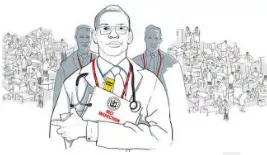
Betraying the oath
The Medical Council of India recently barred 32 colleges across the country. Vidya Krishnan reconstructs how one of those, a Bhopal institute, marshalleddoctors on hire, fake patients and life-saving equipment on rent for inspection day. The coffee is bad and the desserts are drier than you’d expect, but the Amer Bakery Hut is nonetheless one of Bhopal’s popular haunts. Sudhir Singh (name changed) has strategically taken a table at the far end that faces the door opening to the kitchen. No one is likely to spot him there, and he’s not even from Bhopal, but Singh is fidgety (अधीर/बेचैन), looking around every few minutes to check on other patrons before leaning forward to speak in hushed tones. A professor at a medical college affiliated to a Raipur university, Singh was in town in time for an inspection by the Medical Council of India (MCI), the regulatory body for medical education in India. On the MCI team’s inspection list were the RKDF Medical College Hospital and Research Centre, and the Advanced Institute of Medical Science and Research Centre which is on the outskirts of Bhopal. Both have been debarred. The night before this January 11 meeting at the cafe, Singh had called saying “ghost professors”, a euphemism (शिष्टोक्ति /मंगलभाषी) for academics who materialise at inspections conducted by the MCI for money, had checked into the Rajhans hotel. “Shehar mein sabko pata hai inspection week chal raha hai (Everyone in the city knows it’s inspection week),” he said by way of explaining him being so guarded. After all, the Raipur professor claims to have been among those approached to pose as Advanced Institute faculty when the MCI team came calling. Every medical college is associated with a ‘teaching hospital’ — where patients are admitted and students learn while treating them. A medical college must pass a benchmark in terms of infrastructure, faculty strength and patient inflow at the hospital to be recognised by the MCI, upon which it admits a prescribed number of students. The Advanced Institute had sought recognition to enrol 150 students and start a teaching hospital. On January 13, 2017, a damning report on ‘ghost’ doctors, fake patients, life-saving equipment on loan by dubious vendors in 32 medical colleges across India, authored by the MCI, was submitted to the Health Ministry. The report, which runs into 215 pages, blows the lid off a well-oiled operation which kicks in almost as soon as an entrepreneur dreams of opening a private medical college. The two Bhopal colleges figure among the blacklisted 32. The modus operandi (कार्य-प्रणाली) On January 4 and 5, four inspectors were in Bhopal. They visited Advanced Institute on those two days. News travels fast in the Madhya Pradesh capital. Days ahead of the inspections, the Advanced Institute administration sent out buses to round up nearby villagers from Vidisha and Betul, saying they would conduct a medical camp, claims Singh. “Once admitted, these people were passed off as genuine patients to meet bed occupancy standards.” The villagers bussed in were promised free food and transport during the medical camp. “They were stuck in the hospital till the MCI team visited (on January 4-5) and got restless as none of them had any serious ailments (बीमारी/ विकार), ” adds Singh. The inspectors recorded this exercise in great detail for the Health Ministry’s benefit: “Out of 25.66% indoor patients, many patients did not appear genuine. It seems that some workers/staff members without any medical illness were lying on the beds. No personal belongings, attendant, or medicines were there… (page 70 of the MCI inspection report).” However, Shailendra Bhadoriya, a businessman who owns the daily National Duniya and is the man behind Advanced Institute, says: “It is for the doctors to decide which patient is sick or healthy. That’s not the job of MCI inspectors.” The professor’s account, over coffee, only corroborates what the Health Ministry and court documents have meticulously recorded over the years — that vendors stage-manage medical college inspections in India, ‘ghost’ professors pass off as faculty, and fake patients are rounded up ahead of an inspection. Over the years, a cottage industry has thrived with a cast of characters that includes vendors, academics, patients, promoters, and the MCI which for decades had turned a blind eye to the practice. Enter the entrepreneur Last year, Bhadoriya decided to set up the Advanced Institute spread across 25 acres in Bhopal’s Kolar Road area. Around the same time, the Supreme Court, in May 2016, appointed a committee under former Chief Justice Rajendra Mal Lodha with the mandate to oversee the functioning of the scam-tainted (भ्रष्ट/ बिगड़ा हुआ) MCI. This year, the committee (and not MCI) was responsible for recognising medical colleges in India. The MCI had been in the eye of the storm for its failure to rein in malpractices in medical education and for allowing private hospitals and medical colleges flourish under political patronage. The former chief of MCI, Ketan Desai, is under investigation for corruption and criminal conspiracy in a 2010 case for allegedly taking a bribe of Rs. 20 million from a medical college in exchange for an MCI nod, allowing the college to add more students. The permission Bhadoriya’s college received — in August 2016 — from the Lodha committee to admit students was conditional on a second physical inspection. Earlier this month, newspapers in Bhopal reported that a part of Bhadoriya’s college had been attached by the Union Bank of India for defaulting on a Rs. 39 lakh payment. Just before this, on January 24, 2017, all of Bhadoriya’s 150 first-year students went on strike against an abrupt fee hike. The fee, which had been set at Rs. 5 lakh per year, was suddenly increased to Rs. 10 lakh. The agitating students were allegedly roughed up by college administration. “Why did MCI recognise them? The college building was incomplete. There was no faculty. To top that, the administration hiked our fees by Rs. 5 lakh. I’d say the college exists only on paper,” says Anuj Tiwari of Advanced Institute’s first batch. (The MCI inspection report says about Advanced Institute, “Deficiency of faculty is 29.23%.”) Students maintain that there has been no action by the Directorate of Medical Education and Admission and Fee Regulatory Committee (AFRC), Madhya Pradesh, which had fixed the annual fee at Rs. 5 lakh per year, despite complaints being made as early as July 2016. In his defence, Bhadoriya says, “The college administration wanted fee recovery from students who hadn’t paid their fee. The AFRC can only decide the tuition fee. The rest of the fees is up to the college to fix.” While the college fee was fixed by the AFRC, Advanced Institute charged a further Rs. 1.5 lakh for a book bank, Rs. 1.5 lakh as hostel fee, Rs. 1 lakh as caution money and another Rs. 1 lakh as miscellaneous charges. The fee hike hasn’t resulted in any improvement in facilities, claim students. “The hostel doesn’t have almirahs. Books aren’t available either. And I don’t understand what miscellaneous expenses are,” says Tiwari. The MCI report is telling: “Common rooms for boys and girls: Designated area is a single big hall without partition and without furniture.” “Colleges cannot increase their fee midway through the year. We are aware that students are protesting and will be taking action against the college management,” says T.R. Thapak, the AFRC Chairman. Virtual colleges? The Lodha committee’s grant of recognition to 34 medical colleges without physical verification — of which Advanced Institute was a beneficiary — was based on “snapshots” uploaded on college websites. “Out of abundant caution, we granted approvals after putting a condition for bank guarantees of Rs. 2 crore. We also took an undertaking (from the colleges) that all these things are in place. Further, they were to be inspected again by MCI. This is how conditional approvals were given,” explains Justice Lodha. The claims on the college websites, the committee reasoned, could be inspected later but students had to be immediately admitted so as to not waste an academic year. In the case of Advanced Institute, the MCI inspection report pointed out 20 deficiencies ranging from “no blood bank” to “non-genuine” patients admitted across the hospital — in “General Medicine, General Surgery, Orthopaedics and ENT wards”. It further notes: “In case of Dr Rajesh of General Surgery, Preeti Gattani of Obstretics and Gynecology and Vikas Trehan of Anaesthesiology, it was observed that there was false signature in attendance sheet. They were absent during headcounting.” Further, in violation of MCI norms for ventilators/patient ratio, Advanced Institute had just one ventilator for Intensive Coronary Care Unit, Medical Intensive Care Unit and Surgical Intensive Care Unit, the report notes. Ticking the right boxes So, how do colleges get permission to admit students? Singh offers an experiential account. In his case, it began with a phone call. “Kya aap inspection mein appear hone ke liye available hain? Package achcha hai (Are you available to appear in an inspection? The package is good)” said the voice at the other end. It was from an agent who provides ‘ghost’ faculty to private medical colleges. Such faculty have to appear once or twice a year when inspectors from the MCI are scheduled to visit. There is a rate card for different specialities, Singh says. “At a minimum, a doctor can make Rs. 6 lakh a year for one inspection. The college shows us as faculty, with a salary of Rs. 50,000 per month. For doctors with super-specialities like neurosurgery, oncology (The branch of medicine concerned with the study and treatment of tumors) etc. the rate goes up to Rs. 12-14 lakh,” he claims. The phenomenon of ‘ghost’ faculty is Indian medical education’s worst-kept secret. Over interviews, doctors, professors, Health Ministry officials, MCI officials and Justice Lodha himself confirm that they were aware of the menace (ख़तरा). “I hope the setting up of a new medical commission will reform the sector. We need not for-profit teaching hospitals rather than corporate set-ups,” says Dr. Samiran Nundy, Dean of Ganga Ram Institute of Postgraduate Medical Education and Research, who has taken part in MCI inspections. “Sometimes, ‘ghost’ faculty are on the same flight I take to inspect hospitals.” In fact, the ‘rot’ within MCI made it all the way to the highest echelons of power when the 92nd report of the Parliamentary Standing Committee on Health and Family Welfare was released in August 2016. The committee argued for dismantling the MCI stating that it was “a matter of surprise that despite the worst kind of gross unethical practices happening by way of ghost faculty, fake patients and hired instruments and substantial amount of money (not white, of course) reportedly changing hands at the time of inspections, there is little proactive action on the part of the MCI to deal with this malady (बुराई/बीमारी)”. While ‘ghost’ faculties were documented, the scale of “gross unethical practices” was “shocking” to Dr. Jayshree Mehta, the MCI President. “There have been times when our inspectors visit the colleges two days after the inspection and find nothing at the medical college/hospital,” she says. Each year, private medical colleges across the nation submit themselves to MCI inspections — a necessity before they can admit students for five years and turn them into doctors. The acute (विकट/अत्यधिक) scarcity of doctors has led the government to floor the accelerator on medical education reforms. The country has 80 doctors per 1 lakh population — a shortage of nearly 5,00,000 doctors. The Hindu tracked down an employee at Advanced Institute who worked as a ‘liaison agent’. His responsibilities involved everything between breaking up a strike by students, working as a spokesperson, handling logistics and/or getting the college recognised. “They tell you that you need X number of teachers, staff and equipment if you want to teach Y number of students,” he says. “It is fairly straightforward. If we need five ventilators for a 300-bed hospital, we will buy two and rent the rest for the day,” he adds, drawing a flowchart of how he went around fixing the inspection. “Even our photocopier was rented,” he adds. The Hindu further tracked down a vendor who had supplied medical equipment to Advanced Institute ahead of the MCI inspection. One of them, Pradeep Tandon, claims he had stopped supplying to the college due to non-payment. “They won’t be able to run their college in this city any more,” he says, adding, “If all the vendors in Bhopal get together, we will be able to run a medical college better than how it is currently done.” Tandon brags that he could rent or sell any medical equipment on a two-week notice. Bhadoriya, however, dismisses the claims. “All of these are baseless allegations. It is not just our college. Over 30 colleges across the country have been debarred. The matter is still pending and we have presented our position to the Health Ministry,” he says. Medical education reforms? For the academic year 2016-17, the MCI had received 109 applications, of which 18 had been approved at the time the Lodha panel was appointed. The panel invited compliance reports from the rest of the applications (colleges) that were denied permission. Of them, 34 colleges submitted their compliance reports, which were basically some affidavits (शपथ पत्र) and information from their own websites. Only two made the grade. “The court-appointed committee has taken sweeping decisions without proper verification and we are now challenging those in court as well,” says Anand Rai, whistleblower in the infamous Vyapam medical education scam in Madhya Pradesh, who also challenged the Lodha panel’s recommendations to MCI in Supreme Court. The MCI has forwarded its report to the Health Ministry. The Lodha panel’s tenure, meanwhile, winds up on May 1. But as official processes take their own sweet time, it’s the 5,000-odd students of the 32 colleges for whom time is ticking. Ahead of the inspections, the Advanced Institute administration sent out buses to round up nearby villagers, saying they would conduct a medical camp. Once admitted, these people were passed off as genuine patients to meet bed occupancy standards. Sudhir Singh,claims to have posed as 'ghost' professor at Advanced Institute. They tell you that you need X number of teachers, staff and equipment if you want to teach Y number of students. If we need five ventilators for a 300-bed hospital, we will buy 2 and rent the rest for the day. A liaison (संपर्क/संबंध) agent.Fidgety (adjective)
Inclined to fidget; restless or uneasy. अधीर/बेचैन
Synonyms: Restless, Restive, Uneasy, Anxious, Agitated, Discomposed
Example: The audience began to fidget and whisper due to late start of the event.
Euphemism (noun)
A mild or indirect word or expression substituted for one considered to be too harsh or blunt when referring to something unpleasant or embarrassing. शिष्टोक्ति /मंगलभाषी
Synonyms: Polite Term, Mild Alternative, Indirect Term
Example: When I was a kid, my mother described sexual intercourse using a euphemism so I would not be shocked by her words.
Ailment (noun)
An illness, typically a minor one. बीमारी/ विकार
Synonyms: Illness, Disease, Disorder, Sickness, Affliction, Malady
Example: Even after several diagnostic tests, the physician could not identify the cause of Lance’s ailment.
Modus operandi (noun)
A particular way or method of doing something. कार्य-प्रणाली
Synonyms: Method of working, Method, Way, Manner, Technique, Style
Example: Every killer has his own special modus operandi.
Taint (verb)
Contaminate or pollute (something)/ affect with a bad or undesirable quality. भ्रष्ट होना / बिगड़ा हुआ होना
Synonyms: Corrupt, Contaminate, Pollute, Adulterate, Infect
Example: The spilled chemicals worked to taint the experiment, forcing the students to start over.
Menace (noun)
Express a threat either by an utterance or a gesture/ a threat or danger. ख़तरा
Synonyms: Threat, Danger, Jeopardy, Hazard, Peril
Example: The weeds invading my vegetable garden are a huge menace.
Malady (noun)
A disease or ailment/ a serious problem. बुराई/बीमारी
Synonyms: Illness, Sickness, Ailment, Disorder, Complaint, Disease, Infection, Indisposition
Example: Her respiratory malady required her to carry oxygen with her wherever she went.
Acute (adjective)
Present or experienced to a severe or intense degree. विकट/अत्यधिक
Synonyms: Severe, Critical, Drastic, Dire
Example: I knew I needed to go to the doctor when the acute pain in my chest did not respond to my heart medicine.
Affidavit (noun)
): A statement made under oath that is verified by a person of authority शपथ पत्र
Synonyms: Oath, Testimony, Affirmation, Sworn Statement
Example: Once the affidavit is verified, it will be turned over to the judge so he can use it as a factor in his guardianship decision.
Liaison (noun)
Communication or cooperation which facilitates a close working relationship between people or organizations. संपर्क/संबंध
Synonyms: Cooperation, Contact, Association, Connection, Collaboration
Example: As the liaison between the police department and the public schools in our city, my aunt coordinates officer visits to each of the schools.

Betrayed by their own blood
Apr 23, 2017
Stirring up the nuclear pot
Apr 11, 2017
Hate bubbles over
Feb 27, 2017
Should triple talaq be outlawed
Feb 25, 2017
Tarred by the oil spill
Feb 04, 2017
Vagaries of the job market
Jan 17, 2017





Stay updated with The Hindu Editorial Vocab24 app, your definitive source for breaking news and comprehensive coverage from India and around the globe. Whether it's political developments, business updates, sports highlights, the latest technology trends, or current events, The Hindu brings live, accurate, and reliable news directly to your device.
Don’t fall for sensationalized or fake news shared online. Read and share accurate updates with friends and family through The Hindu Editorial Vocab24 app. Download it today!
News Coverage in The Hindu Editorial Vocab24 App
Breaking News: Receive instant notifications on breaking news stories as they unfold. Stay informed about major events and developments in India and around the world with live blogs, news in shorts videos, and concise articles.
Politics: Get the latest updates on Indian politics, including elections, policy changes, government decisions, and political events that shape the nation.
Business and Economy: Stay ahead in the economic landscape with detailed business news and market analysis. Learn about stock market trends, financial reports, corporate news, and economic developments to make informed investment decisions.
Current Events: Follow stories on social issues, policy changes, global events, and daily current affairs, tailored for UPSC and other competitive exam preparations.
Technology: Keep up with the latest gadgets, innovations, and tech trends. Read expert reviews and analyses in short, concise updates on cutting-edge technology from India and beyond.
Sports: Never miss a moment of your favorite sports. Get live scores, match reports, and expert analysis on cricket, football, tennis, and more.
International News: Stay informed about global events and geopolitical developments, including the Russia-Ukraine war, Israel-Palestine conflict, and other key international stories.
Local News: Stay connected to your community with the latest updates on city events, issues, and local news. Coverage includes hyperlocal updates from cities like Bangalore, Chennai, Delhi, Hyderabad, Mumbai, Kolkata, and more.
Trending Topics: Discover what's trending today with the most talked-about stories and hot topics across India and the world.
Experience journalism that values integrity, accuracy, and reliability. Download The Hindu Editorial Vocab24 app today and stay connected with the world.
Subscribe to our newsletter!







