

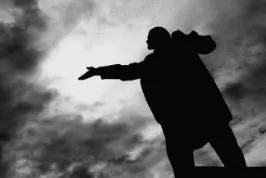
Be alert to operation 'dhakka' on the toppling of the lenin statue
The toppling of the Lenin statue in Tripura is a reminder of the grave danger to Indian democracy.There one moment, gone the next — statue of Vladimir Ilich Ulyanov, known internationally as Lenin, March 5, 2018, Belonia, Tripura. “Bharat Mata ki jai!” saffron-sporting men yelled as they felled the statue of the Russian communist revolutionary. It did not matter to them that Lenin had hailed that same Bharat, its revolutionary ardour, for struggling to free itself from British imperialist and indigenous yokes. It did not matter to them that Lenin had been the inspiration to generations of Indians, leaders and led, in their strivings (make great efforts to achieve or obtain something) for a just Bharat. What mattered to them was that Lenin had inspired the Communist Party of India (Marxist)-led government in that northeastern State, which had been un-seated after an un-broken 25 years of ‘red rule’.
A second Lenin statue was to be similarly toppled (to fall or cause to fall from an upright position) at another site in the State shortly thereafter. A report said the statue’s decapitated head was turned into a ‘football’. Visuals of the statue’s ‘slaying’ and of the ‘slain’ figure lying amidst what looks like garbage sped across the globe. And millions watched them in disbelief. ‘What ever happened to Tripura? Where is Indian democracy headed?’
Operation Dhakka
And the chronology unfolded in thinking, remembering minds of other demolitions, charrings that seem to belong to a family of hate, of violent hate. The Babri Masjid, Ayodhya, December 6, 1992. The Wali Dakhani Mazaar, just outside the office of the Commissioner of Police, Ahmedabad, March 1, 2002. An estimated 272 minority shrines in Gujarat over six days thereafter. St. Sebastian’s Church, Dilshad Bagh, Delhi, Christmas eve, 2014.
“Ek dhakka zor se (one more shove, and make it strong)” was an inflammatory cry that was heard at the time of the Babri Masjid demolition. The list of demolitions together can be called ‘Operation Dhakka’.
What does one say to this sample scroll?
That the mindset of the people of India is now happy with the bulldozer? That it now endorses the blade that cuts, crushes, decimates the ‘other’? Does it approve the claw that then moves the heap away?
The response
The nationwide response to the vandalization (willful or malicious destruction or defacement of public or private property) rejects that despondent (feeling or showing extreme discouragement, dejection, or depression) hypothesis. So swift was the reaction, all in real time, even before the news condensed into cold print the following day, that the Bharatiya Janata Party functionary who tweeted with the speed of sound to the effect that ‘Lenin today, Periyar tomorrow’ had to retract that with the speed of light. Thank God, one might say, begging Periyar’s atheistic pardon, for Periyar’s giant stature. Even in death, his stature remain stronger than any statue bulldozer.
And the Prime Minister, sensitive to world opinion, and aware of the reaction to the Tripura shame, has asked the Union Ministry of Home Affairs (MHA) to say that what has happened is not acceptable. He has done what is only right and proper. And quickly enough. He deserves to be complimented. The new Chief Minister, too, deserves appreciation for his expression of disapproval. Those who said things that seemed to explain away the dhakka will be hopefully be sobered by the Prime Minister’s admonition.
But is the admonition enough?
The questions remain: Why do supporters of his party feel that they can do what they have done, in the first place? Why do they feel they can do that and get away with it? Or that – even if the administration was to prosecute them – the dhakka has done its work and so, yay!
The Prime Minister’s chastisement (to criticize someone harshly for doing something wrong), last year, of cow vigilantism was salutary (producing a beneficial effect), though it came not nearly as fast as his response to the Lenin dhakka. But did cow vigilantism stop? Is the cattle trade now free of fear? We know the answer.
Why? Because the culture of dhakka is abroad. And so it will be until India gets another clear message, direct and unmistakable, in continuation of his advisory to the MHA, from the Prime Minister saying he is deeply troubled and hurt by what happened in Tripura, that no one owing allegiance to ‘saffron’ will ever conduct such an ‘Operation Dhakka’ again, not just because a statue of a great world leader was vandalised but because that vandalisation reflects political coarseness, un-democratic belligerence (an aggressive or truculent attitude, atmosphere, or disposition).
Bullies are not democrats. And democracy is not a bully. That adds up to a paradox: the bullying of democracy and the enfranchising (to set free; liberate) of the bully.
Democracy, as organised for us by our Constitution, does not disentitle (to deprive of title, claim, or right) bullies from participating in election campaigns, electoral contests. Why? Because, to borrow and adapt, begging his pardon, Gandhi’s famous description of God, the bully is “an indefinable mysterious power… which makes itself felt and yet defies all proof…”
Unveiling the electoral process for the electing population, our democracy says to the voter what a voter may or may not do as that essential digit in democracy, namely, the elector. It says to the candidate and campaigner what they may or may not do in the run-up to the polls. It says to election officers what they may or may not do as the polls are on. It says to Presidents and Governors what they should or should not do, how they should and should not act when scrutinising results to see who should be called to form governments.
But democracy does not tell the public to not let the anti-social, the anti-democracy bully take the law into his hands and hold peace to ransom, peaceful change to ransom, the democratic process itself to ransom. Democracy does not tell us that but governance can, administrations should. And that, through the medium of the laws, the dicta of ‘law and order’.
Operation Dhakka has therefore happened right under democracy’s nose and above governments’ heads. It has happened, I said. But that is surely an under-statement and, in fact, a mis-statement. It has been allowed to happen, it has been enabled to happen. ‘No flout without clout.’ Certainly no flout of the scale that Operation Dhakka represents.
But stopping the culture of dhakka cannot be left to the administration’s law and order maintenance mechanism.
Relay and retaliatory dhakkas are likely, with the defacement of a Periyar statue having been already attempted, incredibly, and a Syama Prasad Mukherjee statue in Kolkata being black-inked. This is an incendiary (tending to stir up conflict) risk which only political leadership can address.
Treating the risk as a ‘law and order matter’ is not the answer, for the dhakka challenge runs deeper. It threatens to erode the very fabric of our democracy.
It is imperative that all democratic forces unite in saying no one should repeat or retaliate in copy-cat shames, the Tripura shame. West Bengal Chief Minister Mamata Banerjee’s statement has been frank and fearless. “Karl Marx or Mohamati [The Great] Lenin are not my leaders,” she said. “But they do matter in Russia. Different people are leaders in different countries and different places formed this [the world] but you [the BJP] do not have the right to raze the statues of Marx or Lenin, just because you came to power.”
Bulldoze bulldozing
Strong words. The communist parties of India and the Trinamool Congress can recall violence for which they hold the other squarely responsible. But surely the time has come for them and all parties that sense a new danger from dhakka-ism to democracy to now arouse India’s faith in democratic choice and thereby bulldoze bulldozing.



Top court quashes FIRs against Gen Z protesters
Sep 04, 2026






Stay updated with The Hindu Editorial Vocab24 app, your definitive source for breaking news and comprehensive coverage from India and around the globe. Whether it's political developments, business updates, sports highlights, the latest technology trends, or current events, The Hindu brings live, accurate, and reliable news directly to your device.
Don’t fall for sensationalized or fake news shared online. Read and share accurate updates with friends and family through The Hindu Editorial Vocab24 app. Download it today!
News Coverage in The Hindu Editorial Vocab24 App
Breaking News: Receive instant notifications on breaking news stories as they unfold. Stay informed about major events and developments in India and around the world with live blogs, news in shorts videos, and concise articles.
Politics: Get the latest updates on Indian politics, including elections, policy changes, government decisions, and political events that shape the nation.
Business and Economy: Stay ahead in the economic landscape with detailed business news and market analysis. Learn about stock market trends, financial reports, corporate news, and economic developments to make informed investment decisions.
Current Events: Follow stories on social issues, policy changes, global events, and daily current affairs, tailored for UPSC and other competitive exam preparations.
Technology: Keep up with the latest gadgets, innovations, and tech trends. Read expert reviews and analyses in short, concise updates on cutting-edge technology from India and beyond.
Sports: Never miss a moment of your favorite sports. Get live scores, match reports, and expert analysis on cricket, football, tennis, and more.
International News: Stay informed about global events and geopolitical developments, including the Russia-Ukraine war, Israel-Palestine conflict, and other key international stories.
Local News: Stay connected to your community with the latest updates on city events, issues, and local news. Coverage includes hyperlocal updates from cities like Bangalore, Chennai, Delhi, Hyderabad, Mumbai, Kolkata, and more.
Trending Topics: Discover what's trending today with the most talked-about stories and hot topics across India and the world.
Experience journalism that values integrity, accuracy, and reliability. Download The Hindu Editorial Vocab24 app today and stay connected with the world.
Subscribe to our newsletter!







