


Asia’s remarkable economic transformation
Governments played a vital role, ranging from leader to catalyst or supporter, in Asia’s half-century of development.Two centuries ago, in 1820, Asia accounted for two-thirds of the world’s population and more than a half of world income. It also contributed more than a half of manufacturing production in the world economy. The subsequent decline of Asia was attributable to its integration with the world economy shaped by colonialism and driven by imperialism. By 1962, its share in world income had plummeted to 15%, while its share in world manufacturing had dropped to 6%. Even in 1970, Asia was the poorest continent. Its demographic and social indicators of development, among the worst anywhere, epitomised its underdevelopment. Gunnar Myrdal, who published his magnum opus Asian Drama in 1968, was deeply pessimistic about the continent’s development prospects.
Key metrics
In the half century since then, Asia has witnessed a profound transformation in terms of economic progress of nations and living conditions of people. By 2016, it accounted for 30% of world income, 40% of world manufacturing, and over a third of world trade. Its income per capita also converged towards the world average, although the convergence was at best modest compared with industrialised countries because the initial income gap was so enormous. This transformation was unequal across countries and between people. Even so, predicting it would have required an imagination to run wild. Indeed, Asia’s economic transformation in this short time span is almost unprecedented in history.
It is essential to recognise the diversity of Asia. There were marked differences between countries in geographical size, embedded histories, colonial legacies, nationalist movements, initial conditions, natural resource endowments, population size, income levels and political systems. The reliance on markets and degree of openness in economies varied greatly across countries and over time. The politics too ranged widely from authoritarian regimes or oligarchies to political democracies. So did ideologies, from communism to state capitalism and capitalism. Development outcomes differed across space and over time. There were different paths to development, because there were no universal solutions, magic wands, or silver bullets. Despite such diversity, there are common discernible patterns.
For Asian countries, political independence, which restored their economic autonomy and enabled them to pursue their national development objectives, motivated and drove this transformation. And, unlike Latin America and Africa, most Asian countries did have a long history of well-structured states and cultures, which were not entirely destroyed by colonialism.
Economic growth drove development. Growth rates of GDP and GDP per capita in Asia were stunning and far higher than elsewhere in the world. Rising investment and savings rates combined with the spread of education were the underlying factors. Growth was driven by rapid industrialisation, often export-led. There was a virtuous circle of cumulative causation, wherever rapid investment growth coincided in time with rapid export growth, leading to rapid GDP growth. This was associated with structural changes in the composition of output and employment. The process was also supported by a coordination of economic policies across sectors and over time.
Unequal outcomes
However, development outcomes were unequal across sub-regions and countries. East Asia was the leader and South Asia was the laggard, with Southeast Asia in the middle, while progress in West Asia did not match its high-income levels. In just 50 years, South Korea, Taiwan and Singapore joined the league of industrialised nations. China was a star performer throughout, making impressive strides in development after 1990. The economic dynamism of Indonesia, Malaysia, and Thailand waned after the Asian financial crisis. The growth performance of India, Bangladesh and Vietnam was most impressive during the past quarter century, although India and Bangladesh did not match the rest of Asia in social progress. In comparison, the performance of Sri Lanka was respectable, while that of Turkey was average; but that of Pakistan and the Philippines was relatively poor.
Rising per capita incomes transformed social indicators of development, as literacy rates and life expectancy rose everywhere. Rapid economic growth led to a massive reduction in absolute poverty. But the scale of absolute poverty that persists, despite unprecedented growth, is just as striking as the sharp reduction therein. The poverty reduction could have been much greater but for the rising inequality. Inequality between people within countries rose almost everywhere, while the gap between the richest and poorest countries in Asia remains awesome.
Governments performed a vital role, ranging from leader to catalyst or supporter, in the half-century economic transformation of Asia, while their willingness and ability to do so depended on the nature of the state, which in turn was shaped by politics. Success at development in Asia was about managing this evolving relationship between states and markets, complements rather than substitutes, by finding the right balance in their respective roles that also changed over time. Countries where governments could not perform this role lagged behind in development.
The developmental states in South Korea, Taiwan and Singapore coordinated policies across sectors over time in pursuit of national development objectives, using carrot and stick to implement their agenda, and were able to become industrialised nations in such a short time span. China emulated these developmental states with much success, and Vietnam followed on the same path two decades later, as both countries have strong one-party communist governments that could coordinate and implement policies.
It is not possible to replicate these states elsewhere in Asia. But other countries did manage to evolve some institutional arrangements, even if less effective, that were conducive to industrialisation and development. In some of these countries, the institutionalised checks-and-balances of political democracies were crucial to making governments more development-oriented and people-friendly.
Openness, industrialisation
Economic openness performed a critical supportive role in Asian development, wherever it was in the form of strategic integration with, rather than passive insertion into, the world economy. While openness was necessary for successful industrialisation, it was not sufficient. Openness facilitated industrialisation only when combined with industrial policy. Clearly, success at industrialisation in Asia was driven by sensible industrial policy that was implemented by effective governments. In future, however, technological learning and technological capabilities are also essential to provide the foundations for sustaining industrialisation.
The countries in Asia that modified, adapted and contextualised their reform agenda, while calibrating the sequence of, and the speed at which, economic reforms were introduced, did well. They did not hesitate to use heterodox or unorthodox policies, or experiment and innovate, for their national development objectives. Learning and unlearning were part of a process in which economic policies were seen as means to the end of development, and not ends in themselves.
Challenges ahead
The rise of Asia represents the beginnings of a shift in the balance of economic power in the world and some erosion in the political hegemony of the West. The future will be shaped partly by how Asia exploits the opportunities and meets the challenges and partly by how the present difficult economic and political conjuncture in the world unfolds. Even so, by 2030, per capita income in Asia, relative to the world, will return to its level in 1820. In terms of per capita income, however, it will be nowhere near as rich as the United States or Europe. Thus, Asian countries would emerge as world powers, without the income levels of rich countries.
Yet, it is plausible to suggest that in circa 2050, a century after the end of colonial rule, Asia will account for more than a half of world income and will be home to more than half the people on earth. It will thus have an economic and political significance in the world that would have been difficult to imagine 50 years ago, even if it was the reality in 1820.


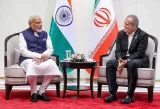
Ensure peace, freedom of navigation, PM urges Iran
Sep 03, 2026








Stay updated with The Hindu Editorial Vocab24 app, your definitive source for breaking news and comprehensive coverage from India and around the globe. Whether it's political developments, business updates, sports highlights, the latest technology trends, or current events, The Hindu brings live, accurate, and reliable news directly to your device.
Don’t fall for sensationalized or fake news shared online. Read and share accurate updates with friends and family through The Hindu Editorial Vocab24 app. Download it today!
News Coverage in The Hindu Editorial Vocab24 App
Breaking News: Receive instant notifications on breaking news stories as they unfold. Stay informed about major events and developments in India and around the world with live blogs, news in shorts videos, and concise articles.
Politics: Get the latest updates on Indian politics, including elections, policy changes, government decisions, and political events that shape the nation.
Business and Economy: Stay ahead in the economic landscape with detailed business news and market analysis. Learn about stock market trends, financial reports, corporate news, and economic developments to make informed investment decisions.
Current Events: Follow stories on social issues, policy changes, global events, and daily current affairs, tailored for UPSC and other competitive exam preparations.
Technology: Keep up with the latest gadgets, innovations, and tech trends. Read expert reviews and analyses in short, concise updates on cutting-edge technology from India and beyond.
Sports: Never miss a moment of your favorite sports. Get live scores, match reports, and expert analysis on cricket, football, tennis, and more.
International News: Stay informed about global events and geopolitical developments, including the Russia-Ukraine war, Israel-Palestine conflict, and other key international stories.
Local News: Stay connected to your community with the latest updates on city events, issues, and local news. Coverage includes hyperlocal updates from cities like Bangalore, Chennai, Delhi, Hyderabad, Mumbai, Kolkata, and more.
Trending Topics: Discover what's trending today with the most talked-about stories and hot topics across India and the world.
Experience journalism that values integrity, accuracy, and reliability. Download The Hindu Editorial Vocab24 app today and stay connected with the world.
Subscribe to our newsletter!







