

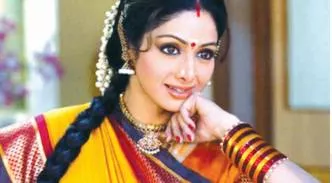
A superior southern style
She saw herself as an actor in the south, but as a show thing in the north. “In Tamil films they love to see me act naturally. But in Hindi films all they want is lot of glamour, richness and masala.”Brilliant movie star Sridevi who died unexpectedly at 55 on Saturday had something in common with Karachi-based progressive ideologue Biyyathil Mohyuddin Kutty.
They both shared an invisible cultural gift without flaunting (display (something) ostentatiously, especially in order to provoke envy or admiration or to show defiance) it. Both being quintessential (representing the most perfect or typical example of a quality or class) South Indians embraced the forbidding northern terrains to bare their souls but without rubbing in the point.
Sridevi could excel in her native Tamil apart from Malayalam, Kannada and Telugu, the four so-called Dravidian languages she spoke and performed memorable roles in with ease.
In the north, a few mocked her dialogue delivery in the staple (a primary part of something. A key component) Hindi fare she earned her fame from, for what they saw as a thick Tamil accent. There could be a small point there, if at all, but then how many northerners in the subcontinent’s sprawling (to develop or spread without limitation) movie industry or even outside can really converse in a smattering (a small amount of something) of Tamil, with or without an accent, leave alone claiming a fluent accord with Malayalam, Kannada or Telugu?
And who says Amitabh Bachchan can speak Urdu-Hindi with the clear correct inflection of, say, Raj Kapoor or Balraj Sahani, to stay within the northern ambit (the scope, extent, or bounds of something)?
Kutty, who shot to fame during the Zia years of repression, participated in the Movement for Restoration of Democracy in Pakistan along with Benazir Bhutto and the legendary Mir Ghaus Bukhsh Bizenjo.
His ideological pursuits required him to appreciate Faiz and Josh, revolutionary poets of Urdu, which he did with relish. He even absorbed the nuances of Baloch, Pushto, Punjabi and Sindhi cultures. But how many Baloch, Pathans, Sindhis, Urdu and Punjabi speakers can appreciate Kutty sahib’s native Malayali sensibility?
How many among them have ever appreciated the acting talent of, say, P.J. Anthony in Nirmalyam, or have they even heard about the classic film from Kerala, just to consider one example?
How many would be aware that Jesudas, known via the narrow northern prism for a couple of memorable film songs, is a most accomplished classical vocalist who though a pious Christian religiously performs bhajans to Krishna outside the Guruvayur temple near Pattambi — outside and not inside, because the ethnically northern priests would not allow him in?
Sridevi recast her gamut (the complete range or scope of something) of talents professionally as an actor to comply with her limited northern brief. A Hindi movie removed from her standard Bombay masala (formula film) was Sadma. Here she excelled as an actor because she was allowed to act. Significantly, Sadma was a remake of a Tamil original. English Vinglish and Mr India allowed her to flourish as an actor though. I may be missing out one or two others.
Sridevi was not alone in crossing the Vindhyas that had hitherto secured the south from a relatively overbearing and crudely intrusive (causing disruption or annoyance through being unwelcome or uninvited) north. (We are not racist, for if we were how would we be living in harmony with South Indians? — so spoke a northern MP, mirroring a vulgar cultural grooming.)
M.S. Subblakshmi, the amazing singer from the south, could sing bhajans in Brijbhasha, and she has even attempted Ghalib’s complex ghazal — Ishrat-i-qatra hai dariya mein fana ho jana in Urdu. Try and figure out someone of her calibre from the north who has practised their vocal chords in the south in a southern language?
There are rare exceptions. Abdul Karim Khan, for example, left Kirana in Punjab, travelled through the Marathi heartland while blending his Hindustani vocal prowess with natya sangeet, a challenging form of stage music. And he eventually fell in love with the south from where he learnt and expanded his repertoire (a set of skills or types of behavior that a person uses regularly).
Kharaharpriya is a delicate Carnatic raga that Karim Khan sang ad verbatim in the original language. He also blended Carnatic raga Devgandhari into a Marathi composition — Chandrika hi janu. Yes, there are South Indian ragas adapted in the northern repertoire, like there are South Indian artists making waves in the north. (Little do we know that the famous circuses of our childhood — Kamla Circus and Gemini Circus, for example — came from Thalassery in Kerala.)
Sridevi followed in the footsteps of other movie goddesses from the south who could all dance professionally. (Madhubala and Meena Kumari in the north could not do a foxtrot to save their lives though they were great actors.)
Waheeda Rehman was found by Guru Dutt after a magical dance in a Telugu movie. Vyjayantimala was easily the towering female actor from any part of India.
No man or woman from north or south could approach her perfect facility with the complicated eastern Awadhi dialect of Ganga Jamuna. And which male or female lead from the north can come anywhere near Kamal Haasan’s dancing prowess?
Witness the sense of rhythm at the congregations in Kerala that cut across religious communities. Hindu, Muslim, Christian or tribespeople, they don’t celebrate anything without the drums. Sari-clad women heading to the Catholic church in Thekkady swaying rhythmically to the drums they each carried connect much of the south to the African sensibility, just as their martial arts and fishing traditions take us straight to China.
It is not clear how Sridevi responded to the north’s obsession with fair skin, but let me leave you with a lovely story I heard from Akbar Khaleeli of Sir Mirza Ismail’s family of Persian settlers in Madras.
The Anglo-Indian headmistress in a Madras school asked the boys to name a bird. “Robin, teacher,” said an eager north Indian boy. His Tamil compatriot was incensed (displaying or feeling strong anger) and chided him: “Yennada. Kaka pakillya?” Hey fellow, never seen a crow? Sridevi would have laughed like a child. That’s how I would remember her. Kutty sahib would smile too.


Philippines president rodrigo duterte slams unhcr
Apr 06, 2018
Oli to take up currency ban issue with pm modi
Apr 02, 2018
Curbing the khaps
Apr 01, 2018





Stay updated with The Hindu Editorial Vocab24 app, your definitive source for breaking news and comprehensive coverage from India and around the globe. Whether it's political developments, business updates, sports highlights, the latest technology trends, or current events, The Hindu brings live, accurate, and reliable news directly to your device.
Don’t fall for sensationalized or fake news shared online. Read and share accurate updates with friends and family through The Hindu Editorial Vocab24 app. Download it today!
News Coverage in The Hindu Editorial Vocab24 App
Breaking News: Receive instant notifications on breaking news stories as they unfold. Stay informed about major events and developments in India and around the world with live blogs, news in shorts videos, and concise articles.
Politics: Get the latest updates on Indian politics, including elections, policy changes, government decisions, and political events that shape the nation.
Business and Economy: Stay ahead in the economic landscape with detailed business news and market analysis. Learn about stock market trends, financial reports, corporate news, and economic developments to make informed investment decisions.
Current Events: Follow stories on social issues, policy changes, global events, and daily current affairs, tailored for UPSC and other competitive exam preparations.
Technology: Keep up with the latest gadgets, innovations, and tech trends. Read expert reviews and analyses in short, concise updates on cutting-edge technology from India and beyond.
Sports: Never miss a moment of your favorite sports. Get live scores, match reports, and expert analysis on cricket, football, tennis, and more.
International News: Stay informed about global events and geopolitical developments, including the Russia-Ukraine war, Israel-Palestine conflict, and other key international stories.
Local News: Stay connected to your community with the latest updates on city events, issues, and local news. Coverage includes hyperlocal updates from cities like Bangalore, Chennai, Delhi, Hyderabad, Mumbai, Kolkata, and more.
Trending Topics: Discover what's trending today with the most talked-about stories and hot topics across India and the world.
Experience journalism that values integrity, accuracy, and reliability. Download The Hindu Editorial Vocab24 app today and stay connected with the world.
Subscribe to our newsletter!







