

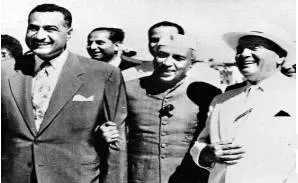
A new nam for the new norm
India must seek nonaligned partnerships which can work together outside the influence of the U.S., China and Russia.From all accounts, the Cold War is breaking out again. The United States has identified both China and Russia as adversaries, whose leaders, Xi Jinping and Vladimir Putin, are strong and determined to stand up to a faltering (to stop being strong or successful) Donald Trump, who is desperately clinging on to doctrines of ultranationalism and nuclear hegemony (Leadership or dominance, especially by one state or group over others).
The Russia dare
Mr. Putin has just announced that Russia has invincible doomsday machines like an underwater drone armed with a nuclear warhead powerful enough to sweep away coastal facilities, aircraft carriers and a hypersonic vehicle impossible to intercept as it flies in a cloud of plasma “like a meteorite”.
Cuba is in the dog house again and the “axis of evil” has emerged once again under Iran’s leadership. This time it is a three-cornered Cold War, without any corner having committed countries to act together as military allies. Potential allies are hedging (protect oneself against loss on (a bet or investment) by making balancing or compensating transactions), with no viable grouping to protect the interests of the weak and the poor. If the Cold War is here in a new form, can a reincarnation of the Non-Aligned Movement (NAM) be far behind?
NAM is anathema (something or someone that one strongly dislikes; someone who is cursed or shunned) today even to those who helped shape it and reveled (to take intense pleasure or satisfaction) in it for years. India was one of its leaders, if not the leader. India had a stake in its integrity and India toiled (work extremely hard or incessantly) tirelessly to keep it on the middle road, not to be hijacked by Cuba to the left or Singapore to the right. We fought to keep Egypt within it when every Arab country wanted it to be ousted in 1979 after the Camp David agreements. Indira Gandhi risked a bear hug from Fidel Castro as she took the NAM gavel to save it from the uncertain leadership of Iraq. Had it not been for India, NAM would have been wound up at a ministerial meeting in Ghana in 1991 soon after the collapse of the Berlin Wall. It was characterised as the “last gasp of the old style radicals”.
India argued vehemently against those who felt that NAM had outlived its utility. Since the essence of nonalignment was freedom of thought and action, India insisted that it was valid whether there was one bloc or no bloc. Even while building alliances with others, we availed of the NAM umbrella to promote our national strategies when it suited us. The very lack of homogeneity and unity in NAM enhanced its utility for us. One forum where we effectively used the NAM constituency was the Working Group on UN Reform, where we blocked an effort by the U.S. and others to add Germany and Japan as permanent members and close the doors for further expansion.
Hit refresh
An effort was made in 2012 to craft a ‘Nonalignment 2.0’ in the context of the new global situation, India’s growing importance and the rivalry between the U.S. and China. The report moved the concept of nonalignment away from its origins. It reiterated that India needed to move quickly to extend its global role and influence. But the authors said India’s big challenge would be to aim at not just being powerful but to set new standards for what the powerful must do. India’s legitimacy in the world will come from its ability to stand for the highest human and universal values and at the global level, “India must remain true to its aspiration of creating a new and alternative universality.”
In a situation where the world is no longer bifurcated (to cause to divide into two branches or parts) between two dominant powers, nonalignment today will require managing complicated coalitions and opportunities in an environment that is not structurally settled, the report said. The policy of “strategic autonomy” recommended that India should not take sides in the rivalry between China and the U.S. The report emphasised that for its strategic and foreign policy to be successful, India must sustain domestic economic growth, social inclusion and democracy.
Coming as it did in the wake of a strategic partnership with the U.S., a revival of NAM, even with caveats (a warning or proviso of specific stipulations, conditions, or limitations) of various kinds, did not seem to appeal either to the Manmohan Singh government or the opposition Bharatiya Janata Party. For Prime Minister Narendra Modi too, NAM was nothing but a relic (a trace of some past or outmoded practice, custom, or belief) of the Nehruvian past and it did not form part of his vocabulary.
As he pursued his priorities of development, security, neighbourhood and the diaspora, maintaining a constituency of the poor nations of the world had no place. In his transactional foreign policy, it is easier to act alone rather than as the spokesperson of a group. It was no wonder, therefore, that he did not find it necessary to attend the NAM Summit in Venezuela in 2016. India, which conceived and nursed the concept, was ready to cast it into the dustbin of history. We began a journey from the leadership of the super poor to become a super power.
Where we stand today
Into the second half of his term, Mr. Modi’s balance sheet shows an altogether different scenario. As a close defence partner of the U.S. and a member of the “Quadrilateral”, India is right in the U.S. camp. As the baton of the orchestra passed into the hands of a wayward conductor, the new symphony in India-U.S. relations promised in 2016 has not quite materialised. Both China and Russia, which have been identified as adversaries in the U.S. world view, have their problems with India. Doklam and the Maldives have shown that China is in no mood for a compromise. In fact, China has attributed the increase of its defence budget to the formation of the Quadrilateral, which is being seen as a direct threat to China.
An obvious way is to revive NAM by breathing new life into it and making it fit to deal with the new norm. But it has baggage, which may be difficult to unload. A movement conceived in the context of a bipolar world may not suit a tripolar world, which could become a multipolar world. A partnership of near equals like IBSA (India, Brazil and South Africa) with similar interests without any ideological conflict is probably the best model to follow. Something on the lines of the G-15 organised by India and like-minded countries some years ago could be put together with the objective of dealing with the kind of issues identified by Mr. Modi at Davos — climate change, terrorism and protectionism. The members may have links with the U.S., China and Russia, but should be able to work together without the undue influence of the three.
Mr. Modi is not someone who will hesitate to think out of the box to achieve his objectives. Given the present impasse (a situation in which no progress is possible, especially because of disagreement; a deadlock) in international relations with little leeway for game-changing initiatives, India will do well to move away from being a camp follower of one of the emerging poles to create our own fourth pole.



Top court quashes FIRs against Gen Z protesters
Sep 04, 2026






Stay updated with The Hindu Editorial Vocab24 app, your definitive source for breaking news and comprehensive coverage from India and around the globe. Whether it's political developments, business updates, sports highlights, the latest technology trends, or current events, The Hindu brings live, accurate, and reliable news directly to your device.
Don’t fall for sensationalized or fake news shared online. Read and share accurate updates with friends and family through The Hindu Editorial Vocab24 app. Download it today!
News Coverage in The Hindu Editorial Vocab24 App
Breaking News: Receive instant notifications on breaking news stories as they unfold. Stay informed about major events and developments in India and around the world with live blogs, news in shorts videos, and concise articles.
Politics: Get the latest updates on Indian politics, including elections, policy changes, government decisions, and political events that shape the nation.
Business and Economy: Stay ahead in the economic landscape with detailed business news and market analysis. Learn about stock market trends, financial reports, corporate news, and economic developments to make informed investment decisions.
Current Events: Follow stories on social issues, policy changes, global events, and daily current affairs, tailored for UPSC and other competitive exam preparations.
Technology: Keep up with the latest gadgets, innovations, and tech trends. Read expert reviews and analyses in short, concise updates on cutting-edge technology from India and beyond.
Sports: Never miss a moment of your favorite sports. Get live scores, match reports, and expert analysis on cricket, football, tennis, and more.
International News: Stay informed about global events and geopolitical developments, including the Russia-Ukraine war, Israel-Palestine conflict, and other key international stories.
Local News: Stay connected to your community with the latest updates on city events, issues, and local news. Coverage includes hyperlocal updates from cities like Bangalore, Chennai, Delhi, Hyderabad, Mumbai, Kolkata, and more.
Trending Topics: Discover what's trending today with the most talked-about stories and hot topics across India and the world.
Experience journalism that values integrity, accuracy, and reliability. Download The Hindu Editorial Vocab24 app today and stay connected with the world.
Subscribe to our newsletter!







