

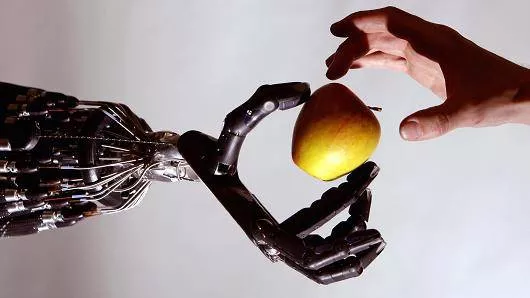
A good year for artificial intelligence
The year 2017 was a seminal year for the field of Artificial Intelligence (AI). The buildup of research breakthroughs, academic whispers, and the occasional policy conversation burst into public consciousness. Suddenly, everyone everywhere was talking about AI, what it means, and how it will affect human societies and economies. Jobs, warfare, healthcare, film-making, even art—no area of human enterprise seemed to be immune from discussions of the coming machine onslaught. Overall, there were three very important outcomes for the field of AI in 2017. First, technologically, the single most important breakthrough in 2017 was the development of Google Deep Mind’s AlphaGo Zero. AlphaGo Zero built on the earlier astonishing success of the AlphaGo program, which mastered the game of Go—an East Asian game widely believed to be significantly more complex than chess. AlphaGo was taught how to play the game through a database of hundreds of thousands of videos of humans playing Go. This method of training AlphaGo is generally indicative of the process by which AI has been achieved thus far—extremely data-intensive, and dependent to a great extent on humans “teaching” the program. AlphaGo Zero, however, attempted to move beyond such data dependence by making the program teach itself how to play the game of Go. There was minimal human support, and in Google’s own words, the program “learns to play simply by playing games against itself, starting from completely random play”. This is a significant breakthrough for the field of AI for two reasons. First, as pointed out by Demis Hassabis, the chief executive officer of Deep Mind, it means that future developments in the field need no longer be constrained by the limits of human knowledge or the quality of the data available for training. Second, the overreliance on data to fuel AI developments has increasingly concentrated new research in a handful of big tech companies: Google, Apple, Amazon, Baidu and Alibaba. AlphaGo Zero, by making potential advances less dependent on access to data, could make research more dispersed. Second, 2017 was also the year when countries across the world began putting AI at the heart of their future plans and policy measures. China released a plan to turn itself into an AI superpower by 2030, Russian President Vladimir Putin noted that “whoever becomes the leader in this sphere, will become the ruler of the world”, and India set up its own AI Task Force to study the possible effects of AI on a variety of economic and social spheres. Alongside, the military effects of AI were recognized as a question of increasing relevance for the international community. The UN held the first round of formal talks on the question of Lethal Autonomous Weapon Systems—weapons that can theoretically act independent of human control via AI technologies, in November. Further talks on this issue have been scheduled for February and March. Third, an interesting facet of the conversations surrounding AI in 2017, was the climbdown in the latter half of the year from the earlier exuberance, often misinformed, of the capabilities of AI. An increasing number of AI researchers and developers began pointing out that in spite of the significant technological leaps in the last few years, AI is in fact not as smart as has been widely reported and presumed. AI as it stands right now is “dumber than a five year old, no smarter than a rat”. Historically, AI has had numerous boom- and-bust cycles. The current boom cycle started roughly in 2012 with the publication of a set of papers which showed that the then theoretical idea of “deep learning” was now practical. However, last year an increasing number of academics and researchers began arguing that current AI advancements have in fact plateaued, signalling the possibility of a new bust cycle. If so, a new generation of breakthroughs is necessary to continue powering the AI euphoria. In 2018, it is necessary to talk about AI within the contours of the reality of the technology and its present capabilities. An honest conversation about the possible benefits and drawbacks of AI cannot be undertaken under a cloud of hype and hyperbole—no “killer robots” and no visions of a robot-ruled future. For this, it is also necessary to move past the idea of AI being a replacement for humans across the board, and begin having a deeper conversation about its effectiveness as a tool in the hands of humans. Finally, much of the discourse on AI thus far has been very Western-centric, with possible effects being discussed in the socioeconomic context of the Western nations. However, it is very unlikely that AI will affect all countries the same way. In 2018, therefore, it becomes very important for a greater number of researchers and academics to study how AI could affect a country as unique as India, and thereby help develop multiple discourses on AI. This has already begun in China, where the state sees AI as central to its continued economic growth and future dominance of global affairs, and is developing a China-centric vision of AI that looks to harness its potential to China’s advantage. A similar effort needs to be undertaken in India in coordination between the government, the industry, and academia to concretely envision how AI might affect various facets of the economy and society, and develop policy measures to ensure a beneficial national outcome to the AI revolution. Courtesy : Livemint Editorial
The non trivial costs of a slow judiciary
Jan 31, 2018
Very important the economic survey an overview
Jan 30, 2018
The conflict between equity and efficiency
Jan 29, 2018
Judicial primacy is not the same as exclusivity
Jan 25, 2018
Global monetary policy enters a decisive phase
Jan 25, 2018





Stay updated with The Hindu Editorial Vocab24 app, your definitive source for breaking news and comprehensive coverage from India and around the globe. Whether it's political developments, business updates, sports highlights, the latest technology trends, or current events, The Hindu brings live, accurate, and reliable news directly to your device.
Don’t fall for sensationalized or fake news shared online. Read and share accurate updates with friends and family through The Hindu Editorial Vocab24 app. Download it today!
News Coverage in The Hindu Editorial Vocab24 App
Breaking News: Receive instant notifications on breaking news stories as they unfold. Stay informed about major events and developments in India and around the world with live blogs, news in shorts videos, and concise articles.
Politics: Get the latest updates on Indian politics, including elections, policy changes, government decisions, and political events that shape the nation.
Business and Economy: Stay ahead in the economic landscape with detailed business news and market analysis. Learn about stock market trends, financial reports, corporate news, and economic developments to make informed investment decisions.
Current Events: Follow stories on social issues, policy changes, global events, and daily current affairs, tailored for UPSC and other competitive exam preparations.
Technology: Keep up with the latest gadgets, innovations, and tech trends. Read expert reviews and analyses in short, concise updates on cutting-edge technology from India and beyond.
Sports: Never miss a moment of your favorite sports. Get live scores, match reports, and expert analysis on cricket, football, tennis, and more.
International News: Stay informed about global events and geopolitical developments, including the Russia-Ukraine war, Israel-Palestine conflict, and other key international stories.
Local News: Stay connected to your community with the latest updates on city events, issues, and local news. Coverage includes hyperlocal updates from cities like Bangalore, Chennai, Delhi, Hyderabad, Mumbai, Kolkata, and more.
Trending Topics: Discover what's trending today with the most talked-about stories and hot topics across India and the world.
Experience journalism that values integrity, accuracy, and reliability. Download The Hindu Editorial Vocab24 app today and stay connected with the world.
Subscribe to our newsletter!







