

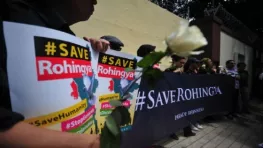
A get out campaign or genocide
When it comes to the Rohingya crisis in the northern-most region of Myanmar’s western-most Rakhine state (formerly Arakan), global public opinion has always been a foregone conclusion. It has depicted the crisis in binary fashion, with destitute (extremely poor and lacking the means to provide for oneself.) and helpless Rohingya Muslims cast as victims of Myanmar’s predominantly Buddhist army and government, the latter led by Aung San Suu Kyi.That more than half a million Rohingya Muslims have been driven out of their homes and displaced into makeshift shanty (a small crudely built dwelling or shelter usually of wood) camps inside Bangladesh along the border with Myanmar is not in doubt. At the same time, perception is not always the same as reality and, in this case, intractable (hard to control or deal with.) dilemmas need to be teased out (unravel) for a more balanced perspective.
The many images and reports from various sources make it plain that mass persecution of Muslims in Rakhine state has taken place, but whether or not that amounts to a systematic “genocide” and “ethnic cleansing” by Myanmar’s army (locally called the Tatmadaw) is a different matter. The politics that lies behind these measures against Rakhine’s Rohingya appear geared more towards “expulsion” and “exclusion” than “extermination” and “extinction”.
It is a “get out” campaign rather than “genocide”. If the Tatmadaw’s “clearance operations” after Aug 25 had been aimed at genocide and ethnic cleansing, the persecuted Muslims would have been kept inside for the kill rather than kicked out of the country and kept out.
Moreover, the Tatmadaw’s heavyhanded and disproportionate campaign of violence and torching of Rohingya villages, abetted (encourage or assist (someone) to do something wrong, in particular to commit a crime.) by local Rakhine Buddhists, was initially a reaction to the Arakan Rohingya Salvation Army’s (Arsa’s) coordinated attacks against 30 police outposts and an army base on Aug 25, one day after the respected Kofi Annan-led Advisory Commission on Rakhine state announced its recommendations on various issues, including citizenship, communal dialogue, basic security and safety, freedom of movement and bilateral cooperation with Bangladesh.
The raids by hundreds of Arsa assailants led to an orgy (an instance of excessive indulgence in a specified activity.) of violent clashes that left more than 400 dead, mostly Rakhine Muslims but also scores of security personnel and Buddhist and Hindu villagers. Global attention at the outset focused on State Counsellor and Foreign Minister Aung San Suu Kyi and how she had let the violence happen. In fact, it was Arsa that intended to nip in the bud (To stop something at an early stage.) the Kofi Annan commission and the ways forward it pointed to.
Coalescing in mid-2016 from Harakah al-Yaqin (or “Faith Movement”), and led by Ata Ullah, a Rohingya who was born in Pakistan but grew up in Saudi Arabia, Arsa deliberately provoked the Tatmadaw into overreacting in order to alienate Muslims and gain recruits to its separatist cause. Prior to its Aug 25 attacks, Arsa’s first salvo (a simultaneous discharge of artillery or other guns in a battle.) took place in October last year under similar circumstances but on a smaller scale.
This time, the confrontation may have reached a point of no return. Arsa now has the full-blown insurgency it wants, with support from Pakistani and Middle Eastern sources and an ample pool of recruits from disaffected young Rohingya Muslims who have no prospect of a better life in northern Rakhine’s hilly shacks and poverty-stricken towns. The Tatmadaw, however, got the pretext (a reason given in justification of a course of action that is not the real reason.) it needed to systematically drive out Rohingya Muslims, who are not recognised under Myanmar’s 1982 Citizenship Law as one of the country’s 135 ethnic minorities.
The majority of Myanmar’s population is of Burmese (locally called Bamar) ethnicity but its ethnic minorities comprise more than a third of the country’s 53-million population, led by the Shans and the Karens. Rakhine state itself has 3.2 million, 52 per cent of whom are Buddhist and 43 per cent Muslim, with Christians, Hindus and others making up the rest. But in the northern Rakhine towns of Maungdaw, Buthidaung and Rathedaung, the Muslims number 950,000, according to the 2014 national census and the United Nations.
Of these, more than 80 per cent are Muslims with large families, and most of them have now been forced out. Prior to the latest outbreak of violence between Rohingya Muslims, Rakhine Buddhists and the Tatmadaw, periodic bouts of comparable turmoil and bloodshed took place in 1978 and 1992, with the communal violence in 2012 sowing the seeds of Arsa. The Rakhine crisis is deepseated and attributable to the British conquest of India that eventually led to three victorious wars over the Burmese from 1824 onwards, and the subjugation (the action of bringing someone or something under domination or control.) of Burma as a province of British India from 1885 to 1937.
For more than a century, the British brought in workers of different faiths into Burma from India (which subsequently split into Pakistan, India and East Pakistan/Bangladesh). Many South Asian migrants had also trickled into Burma on their own in search of better lives. Among them were Muslim newcomers who mixed with the Muslims who had been in Burma from before as a result of maritime and overland commerce.
The pre-1824 Muslims had integrated into Burmese society. Not so the Muslims who arrived after. It is the descendants of those newer Muslim migrants from Britain’s expansion into and direct rule over Burma that are at the crux of today’s challenge. Myanmar people, not just Barma but also other ethnic minorities, see these later Muslim arrivals as having come mostly from what is today Bangladesh. These post-1824 Muslims are thus considered bogus (fake) dwellers (a person or animal that lives in or at a specified place.) and “interlopers” in Rakhine, having trespassed and refusing to go back to where they came from.
Many Burmese unsurprisingly label them “Bengali”, as they are seen as deriving from Chittagong and elsewhere in Bangladesh. In turn, these Muslims rallied for their own identity and autonomy. The term “Rohingya” thus sprung up in the 1950s as an ethnic construct in search of identity and recognition. “Rohingya” as an ethnic term was stipulated in written records for the first time in 1963.
Other names in contention at the time included “Ruhangya” and “Roewhengya”, based on the oral understanding of “Rwangya”. What will happen now is that many thousands of Rohingya Muslims may not be coming back to Myanmar and will form a long-term refugee population in limbo ( in a state of neglect;) on the Myanmar-Bangladesh border where tensions and human rights violations will persist, with a grinding humanitarian crisis that rolls on indefinitely.
In turn, the Tatmadaw may rebalance the northern Rakhine population by bringing in Barma and/or Rakhine Buddhists to reduce the Muslim majority there. When she spoke on Sept 19, after more than three weeks of silence, what Ms Suu Kyi unwittingly implied about “verification” and the right of return is that many Rohingya Muslims are not likely to be allowed back because they lack identity papers, as they belong to an unrecognised ethnic minority group of Myanmar. As a result, global condemnation of “The Lady” is unlikely to let up.
Yet Ms Suu Kyi is stuck between a rock and a hard place. After five decades of military dictatorship, including 21 years when she was mostly under house arrest in Yangon, she has ushered in a fragile democracy with the elections of November 2015. But this democratic achievement was premised on a compromise with the Tatmadaw, headed by Senior General Min Aung Hlaing. As the army vehemently rejects the Rohingyas, and is backed by widespread popular support in doing so, maintaining a civil-military compromise on the matter so as to keep democracy on track is the trade-off Ms Suu Kyi has to make.
Sticking up for the Rohingyas would undermine her support base, alienate the Tatmadaw and potentially derail the semblance of democratic rule. For there to be a way forward, it would have to be based on a regional approach built on the back of upgraded Myanmar-Bangladesh ties. Asean has proved ineffectual – and even divided – on the Rohingya case. Malaysia recently disavowed a statement issued by the Philippines, the current Asean chair, on the Rakhine situation. While its role is indispensable in mitigating the Rohingya crisis, Bangladesh is not part of Asean.
Five countries are key, namely Myanmar, Bangladesh, Malaysia, Thailand and Indonesia. In recent years, thousands of Rohingyas have risked their lives by crossing the seas in rickety (poorly made and likely to collapse.) boats in search of jobs, with many heading to Malaysia’s plantations and transiting through Thailand for supplies. Indonesia, the world’s largest Muslim-majority country, wants to show compassion and leadership on the Rohingya front.
Third-country settlements can play a small but significant part. Finally, the recommendations of the Kofi Annan-led commission provide the most comprehensive solution going forward. A new committee led by Ms Suu Kyi set up to implement these recommendations, is a step in the right direction. The Rohingya crisis is structurally intractable, a piece of historical baggage for which there is no effective redress (remedy or compensation for a wrong or grievance.).
The crisis can be mitigated but not solved. There is certainly a lot that is wrong about the Rohingya plight, as global headlines will keep portraying. But, lest we forget, there is also still so much right about Myanmar today – after its decades of going nowhere.



Philippines president rodrigo duterte slams unhcr
Apr 06, 2018
Oli to take up currency ban issue with pm modi
Apr 02, 2018
Curbing the khaps
Apr 01, 2018





Stay updated with The Hindu Editorial Vocab24 app, your definitive source for breaking news and comprehensive coverage from India and around the globe. Whether it's political developments, business updates, sports highlights, the latest technology trends, or current events, The Hindu brings live, accurate, and reliable news directly to your device.
Don’t fall for sensationalized or fake news shared online. Read and share accurate updates with friends and family through The Hindu Editorial Vocab24 app. Download it today!
News Coverage in The Hindu Editorial Vocab24 App
Breaking News: Receive instant notifications on breaking news stories as they unfold. Stay informed about major events and developments in India and around the world with live blogs, news in shorts videos, and concise articles.
Politics: Get the latest updates on Indian politics, including elections, policy changes, government decisions, and political events that shape the nation.
Business and Economy: Stay ahead in the economic landscape with detailed business news and market analysis. Learn about stock market trends, financial reports, corporate news, and economic developments to make informed investment decisions.
Current Events: Follow stories on social issues, policy changes, global events, and daily current affairs, tailored for UPSC and other competitive exam preparations.
Technology: Keep up with the latest gadgets, innovations, and tech trends. Read expert reviews and analyses in short, concise updates on cutting-edge technology from India and beyond.
Sports: Never miss a moment of your favorite sports. Get live scores, match reports, and expert analysis on cricket, football, tennis, and more.
International News: Stay informed about global events and geopolitical developments, including the Russia-Ukraine war, Israel-Palestine conflict, and other key international stories.
Local News: Stay connected to your community with the latest updates on city events, issues, and local news. Coverage includes hyperlocal updates from cities like Bangalore, Chennai, Delhi, Hyderabad, Mumbai, Kolkata, and more.
Trending Topics: Discover what's trending today with the most talked-about stories and hot topics across India and the world.
Experience journalism that values integrity, accuracy, and reliability. Download The Hindu Editorial Vocab24 app today and stay connected with the world.
Subscribe to our newsletter!







