EC tells SC it has duty to weed out foreigners
Counsel for the EC says the Constitution is citizen-centric; the central theme is citizenshipPoll body defends SIR in the Supreme Court, insists it has power to verify citizenship status
EC stresses that NRC register includes all citizens; the electoral rolls only consider those above 18
The Election Commission of India (EC) began its defence of the ongoing special intensive revision (SIR) of electoral rolls before the Supreme Court on Tuesday by dismissing claims that it is conducting a “parallel” National Register of Citizens (NRC) as sheer “rhetoric”.
The poll body maintained that it has the “constitutional power, even a constitutional duty” to ensure that not a single foreigner, as far as possible, occupies space in the nation’s electoral rolls.
The SIR kicked off in Bihar last year and expanded to cover 12 more States and Union Territories in the ongoing second phase.
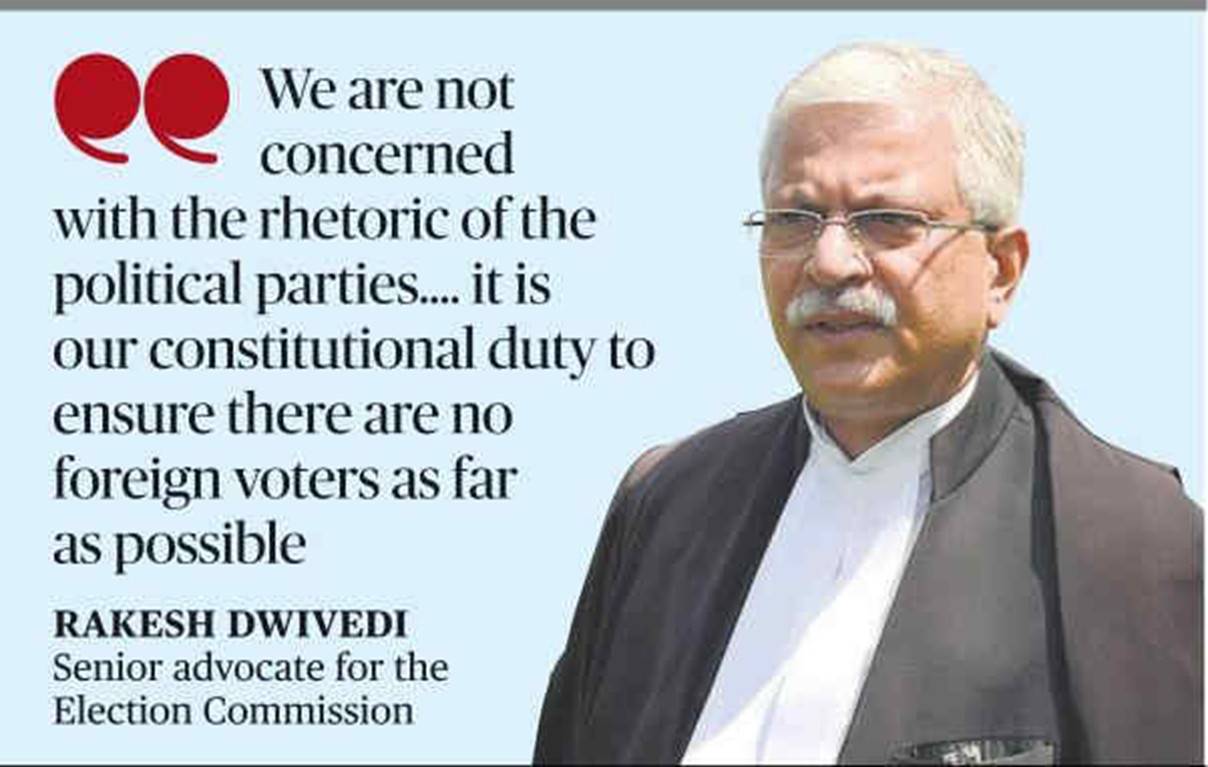
“We have a constitutional duty, and not just a constitutional power, to ensure no foreigners are there on the electoral rolls. It is not important how many foreigners are found… It was repeatedly asked of us to show how many foreigners were found in Bihar, but that is not important. Even if there was one foreigner, he had to be excluded. We are not concerned with the rhetoric of the political parties. They may be right or wrong. As the Election Commission, it is our constitutional duty to ensure there are no foreign voters as far as possible,” senior advocate Rakesh Dwivedi, appearing for the EC, clarified before a Bench headed by Chief Justice of India Surya Kant.
Faulty comparison
Mr. Dwivedi said the comparison of the SIR with the NRC was devoid of truth. The EC differentiated between the NRC conducted in Assam and the “special revision” of electoral rolls underway in the State.
“The NRC register includes all the people, all citizens, whereas, in electoral rolls it is citizens who are above 18 years of age. Less than that they are not in the electoral roll. A person of unsound mind is excluded from the electoral roll, but is part of the NRC. Preparation of the electoral roll is not a parallel NRC on the face of it,” Mr. Dwivedi contended.
The senior counsel argued that it was for the Centre to issue a ‘national identity card’ and maintain a ‘National Register of Indian Citizens’ and, for that purpose, establish a National Registration Authority under Section 14A of the Citizenship Act, 1955. On the other hand, the EC drew its power to verify citizenship for the “preparation of the electoral rolls” under Article 324 of the Constitution. Mr. Dwivedi said the Constitution was “citizen-centric”, which meant ‘citizenship’ was a central theme.
“All the important functionaries of the three organs of governance have to be citizens of India, be it the President, Vice-President, MPs, MLAs, or judges of the constitutional courts. One of the conditions is that they be citizens… No person is eligible to participate in the electoral process unless he is a citizen,” Mr. Dwivedi said.
Citizenship status
He noted how citizenship had played a prime part in the struggle for nationhood. The Government of India Act, 1935, had allowed a separate electorate for Europeans, leading to an objection raised in the Constituent Assembly.
“From the aforesaid, it is evident that from its inception, the Constituent Assembly intended that authorities responsible for preparation of electoral rolls would enquire into citizenship and exclude those who were not citizens from the electoral rolls of constituencies. Later, the EC was vested with plenary powers with respect to superintendence, direction, and control over all elections, as well as the power to verify the status of citizenship under Article 324 read with Article 326 (adult suffrage),” Mr. Dwivedi submitted for the poll body.
Even the power of Parliament under Article 327 to frame election laws was “subject to provisions of the Constitution”, Mr. Dwivedi said, adding that this means that “the legislative powers of Parliament envisaged under Article 327 are subject to Articles 324 and 326.”
Citizenship Act
Addressing the petitioners’ submission that citizenship was exclusively the domain of the Union government, the EC counsel pointed to Section 9(2) of the Citizenship Act. “The Central government has exclusive jurisdiction only with termination of citizenship on account of voluntary acquisition of foreign citizenship under this provision,” Mr. Dwivedi submitted.
During the WAVES Summit in Mumbai, Prime Minister Narendra Modi underlined India's developing position in the global creative economic sector. During his opening address, India earned the description of an "orange economy" because cultural and creative sectors drive both financial growth and job creation. Rajnikanth and Mukesh Ambani joined

The Mahahtra government achieved a historical milestone by returning to India the historic sword of Raghuji Bhosale I during a Sotheby’s auction in London, which belonged to a notable 18th-century Maratha ruler. The state of Mahahtra achieves its first success in acquiring historical artifacts from international auctions. The bidding


Stay updated with The Hindu Editorial Vocab24 app, your definitive source for breaking news and comprehensive coverage from India and around the globe. Whether it's political developments, business updates, sports highlights, the latest technology trends, or current events, The Hindu brings live, accurate, and reliable news directly to your device.
Don’t fall for sensationalized or fake news shared online. Read and share accurate updates with friends and family through The Hindu Editorial Vocab24 app. Download it today!
News Coverage in The Hindu Editorial Vocab24 App
Breaking News: Receive instant notifications on breaking news stories as they unfold. Stay informed about major events and developments in India and around the world with live blogs, news in shorts videos, and concise articles.
Politics: Get the latest updates on Indian politics, including elections, policy changes, government decisions, and political events that shape the nation.
Business and Economy: Stay ahead in the economic landscape with detailed business news and market analysis. Learn about stock market trends, financial reports, corporate news, and economic developments to make informed investment decisions.
Current Events: Follow stories on social issues, policy changes, global events, and daily current affairs, tailored for UPSC and other competitive exam preparations.
Technology: Keep up with the latest gadgets, innovations, and tech trends. Read expert reviews and analyses in short, concise updates on cutting-edge technology from India and beyond.
Sports: Never miss a moment of your favorite sports. Get live scores, match reports, and expert analysis on cricket, football, tennis, and more.
International News: Stay informed about global events and geopolitical developments, including the Russia-Ukraine war, Israel-Palestine conflict, and other key international stories.
Local News: Stay connected to your community with the latest updates on city events, issues, and local news. Coverage includes hyperlocal updates from cities like Bangalore, Chennai, Delhi, Hyderabad, Mumbai, Kolkata, and more.
Trending Topics: Discover what's trending today with the most talked-about stories and hot topics across India and the world.
Experience journalism that values integrity, accuracy, and reliability. Download The Hindu Editorial Vocab24 app today and stay connected with the world.
Subscribe to our newsletter!