

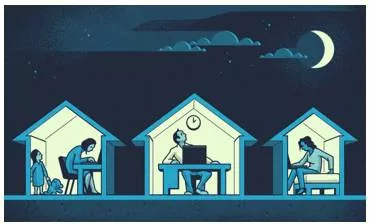
Working from home has entrenched inequality – how can we use it to improve lives instead
It was Omicron that did it. Up until early December, office workers in England seemed to be steadily returning to their desks. But once the new variant had arrived, a change that had been taking shape since the Covid crisis started suddenly felt irresistible. Back-to-the-office schedules were binned, more companies announced long-term plans for so-called hybrid employment split between homes and workplaces, and there it was: a quiet revolution, whose consequences will unfold over the next year and beyond.Home and hybrid working has been embraced by a long list of tech companies that includes Facebook, Google, Microsoft, Spotify and dozens more. Something similar seems to be happening in the financial sector. In the UK, 18m sq ft of office space has been vacated since the start of the pandemic. In the past year, in such places as Derby, Southampton and the London borough of Brent around 20% of offices have been taken out of use, and there are projections that between now and 2027, one in 10 British offices will no longer be needed.
For all the government’s wishful thinking about a looming return to pre-Covid normality, this looks like deep, era-defining change. Talk to people in trade unions, and you get a sense of a new frontier that demands urgent and careful attention. At the union Unite, for example, they are working on a detailed template for home working agreements, designed to minimise the risk of isolation, “stress and depression” and “health and safety risks from working in an unsuitable environment”. So far, though, any political debate about what is happening has reduced everything to yet another instalment of the culture wars. The right seems to see any move away from the traditional workplace as a mortal threat to both the economy and our moral wellbeing, while more liberal voices glimpse something almost utopian: liberation from the daily commute, increased productivity, more family time. What both sides tend to ignore are massive issues about inequality, what work actually involves, and the way that big companies too often try to offload responsibility and risk on to fragile individuals.
For a start, only a minority of us are actually able to work from home (WFH). In April 2020, the Office for National Statistics put the figure at 46%, although the number varied wildly across the UK: 57% of Londoners said they were able to do at least some work at home, whereas the figure in the West Midlands was 35%. In that context, even if home working ushers some of those who do it into an idyll of autonomy and holistic living, it threatens to make the class divisions that the pandemic widened both permanent and huge.
Other questions centre on the people who now do at least some of their work not far from where they sleep. If you live alone, WFH may well represent both a degree of freedom and a snatching-away of human interaction. For young people at the start of their working lives, not being in an office will probably entail two kinds of disadvantage: being cut adrift from the collective workplace experiences that allow people to find their professional feet, and not having the domestic space to do your job effectively. There is, needless to say, clear evidence of how traditional gender roles affect home working: in American research done by the management consultants McKinsey, 79% of men said they experienced “positive work effectiveness” at home, compared with only 37% of women. Whoever you are, moreover, there is a good chance that WFH will have increased your hours: research during the first global lockdown found that for 3 million remote workers around the world, the average working day had increased by 8.2%, or nearly 50 minutes.
The American writers Charlie Warzel and Anne Helen Petersen recently published Out of Office, an exhaustive but very readable book about the upsides and drawbacks of working from home. Its central contention, partly based on their experience of leaving behind office jobs in New York and attempting a new life in Montana, is that working remotely can “remove you from the wheel of constant productivity”, as well as turning you into “a better friend and partner”. The big problem, as they see it, is that far too many employers have quickly built a model of home working on workplace cultures that emphasise long hours, the kind of camaraderie that quickly turns painful, and close monitoring of what people do. They cite the comedian Kevin Farzad’s observation that “if an employer ever says, ‘we’re like family here’ what they mean is they’re going to ruin you psychologically”. Allow those attitudes into people’s domestic environment, and you risk “the total collapse of work-life balance”.
To understand that point, forget any visions of high-powered people flitting between the city and country and hosting Zoom meetings in their summerhouses. Instead, think about call-centre work, which was being pushed into people’s homes long before the pandemic. Here, you see not just the connections to be drawn between home working and bogus self-employment, but a new world of remote worker surveillance. In March last year, the Guardian reported on the multinational call centre company Teleperformance, and software built around webcams in home-workers’ laptops. “If the system detects no keyboard stroke and mouse click, it will show you as idle for that particular duration, and it will be reported to your supervisor,” said one set of instructions.
“If you don’t talk about power in the workplace, you’re not going to get this right,” says Andrew Pakes, a deputy general secretary of the white-collar union Prospect. From this basic point, everything follows. We fixate on home working, when we really should begin with flexibility: irrespective of where they work, the chance for people to start and finish at times of their choosing, carve out free time and ensure holidays complement the other aspects of their lives. Companies ought to pay much more attention to the needs of new recruits – pairing them with dedicated mentors, ensuring they have the option of spending all or most of their working hours in a workplace, allowing them to join a trade union. For all employees, there ought to be both an entitlement to collective representation, and the kind of right to disconnect – to not have to deal with emails, calls and messages outside working hours – that has been adopted in France, Italy and Spain, and is now tentatively supported – for public sector staff at least – by the SNP-led government in Edinburgh.
Somewhere in all that might be the beginnings of home and hybrid working that could actually improve people’s lives. The danger of the weary, punch-drunk mood of early 2022 is that indifference and fatalism will set in, and we will end up sleepwalking into a post-pandemic reality that no one wants. Amid grief, disruption and huge changes to our everyday experiences, the future has arrived: not just of work, but all the other aspects of life that it touches. When do we start doing something about it?












Stay updated with The Hindu Editorial Vocab24 app, your definitive source for breaking news and comprehensive coverage from India and around the globe. Whether it's political developments, business updates, sports highlights, the latest technology trends, or current events, The Hindu brings live, accurate, and reliable news directly to your device.
Don’t fall for sensationalized or fake news shared online. Read and share accurate updates with friends and family through The Hindu Editorial Vocab24 app. Download it today!
News Coverage in The Hindu Editorial Vocab24 App
Breaking News: Receive instant notifications on breaking news stories as they unfold. Stay informed about major events and developments in India and around the world with live blogs, news in shorts videos, and concise articles.
Politics: Get the latest updates on Indian politics, including elections, policy changes, government decisions, and political events that shape the nation.
Business and Economy: Stay ahead in the economic landscape with detailed business news and market analysis. Learn about stock market trends, financial reports, corporate news, and economic developments to make informed investment decisions.
Current Events: Follow stories on social issues, policy changes, global events, and daily current affairs, tailored for UPSC and other competitive exam preparations.
Technology: Keep up with the latest gadgets, innovations, and tech trends. Read expert reviews and analyses in short, concise updates on cutting-edge technology from India and beyond.
Sports: Never miss a moment of your favorite sports. Get live scores, match reports, and expert analysis on cricket, football, tennis, and more.
International News: Stay informed about global events and geopolitical developments, including the Russia-Ukraine war, Israel-Palestine conflict, and other key international stories.
Local News: Stay connected to your community with the latest updates on city events, issues, and local news. Coverage includes hyperlocal updates from cities like Bangalore, Chennai, Delhi, Hyderabad, Mumbai, Kolkata, and more.
Trending Topics: Discover what's trending today with the most talked-about stories and hot topics across India and the world.
Experience journalism that values integrity, accuracy, and reliability. Download The Hindu Editorial Vocab24 app today and stay connected with the world.
Subscribe to our newsletter!







