

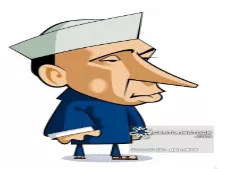
Why nehru matters more than ever
An otherwise ordinary ‘first’ speech given by India’s fourteenth President, Ram Nath Kovind, would have gone unremarked, except for one notable omission (someone or something that has been left out or excluded). The name of Pandit Jawaharlal Nehru, arguably the foremost leader of the freedom struggle, and India’s first Prime Minister, was spectacularly missing from the inventory of prominent Indians listed by the President. Though the government under Prime Minister Narendra Modi has gone to extraordinary lengths to eliminate references to the architect of democratic India, we expect the head of state to stand above partisan party politics. There is cause for disappointment. A few days after Mr. Kovind’s speech, the Bharatiya Janata Party (BJP) published a largish booklet to celebrate the birth centenary of Deen Dayal Upadhyaya. In the section on great leaders of India, ‘Mahapurush’, the names of Nehru as well as Mahatma Gandhi are conspicuous (clearly visible) by their absence. Almost 10 lakh senior school students in Uttar Pradesh are forced to study the booklet, appear for an exam, and be rewarded if they perform well. Many of the ‘great men’ listed in the booklet have never taken part in the freedom struggle, and never been jailed for combating colonialism, unlike Nehru and the Mahatma. But their names occupy pride of place in oral and written histories authored by the BJP. Leaders who fought for Independence are simply written off. The historical perspective The belittling (disparage someone) of Pandit Nehru is odd, because the standing of the current Prime Minister is not validated by writing out a previous Prime Minister from the annals (a record of events year by year) of history. The future will judge both leaders on their own merit, their success or their failure in managing a complex and plural society, their credentials as democrats, and their political, economic, and strategic visions. Both have a place in modern India. What that place is, will be decided by history. The current dispensation should take the art of history writing seriously and not reduce it to pamphleteering (write and issue political pamphlets). History is important for collective self-understanding, because it enables us to understand where we have come from, and how we got from ‘there’ to ‘here’. Without competent histories that allow us to understand our collective past and present, and help us generate visions for the future, entire generations will lose their bearings. What the philosopher Jürgen Habermas calls the ‘public use of history’ should be, for this reason, subjected to strong evaluations. Since the craft has a bearing on the human condition, we ought to distinguish between histories that inspire a democratic, critical sensibility to contain and challenge authoritarianism, from those that feed appetites for absolute power. History, of course, must narrate tales of tyrants (a cruel and oppressive ruler) and despots (a ruler or other person who holds absolute power), so that we take care not to repeat the errors of the past. But it must also chronicle (record (a series of events) in a factual and detailed way) tales of the triumph of the human spirit, and inspire us to struggle against totalitarianism and suppression of individual freedom. For the ruling class, history should be important, because it reminds them that absolute power, often won at the expense of human freedom, does not endure. Unexpected moments arise in the life of a society when its members clamour for change, when existing gods are brought down, and new ones erected in their place, condemned to wait for their own downfall. All of us should be wary of changing tides of fortune. Fortune, wrote the 16th century political theorist of Florence, Niccolò Machiavelli, is unpredictable and inexplicable. She is an active sharer in man’s making of history, she produces the unforeseen, and she will never be dominated, but will dominate men. That is why Machiavelli advised the Prince of Florence to study history. The public role of history is to remind rulers that fortune is fickle (changing frequently) . After all, Nehru, who once led India to freedom, is vilified in his own country by the benighted (in a state of pitiful or contemptible intellectual or moral ignorance.) cyberspace industry. This is short-sighted, because to unremember the man is to forget that there is an alternative to narrow and energy-consuming nationalism. Despite all attempts, Nehru continues to be remembered by many for his contribution to the institutionalisation of democracy, establishing institutions of excellence, and his conviction that poverty and inequality in India cannot be tackled by the market. There is, however, more to a good society: solidarity with struggling people within and outside the country. Nehru, as one of the most distinguished leaders of Third World solidarity, reached out to the rest of the colonised world, and forged a joint front against colonialism and a reinvented imperialism. He was, by temperament and experience, a cosmopolitan. His frequent visits to Europe, his deep familiarity with the past, and his understanding of the contemporary ideologies of the day, from liberalism to Fabian socialism, to communist internationalism, had convinced him that the future of India was incomplete without the liberation of other colonies. Role of intellectual journeys Nehru’s commitment to the independence of the Third World had been shaped by intellectual journeys through history, as well as participation in a number of international conferences such as the Congress of Oppressed Nationalities in Brussels in 1927. He played a prominent role in the 1955 Bandung Conference, which set the stage for the emergence of a new bloc, and a new ideology in global affairs. Representatives of 29 countries from the global South, comprising well over a billion people, met to consider and debate on how they could help each other to neutralise the harmful effects of colonialism, and bring economic and social well-being to their people. Towering over leaders who had won their political spurs by piloting their countries to independence were Nehru, Kwame Nkrumah, the Prime Minister of Ghana, Gamal Abdel Nasser, the President of Egypt, Zhou Enlai, the Premier of China, and Ho Chi Minh, the Prime Minister of Vietnam. The agenda included every topic over which the colonised and the newly decolonised world had agonised for decades — religion, colonialism, sovereignty, and world peace. The Bandung meeting sparked off (to bring into being or action) reflections on the distinct attractions of non-alignment, and of the strengths that a movement of the non-aligned could acquire in global forums. A deep cosmopolitanism Interestingly, if one strand of anti-colonial nationalism focussed on the idea and the imaginaries of the nation, the second moved away from processes of closed identity formation towards other ways of being in the world. Nehru’s cosmopolitanism acknowledged that our political identities are forged in and through conversations not only with people who are like us, but people who belong to other cultures, other countries, other societies, and other traditions, but who are like us in many ways. Contemporary history has not treated this statesman kindly. This is a great pity because today’s generation might know what globalisation is, but not what cosmopolitanism is about. Even as our society globalises at a frenetic (fast and energetic) pace, it has turned inwards and become claustrophobic. History must remember Nehru, he taught us to look outwards, to express solidarity, and to become, in the process, cosmopolitans. We must remember him because we have lost out on something that is rather important, teaching our children that our imaginations and our energies should be harnessed to the cause of the oppressed over the world, that closed-in societies lead to stagnation if not to certain death, and that such societies circumscribe imaginings and truncate (shorten (something) visions. We have, perhaps, become lesser human beings.Omission (noun)
(Someone or something that has been left out or excluded) चूक/छोड़ देना
Synonyms: Exclusion, Lacuna, Hiatus, Oversight
Example: Since Jose was such a great soccer player, his omission from the team made him disappointed.
Annals (noun)
(A record of events year by year) वर्ष वृतान्त/ वर्षक्रमिक इतिहास
Synonyms: Records, Archives, Chronicles, Accounts, Journals
Example: During a tax investigation, the company was instructed to hand over their annals.
Tyrant (noun)
(A cruel and oppressive ruler) निरंकुश शासक
Synonyms: Dictator, Autocrat, Absolute Ruler, Authoritarian, Oppressor
Example: A majority of the country’s people have decided to rise up against the tyrant who kills anyone he views as a threat to his power.
Chronicle (verb)
(Record (a series of events) in a factual and detailed way) लिपिबद्ध करना
Synonyms: Record, Write Down, Set Down, Document, Register, Report
Example: When the detective read the chronicle of the attack, he knew how and when the victim died.
Belittle (verb)
(Disparage someone/ dismiss (someone or something) as unimportant.) महत्व घटाना/अनादर करना
Synonyms: Disparage, Depreciate, Downgrade, Treat Lightly, Undervalue, Underrate
Example: Since the Internet creates a feeling of anonymity, many people belittle others online because they do not fear any consequences.
Benighted (adjective)
(In a state of pitiful or contemptible intellectual or moral ignorance.) अनाड़ी/मूर्ख
Synonyms: Ignorant, Unenlightened, Uneducated, Unschooled, Untutored, Illiterate, Unlettered, Unlearned, Unscholarly
Example: In today’s world, high school dropouts are seen as benighted individuals fit only for menial jobs.
Spark off (Phrasal verb)
(To bring into being or action) शुरू करना
Synonyms: Start, Initiate, Activate, Institute, Break The Ice
Example: The argument between the groups sparked off a fight.
Frenetic (adjective)
(Fast and energetic in a rather wild and uncontrolled way) अतिउत्तेजित
Synonyms: Frantic, Wild, Frenzied, Energetic, Intense
Example: After the concert, the frenetic crowd surged through the exit doors and began to dance in the street.
Despot (noun)
(A ruler or other person who holds absolute power) तानाशाह
Synonyms: Tyrant, Dictator, Absolute Ruler, Totalitarian, Authoritarian, Autocrat, Oppressor. Antonyms: Democrat
Example: When a kind leader replaced the despot, he brought about peace in a once troubled nation.
Truncate (verb)
(Shorten (something) काट कर छोटा करना
Synonyms: Shorten, Cut, Cut short, Curtail, Trim, Lop, Abbreviate
Example: Jill had to truncate her presentation so it would not exceed five minutes.








Stay updated with The Hindu Editorial Vocab24 app, your definitive source for breaking news and comprehensive coverage from India and around the globe. Whether it's political developments, business updates, sports highlights, the latest technology trends, or current events, The Hindu brings live, accurate, and reliable news directly to your device.
Don’t fall for sensationalized or fake news shared online. Read and share accurate updates with friends and family through The Hindu Editorial Vocab24 app. Download it today!
News Coverage in The Hindu Editorial Vocab24 App
Breaking News: Receive instant notifications on breaking news stories as they unfold. Stay informed about major events and developments in India and around the world with live blogs, news in shorts videos, and concise articles.
Politics: Get the latest updates on Indian politics, including elections, policy changes, government decisions, and political events that shape the nation.
Business and Economy: Stay ahead in the economic landscape with detailed business news and market analysis. Learn about stock market trends, financial reports, corporate news, and economic developments to make informed investment decisions.
Current Events: Follow stories on social issues, policy changes, global events, and daily current affairs, tailored for UPSC and other competitive exam preparations.
Technology: Keep up with the latest gadgets, innovations, and tech trends. Read expert reviews and analyses in short, concise updates on cutting-edge technology from India and beyond.
Sports: Never miss a moment of your favorite sports. Get live scores, match reports, and expert analysis on cricket, football, tennis, and more.
International News: Stay informed about global events and geopolitical developments, including the Russia-Ukraine war, Israel-Palestine conflict, and other key international stories.
Local News: Stay connected to your community with the latest updates on city events, issues, and local news. Coverage includes hyperlocal updates from cities like Bangalore, Chennai, Delhi, Hyderabad, Mumbai, Kolkata, and more.
Trending Topics: Discover what's trending today with the most talked-about stories and hot topics across India and the world.
Experience journalism that values integrity, accuracy, and reliability. Download The Hindu Editorial Vocab24 app today and stay connected with the world.
Subscribe to our newsletter!







