

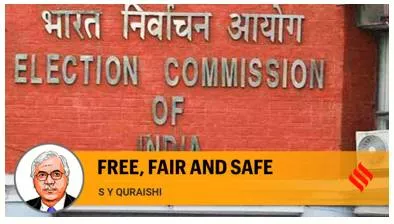
Why ec can’t delay upcoming polls
Ever since the Allahabad High Court urged the Election Commission of India to consider banning all political rallies or postponing the upcoming Assembly elections due to the increasing threat of Omicron, the focus of debate has shifted to the EC. Whether it is the EC’s meeting with the health secretary, or the EC visiting the states, these have become the topic of debate rather than the political rallies, with lakhs of people openly flouting Covid guidelines. And not a word of advice or precautionary measure from the leaders.While the debate is raging on what the EC should do, election rallies of all political parties are in full swing, especially in UP. Home Minister Amit Shah led a massive roadshow in Hardoi on December 28, Samajwadi Party chief Akhilesh Yadav addressed a huge rally in Unnao on the same day, and the Congress conducted a women’s march in Lucknow and Jhansi. At none of these events were Covid regulations followed. With less than 30 per cent of UP’s population vaccinated, these rallies are a major threat to people’s health.
The Omicron variant has been spreading rapidly across the globe in the last few months. Many countries like the Netherlands and Austria have declared full lockdowns to stop the spread of the new variant. Germany has mobilised its armed forces to buttress the health infrastructure to stop the spread. There is a worldwide debate going on about the possible health problems that the Omicron variant could cause. In India, the numbers are doubling or trebling every day in several parts of the country. In this situation, the massive rallies organised by political parties in India could spell nothing but disaster.
The Assembly elections of five states are due in the early months of 2022, four of these in March itself — Goa (by March 15), Manipur (March 19), Uttarakhand (March 23) and Punjab (March 27). The fifth — UP — is due by May 14. As per practice, the EC clubs all elections that are so close to each other to ensure that the results in one state do not influence the voters in the state going to the polls soon after. The earliest due date of a state determines the poll dates for all the clubbed states. The EC cannot delay an election even by a day, although it can advance it by up to six months. Goa being the earliest, we must have all five elections completed before March 15 — preferably by March 10 to keep a safety margin.
Since the UP elections are expected to be spread over at least a month in 6-7 phases, the polls must begin by February 10. The law requires a poll process of 26 days, which means the notification of the first phase/poll must be issued by January 15. Before the notification, the EC has a maximum of 21 days at its discretion. This means the election could, or rather should, have been announced on December 25 or soon thereafter. An immediate announcement is imperative as political parties have made it clear that they will not stop the election rallies unless and until the EC orders them.
It is strange that people are talking about banning rallies and postponing elections in the same breath. Banning rallies is an executive order of the EC, the simplest thing to do once an election is announced. Postponing elections is not in their hands at all, and would be a violation of the constitutional mandate that gives every Vidhan Sabha a fixed term. As soon as the term is over, the House stands dissolved automatically. The term of the House cannot be extended except in an emergency declared by Parliament, which the Constitution restricts to only two situations — war and breakdown of law and order. In the seven decades of our electoral history, this has happened only three times — in Assam, Punjab and Jammu and Kashmir — in insurgency situations.
Before the Bihar elections of 2020, the EC had issued detailed guidelines to ensure smooth conduct of polls in the thick of the pandemic, based on its observation of other countries that conducted elections that year, like South Korea and Sri Lanka. These guidelines included the reduction of the number of electors per polling booth from 1,500 to 1,000, to prevent over-crowding, which required the addition of 33,797 auxiliary polling stations, and Covid-sensitive capacity-building of election officials. The ECI also extended the postal ballot option to senior citizens over the age of 80, Covid-positive patients, persons with disabilities and voters in essential services. Virtual campaigning was also encouraged to stop election rallies contributing to Covid. Besides the standard social distancing and sanitising norms, voters were provided with gloves to touch the EVMs. To avoid crowding at the counting centres, the counting tables were reduced from 14 to seven per assembly constituency.
The aftermath of the Bengal elections saw a sharp rise in Covid infections. The EC had banned roadshows and rallies of more than 500 people only after six phases were over and just two were left. Till today, people blame this fatal delay for the spread of Covid in West Bengal.
Many people confuse this poor implementation with the guidelines themselves. In my opinion, the guidelines are perfect and among the best in the world. The focus should have been on strict enforcement, which is where the Commission faltered, waiting for the top leaders to finish their preplanned rallies.
This election is an opportunity for the EC to redeem its image. More importantly, it must guard itself against the trap of postponing the polls under any persuasion.












Stay updated with The Hindu Editorial Vocab24 app, your definitive source for breaking news and comprehensive coverage from India and around the globe. Whether it's political developments, business updates, sports highlights, the latest technology trends, or current events, The Hindu brings live, accurate, and reliable news directly to your device.
Don’t fall for sensationalized or fake news shared online. Read and share accurate updates with friends and family through The Hindu Editorial Vocab24 app. Download it today!
News Coverage in The Hindu Editorial Vocab24 App
Breaking News: Receive instant notifications on breaking news stories as they unfold. Stay informed about major events and developments in India and around the world with live blogs, news in shorts videos, and concise articles.
Politics: Get the latest updates on Indian politics, including elections, policy changes, government decisions, and political events that shape the nation.
Business and Economy: Stay ahead in the economic landscape with detailed business news and market analysis. Learn about stock market trends, financial reports, corporate news, and economic developments to make informed investment decisions.
Current Events: Follow stories on social issues, policy changes, global events, and daily current affairs, tailored for UPSC and other competitive exam preparations.
Technology: Keep up with the latest gadgets, innovations, and tech trends. Read expert reviews and analyses in short, concise updates on cutting-edge technology from India and beyond.
Sports: Never miss a moment of your favorite sports. Get live scores, match reports, and expert analysis on cricket, football, tennis, and more.
International News: Stay informed about global events and geopolitical developments, including the Russia-Ukraine war, Israel-Palestine conflict, and other key international stories.
Local News: Stay connected to your community with the latest updates on city events, issues, and local news. Coverage includes hyperlocal updates from cities like Bangalore, Chennai, Delhi, Hyderabad, Mumbai, Kolkata, and more.
Trending Topics: Discover what's trending today with the most talked-about stories and hot topics across India and the world.
Experience journalism that values integrity, accuracy, and reliability. Download The Hindu Editorial Vocab24 app today and stay connected with the world.
Subscribe to our newsletter!







