

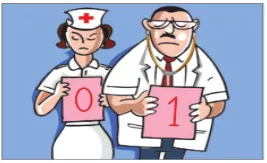
Why doctors need humanities
Including it in medical education is the best way to bring back humanism to the profession. Medicine is defined as the art and science of healing. Today globally, science has largely overridden (लंघन करना/आगे चले जाना) the art part of healing. In India, entrance to medical schools is based entirely on tests based on scientific facts and concepts with a little of logical critical thinking ¬ areas handled by the left side of the brain. Our medical curriculum requires hours of drudgery (अरुचिकर व कठिन कार्य) in trying to remember facts and figures. Almost no medical school in India lays any emphasis on art in medical curriculum. The right side of the brain is concerned with fine arts including imagery, poetry and drawing. As someone said “medical school attracts those who are of left brain, but then proceeds to atrophy (क्षीण होना/अपक्षय होना) what is left of their right brain”. Unlike physics or chemistry, medicine is not a pure science. Medicine is largely an applied science and it requires certain skills that are developed by observation, practice and experience ¬ similar to the arts more than science. It can be said that medicine is science when it is used to study disease but becomes an art when it is used to practice healing. While medicine has a long and distinguished history of caring and comforting, the scientific basis of medicine is recent. That medicine is a science is nevertheless the popular belief, and this has been reinforced by the advent (आगमन) of `evidence-based medicine'. Scientific truths are not true for all times, unlike truths in the field of the arts. In art there is no right or wrong but only a perspective or a point of view, whereas in medicine one being right or wrong is life determining. Ideas on causation, diagnosis and management of diseases change with passage of time and advent of new technology or understanding. Even in a given time, one medical practitioner may have a genuinely different opinion of diagnosis and treatment about a particular case with respect to another colleague based on his or her experience and expertise. With progress of science and its application, there has been a rapid decline in the human element of health care provision. The current technological advances have worsened this divide. The art of clinical medicine is dying in the present set-up with high-tech gadgets. The recent upsurge (चढ़ाव/वृद्धि) of doctors being abused and manhandled especially in casualties (हताहत) and emergencies is a consequence of this. This is occurring not because of their lack of scientific knowledge but is related to their insensitive behaviour which emanates (उत्पन्न होना/निर्गत होना) from their ignorance as well as inability to handle the emotional distress of sick individuals and their near and dear ones. Doctors should not allow scientific medicine to blunt their humanity, ignore ethics and the need for empathy (समवेदना/हमदर्दी) . A typical consultation today is of less than ten minutes and consists of a few cursory (सरसरी) questions followed by a long list of investigations and medicines to be taken with poor explanation of whys and hows. Genuine doctor-patient relationships do not exist any longer. In early seventies, when the Framingham Heart study in United States subjects were being recruited through their doctors, most of them opined that while their own physician was a good one, others were no good ¬ clearly an impossible phenomenon! Today in India even that is unlikely. Doctor-patient trust is at its lowest and doctor shopping is blatantly practised. All doctor-patient interactions, whether these are in a hospital or in the community, require a caring attitude from the doctor coupled with communication. Today science has given doctors far more ammunition (अस्र-शस्र) (here the term is used metaphorically) than ever before to fight disease, but the repeated bombarding has made them deafer than ever and they can no longer hear the cries of their patients. A good clinician is one who is armed with scientific knowledge, practices using clinical judgment, compassion and understanding. In India, we need to reverse the pendulum that has swung fully to the science from the art side in medicine. An infusion of arts in medical education might be the solution to this all pervasive deafness of medical professionals. Many medical educationists have argued that art and literature should have a place in the medical curriculum because art helps doctors to understand experiences, illness and human values and that art itself can fulfill a therapeutic role. This kind of education can help doctors grapple with the kinds of existential questions that they expect their patients to answer and that they themselves may not be equipped to answer. All medical colleges usually have a cinema and literary club. They do little to promote either cinema or literature. There is a need to go beyond these tokenisms (Tokenism is the practice of making only a perfunctory or symbolic effort to be inclusive to members of minority groups, especially by recruiting a small number of people from underrepresented groups in order to give the appearance of racial or sexual equality within a workforce.) and aim for some structural changes in medical education in India. It is time the Medical Council of India or its newer avatar considers inclusion of arts in the medical curriculum from first year itself. The importance of humanities in medical education is being realised across the globe and steps are being taken to introduce it in medical schools. India should not be left behind. Today patients in India are being squeezed between incompetence on one side (thanks to a floundering (struggle or stagger clumsily) medical education industry) and corruption on the other (thanks to a commission culture set up by drug and investigative industry); and from the top by arrogance of medical professionals. Instilling empathy among medical practitioners may be the best way to start addressing all these malpractices jointly.Override (verb)
To prevail over/ to extend or pass over. लंघन करना/आगे चले जाना
Synonyms: Move Over, Pass Over, Transcend, Surpass, Set Aside
Example: Don't let your anger override common sense.
Drudgery (noun)
Hard menial or dull work/ exhausting work. अरुचिकर व कठिन कार्य
Synonyms: Menial Work, Donkey Work, Labor Work, Plodding
Example: To me, my summer job at a fast food restaurant was sheer drudgery.
Atrophy (verb)
Gradually decline in effectiveness or vigour due to underuse or neglect. क्षीण होना/अपक्षय होना
Synonyms: Dwindle, Deteriorate, Decline, Wane, Fade, Wither, Shrivel
Example: According to researchers, the lack of exercise causes muscles to atrophy and become feeble.
Advent (noun)
The arrival of a notable person or thing. आगमन
Synonyms: Arrival, Appearance, Emergence, Occurrence, Dawn, Origin, Rise
Example: With the advent of the Internet the technology has changed a lot.
Upsurge (noun)
An upward surge in the strength or quantity of something; an increase. चढ़ाव/वृद्धि
Synonyms: Boom, Improvement, Upswing, Upturn, Increase, Rise
Example: An upsurge in the violent crime in the city makes it less safe for the people.
Casualties (noun)
Loss in numerical strength through any cause, as death, wounds, sickness, capture, or desertion. जनहानि/हताहतों की संख्या
Synonyms: Fatality, Mortality, Dead and injured/wounded, missing in action
Example: The devastating earthquake causes several casualties in the city.
Empathy (noun)
The ability to understand and share the feelings of another. समवेदना/हमदर्दी
Synonyms: Affinity, Compassion, Sympathy
Example: Bart has a hard time forming healthy relationships because he lacks empathy for others.
Cursory (adjective)
Hasty and therefore not thorough or detailed. सरसरी
Synonyms: Perfunctory, Casual, Superficial, Inattentive
Example: After a cursory examination of the artifacts, the archaeologist realized that he had probably stumbled on the find of the century.
Ammunition (noun)
Weapons./ tools, weapons or instruments of a profession. अस्र-शस्र
Synonyms: Armament, Weapon, Ordnance, Cartridge
Example: The gunman arrested by police was apparently carrying enough ammunition to kill hundreds of people.
Emanate (verb)
Originate from; be produced by/ to come out from a source. उत्पन्न होना/निर्गत होना
Synonyms: Arise, Derive, Emerge, Emit, Originate
Example: If you rub the magical lamp, a genie will emanate from the bottle.
Flounder (verb)
Struggle or stagger clumsily जूझना
Synonyms: Struggle, Battle, Conflict, Grapple, Fight
Example: After it hit the iceberg, the Titanic was left to flounder in the Atlantic Ocean before it finally sank.
The hindu bilateral ties
Apr 11, 2017





Stay updated with The Hindu Editorial Vocab24 app, your definitive source for breaking news and comprehensive coverage from India and around the globe. Whether it's political developments, business updates, sports highlights, the latest technology trends, or current events, The Hindu brings live, accurate, and reliable news directly to your device.
Don’t fall for sensationalized or fake news shared online. Read and share accurate updates with friends and family through The Hindu Editorial Vocab24 app. Download it today!
News Coverage in The Hindu Editorial Vocab24 App
Breaking News: Receive instant notifications on breaking news stories as they unfold. Stay informed about major events and developments in India and around the world with live blogs, news in shorts videos, and concise articles.
Politics: Get the latest updates on Indian politics, including elections, policy changes, government decisions, and political events that shape the nation.
Business and Economy: Stay ahead in the economic landscape with detailed business news and market analysis. Learn about stock market trends, financial reports, corporate news, and economic developments to make informed investment decisions.
Current Events: Follow stories on social issues, policy changes, global events, and daily current affairs, tailored for UPSC and other competitive exam preparations.
Technology: Keep up with the latest gadgets, innovations, and tech trends. Read expert reviews and analyses in short, concise updates on cutting-edge technology from India and beyond.
Sports: Never miss a moment of your favorite sports. Get live scores, match reports, and expert analysis on cricket, football, tennis, and more.
International News: Stay informed about global events and geopolitical developments, including the Russia-Ukraine war, Israel-Palestine conflict, and other key international stories.
Local News: Stay connected to your community with the latest updates on city events, issues, and local news. Coverage includes hyperlocal updates from cities like Bangalore, Chennai, Delhi, Hyderabad, Mumbai, Kolkata, and more.
Trending Topics: Discover what's trending today with the most talked-about stories and hot topics across India and the world.
Experience journalism that values integrity, accuracy, and reliability. Download The Hindu Editorial Vocab24 app today and stay connected with the world.
Subscribe to our newsletter!







