

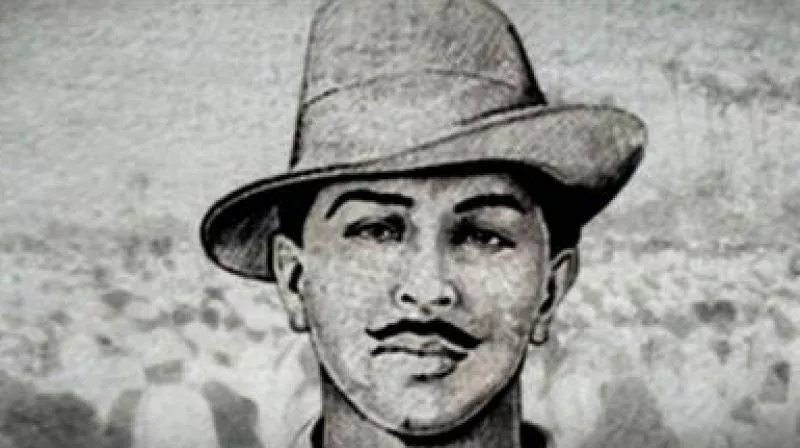
When jinnah fought for bhagat singh
Admirers and critics alike have obscured Jinnah’s stellar role in the Bhagat Singh case. One is glad of the determined efforts of Pakistan’s Bhagat Singh Memorial Foundation to raise a statue at the site in Lahore where Singh and his colleagues, Sukhdev Thapar and Shivaram Rajguru, were hanged on March 23, 1931. It also asks that Bhagat Singh should be conferred posthumously with the “Nishan-i-Haider”, his case be reopened by the Lahore High Court, and the death sentence set aside.Bhagat Singh was born in the village Banga in Lyallpur on Sept 27, 1907. The tribunal that awarded the sentence was illegally constituted, the evidence was weak, the defendants were virtually unrepresented, a mass of prejudice was created by the British, the judges were managed and so was the Privy Council. A book that reproduces the whole record from archives would be a service to truth.
Singh wanted to kill British police superintendent James Scott, who he believed ordered the baton charge on a procession in Lahore on October 30, 1928, that resulted in the death of Lala Lajpat Rai. On Dec 17, 1928, Singh, 23, shot and killed police officer John Saunders, believing him to be Scott. Successfully evading capture, he might have escaped the gallows were it not for the fact that he and Batukeshwar Dutt detonated improvised bombs in the Central Assembly on April 8, 1929. They were sentenced to transportation for life on June 12, 1929.
A month later, the Lahore conspiracy trial began before a tribunal set up by an ordinance of six months’ duration. Itself under a sentence of death, it passed a death sentence on Bhagat Singh. The Lahore High Court Bar Association set up a committee to examine the ordinance. Its report of June 19, 1930, was signed by Sir Moti Sagar, Gokal Chand Narang, Malik Barkat Ali and Allama Iqbal. Singh wrote to the IGP for jails demanding an end to torture, supply of necessities and “literature of all kinds (history, economics, political science, science, poetry, drama or fiction, newspapers)”.
The accused went on hunger strike, causing the death of Jatindra Nath Das. The government came under fierce attack in the Central Assembly, led by Jinnah. The Tribune, generally hostile to him, reported on September 14, 1929: “Mr Jinnah created a profound impression by the excellent form in which he argued the case. The government was sacrificing the fundamental principles of jurisprudence and wanted the House to change the law of the land to create a farce. As regards the Lahore accused, they were creatures of the present system. Mr Jinnah was proceeding in this strain winning applause after applause from the spell-bound House....” Jinnah had done considerable research. The issue was whether a criminal trial can proceed if the accused “has voluntarily rendered himself incapable of remaining before the court” by a hunger strike. He said, “May I ask, with whom are you at war? What are the resources of these few young men who, according to you, have committed certain offences? ... Surely this is not a matter on which there should be this struggle that you should not at once yield to their demands for bare necessities of life.”
Jinnah said, “You know perfectly well that these men are determined to die. It is not a joke. I ask the hon’ble law member to realise that it is not everybody who can go on starving himself to death. ... The man who goes on hunger-strike has a soul. He is moved by that soul and he believes in the justice of his cause; he is not an ordinary criminal who is guilty of cold-blooded, sordid, wicked crime.
“Mind you, sir, I do not approve the action of Bhagat Singh, and I say this on the floor of this House. I regret that, rightly or wrongly, youth today in India is stirred up, and you cannot, when you have three hundred and odd millions of people, prevent such crimes being committed, however much you deplore them and however much you may say that they are misguided. It is the system, this damnable system of government, which is resented by the people.”
During the trial, the government removed justice Agha Hyder from the tribunal because he did not follow their line. He said, “I am a judge, not a butcher.” Six of the seven eye-witnesses’ testimonies collapsed. The survivor, Abdullah, was a chance witness who contradicted himself. Unlike Zia, the British did not wish to hang a man on a divided verdict.
Singh’s last letter to his brother ended with Wajid Ali Shah’s famous line: “Khush raho ahle-watan hum to safar karte hain” (Farewell my countrymen, I embark on a journey).
Author : A G Noorani












Stay updated with The Hindu Editorial Vocab24 app, your definitive source for breaking news and comprehensive coverage from India and around the globe. Whether it's political developments, business updates, sports highlights, the latest technology trends, or current events, The Hindu brings live, accurate, and reliable news directly to your device.
Don’t fall for sensationalized or fake news shared online. Read and share accurate updates with friends and family through The Hindu Editorial Vocab24 app. Download it today!
News Coverage in The Hindu Editorial Vocab24 App
Breaking News: Receive instant notifications on breaking news stories as they unfold. Stay informed about major events and developments in India and around the world with live blogs, news in shorts videos, and concise articles.
Politics: Get the latest updates on Indian politics, including elections, policy changes, government decisions, and political events that shape the nation.
Business and Economy: Stay ahead in the economic landscape with detailed business news and market analysis. Learn about stock market trends, financial reports, corporate news, and economic developments to make informed investment decisions.
Current Events: Follow stories on social issues, policy changes, global events, and daily current affairs, tailored for UPSC and other competitive exam preparations.
Technology: Keep up with the latest gadgets, innovations, and tech trends. Read expert reviews and analyses in short, concise updates on cutting-edge technology from India and beyond.
Sports: Never miss a moment of your favorite sports. Get live scores, match reports, and expert analysis on cricket, football, tennis, and more.
International News: Stay informed about global events and geopolitical developments, including the Russia-Ukraine war, Israel-Palestine conflict, and other key international stories.
Local News: Stay connected to your community with the latest updates on city events, issues, and local news. Coverage includes hyperlocal updates from cities like Bangalore, Chennai, Delhi, Hyderabad, Mumbai, Kolkata, and more.
Trending Topics: Discover what's trending today with the most talked-about stories and hot topics across India and the world.
Experience journalism that values integrity, accuracy, and reliability. Download The Hindu Editorial Vocab24 app today and stay connected with the world.
Subscribe to our newsletter!







