

What the global flow of guns tells us about how states fail
There is an old adage that if you want to understand state building or state breakdown, follow the guns. In conflict zones like Afghanistan, it is all too easy to take recourse to debates over development and culture, while ignoring the dynamics of armed conflict, and the presence of weaponry that militarises society and embeds violence. Even a casual perusal of databases at Small Arms Survey, Geneva, that tracks violent conflict and the proliferation of arms, brings home some basic facts about state building and violence.In their last year of comparative data base 2018, Afghanistan has a rate of 59.8 violent deaths per 1,00,000, below other conflict zones like Syria (187.9), and El Salvador (87). But this data base is also a reminder of two other large trends. First, violence tends to be sticky. Once embedded, it is hard to dislodge. South Africa has a rate of 40.6; Brazil 36.3. Most countries with relatively lower rates are in Asia, or are European social democracies. In Asia, India has a violent death rate of 3.9 per 1,00,000; Pakistan is at 5.9 while big countries like Indonesia, China and Japan are lower than 1. This contrast between Asia and the Americas on this aspect of state building and prevalence of violent death is striking, and rarely made as central to the development literature as poverty.
Violence has complicated causes; even settled societies can have violent political convulsions. There are also forms of violence other than violent death. The relationship between the presence of firearms and violence is also complicated. But again what is striking is the lower prevalence of civilian firearms in Asia. This data base is for both registered and estimated unregistered arms. India has 5.30 per hundred persons, China 3.2, Indonesia less than one. The US, not surprisingly, has 120 per 100; while Brazil and South Africa are closer to 10. Of course, the raw numbers don’t tell much by themselves, but as a first cut they are revealing.
As Priya Satia argued in her brilliant book, The Empire of Guns, The Violent Making of the Industrial Revolution, the prevalence of guns has a social and political history. Colonial practices embedded guns in some societies and not in others. In the Americas, gun ownership was almost obligatory for whites, as part of a racial strategy of supremacy and dispossession of natives and oppression of slaves. In Asia, by contrast, colonial empires, for their own self-protection, pacified and built state and society by disarming citizens. As Satia shows, the British empire in India not just dispossessed Indians of weapons, it also disarmed them of burgeoning indigenous knowledge in weapon-making that had begun to emerge in the 17th century, including innovative forms of metallurgy. The Arms Act of 1878, which tightly controlled arms ownership in India, was an exercise in colonial and racial subordination, such that even Gandhi wanted it overturned later. But it is worth wondering about the counterfactual. Given India’s social fault lines, if India had been awash with guns, what kind of order might have been possible? It is not an accident that the Indian state in 1959 continued restrictive gun laws. Ironically, fearing lower class rebellion, Britain enacted restrictive gun laws in the 1920s as well.
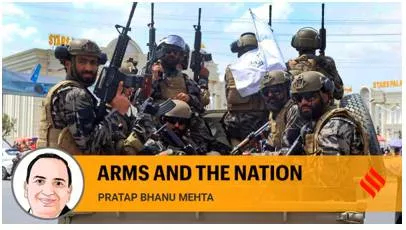
Some armed groups are genuine forces for liberation. But as scholars like Nicholas Marsh and Paul Staniland have argued, the structure of how arms are procured and the social embeddedness of who procures them matters. You can have an instance where a coherent force like a Communist Party or a Maoist movement uses arms to establish hegemony and join the state, as in Nepal. The Taliban’s success in being a unifying force is prima facie more surprising, because development analysts keep telling us that Afghanistan is too decentralised and fractious for a single group to be dominant. But there are other instances where the proliferation of arms simply leads to fragmentation, warlordism or continual insurgency. One thing, however, is clear: The supply of weapons matters, and unless controlled, acquires an autonomous dynamic.
Here the US has been the opposite of the British in India; it has ensured that places it intervenes in are awash in weapons. Just to randomly pick items, it was reported in 2016 in a Pentagon audit that more than 1.5 million firearms supplied to Afghan and Iraqi forces had gone missing. Many of the arms provided to the Mujahideen ended up with successor groups; in Yemen US-supplied arms were being transferred by Gulf states to arms militias. All of this is in addition to the support Pakistan would have provided to so many groups. Saturation of a place with arms is, with rare exceptions, going to backfire. Militias are also hard to decommission, unless they win decisive victories to become the state. In short, you cannot saturate places with weapons and expect development.
In this context, it might be worth looking at the debate over the Small Arms Treaty adopted by the UN General Assembly in 2013. The Treaty aimed to establish the highest possible common standards for regulating conventional arms, and prevent their diversion and illicit trade. The US has withdrawn from the Treaty because of an ideological commitment to exporting weapons. On India’s view, the Treaty protects arms exporters more than importers. But more to the point, the Treaty is not strong enough on arms transfers to non-state actors, which is where a significant part of the problem lies. China has embraced the Treaty in a way guaranteed to make India and the US recoil. Whatever India’s motives, its central concern is not philosophically off the mark. If we are worried about the fear of violent death in armed conflict and the disruptions caused by state breakdown, then there is a case for very stringent regulation of arms transfers and diversion.
The US has a historical tradition of gun ownership to assert racial privilege; and a history of an armed militia winning a war of independence and becoming a modern state. Perhaps that legacy, and the political economy of the military industrial complex, makes the proliferation of weapons its default option in dealing with conflict. Even Asian states are not immune to this temptation. But there is still truth to the old wisdom, the pacification of violence cannot take place with the indiscriminate spread of weapons. If you want to understand failed states, don’t get development consultants. Get people who follow the guns and political elites who are at least willing to control them.












Stay updated with The Hindu Editorial Vocab24 app, your definitive source for breaking news and comprehensive coverage from India and around the globe. Whether it's political developments, business updates, sports highlights, the latest technology trends, or current events, The Hindu brings live, accurate, and reliable news directly to your device.
Don’t fall for sensationalized or fake news shared online. Read and share accurate updates with friends and family through The Hindu Editorial Vocab24 app. Download it today!
News Coverage in The Hindu Editorial Vocab24 App
Breaking News: Receive instant notifications on breaking news stories as they unfold. Stay informed about major events and developments in India and around the world with live blogs, news in shorts videos, and concise articles.
Politics: Get the latest updates on Indian politics, including elections, policy changes, government decisions, and political events that shape the nation.
Business and Economy: Stay ahead in the economic landscape with detailed business news and market analysis. Learn about stock market trends, financial reports, corporate news, and economic developments to make informed investment decisions.
Current Events: Follow stories on social issues, policy changes, global events, and daily current affairs, tailored for UPSC and other competitive exam preparations.
Technology: Keep up with the latest gadgets, innovations, and tech trends. Read expert reviews and analyses in short, concise updates on cutting-edge technology from India and beyond.
Sports: Never miss a moment of your favorite sports. Get live scores, match reports, and expert analysis on cricket, football, tennis, and more.
International News: Stay informed about global events and geopolitical developments, including the Russia-Ukraine war, Israel-Palestine conflict, and other key international stories.
Local News: Stay connected to your community with the latest updates on city events, issues, and local news. Coverage includes hyperlocal updates from cities like Bangalore, Chennai, Delhi, Hyderabad, Mumbai, Kolkata, and more.
Trending Topics: Discover what's trending today with the most talked-about stories and hot topics across India and the world.
Experience journalism that values integrity, accuracy, and reliability. Download The Hindu Editorial Vocab24 app today and stay connected with the world.
Subscribe to our newsletter!







