

Us drone and russia jet crash what we know so far
This is not the first time Russian aircraft have flown so close to U.S. aircraft in the Black Sea that it’s prompted the Pentagon to publicly condemn the incident for putting the crews at risk.When a Russian fighter jet collided with a large U.S. surveillance drone over the Black Sea on Tuesday, it was a rare but serious incident that triggered a U.S. diplomatic protest and raised concerns about the possibility Russia could recover sensitive technology.
U.S. and Russian officials had conflicting accounts of the collision between the MQ-9 Reaper drone and the Russian Su-27 fighter jet — each blaming the other. But a Pentagon spokesman raised the possibility that the Defence Department could eventually declassify and release video it has of the collision.
Defense officials said the drone has not been recovered. But the Pentagon declined to say whether any effort was underway to gather debris or pieces of the Reaper.
Here's what’s known — and uncertain — about the crash.
WHAT THE US SAYS HAPPENED
The Pentagon and U.S. European Command said that two Russian Su-27 aircraft dumped fuel on the MQ-9, which was conducting a routine surveillance mission over the Black Sea in international airspace. They said the Russian jets flew around and in front of the drone several times for 30 to 40 minutes, and then one of the Russian aircraft “struck the propeller of the MQ-9, causing U.S. forces to have to bring the MQ-9 down in international waters.”
Air Force Gen. James Hecker, commander of U.S. Air Forces Europe and Africa, said that the Russian jet’s actions “nearly caused both aircraft to crash.” Pentagon spokesman Brig. Gen. Pat Ryder said the collision likely also damaged the Russian fighter jet, but the Su-27 was able to land. He would not say where it landed.
The Pentagon said the drone was “well clear” of any Ukrainian territory, but did not provide details. A U.S. defense official said it was operating west of Crimea over the Black Sea. The official spoke on condition of anonymity to provide mission details.
It's not clear if the collision was an accident or intentional, but both sides agree the Russian aircraft were trying to intercept the drone.
WHAT RUSSIA SAYS HAPPENED
The Russian Defence Ministry said the U.S. drone was flying near the Russian border and intruded in an area that was declared off limits by Russian authorities. It said that the Russian military scrambled fighters to intercept the U.S. drone. It claimed that “as a result of sharp maneuverer, the U.S. drone went into uncontrollable flight with a loss of altitude and collided with water surface.”
Russia has declared broad areas near Crimea off limits to flights. Ever since the 2014 annexation of Crimea and long before Russia invaded Ukraine last year, Moscow has charged that U.S. surveillance planes were flying too close to its borders while ignoring the notices issued by Russia.
Nations routinely operate in international airspace and waters, and no country can claim limits on territory outside of its own border.
The ministry said the Russian aircraft were scrambled to intercept the drone but didn’t use their weapons and “didn’t come into contact” with it.
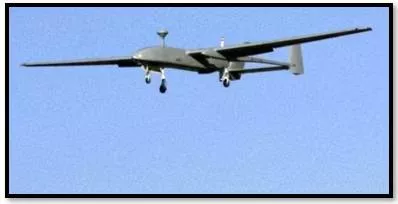
WHAT IS AN MQ-9 REAPER?
The MQ-9 Reaper is a large unmanned Air Force aircraft that is remotely operated by a two-person team. It includes a ground control station and satellite equipment and has a 66-foot (20-meter) wingspan. The team includes a rated pilot who is responsible for flying the aircraft and an enlisted aircrew member who is charged with operating the sensors and guiding weapons.
Used routinely during the Iraq and Afghanistan wars for surveillance and airstrikes, the Reaper can be either armed or unarmed. It can carry up to eight laser-guided missiles, including Hellfire missiles and other sophisticated munitions, and can loiter over targets for about 24 hours. It is about 36 feet long, 12 feet high, and weighs about 4,900 pounds (11 meters long, 4 meters high, and 2,200 kilograms). It can fly at an altitude of up to 50,000 feet (15 kilometres) and has a range of about 1,400 nautical miles (2,500 kilometres).
The Reaper, which first began operating in 2007, replaced the Air Force’s smaller Predator drones. Each Reaper costs about $32 million.
DIPLOMATIC DUST-UP
The collision triggered a diplomatic protest.
The U.S. State Department summoned Russian Ambassador Anatoly Antonov to a meeting Tuesday with Karen Donfried, the assistant secretary of state for Europe.
“We are engaging directly with the Russians, again at senior levels, to convey our strong objections to this unsafe, unprofessional intercept, which caused the downing of the unmanned U.S. aircraft,” said State Department spokesman Ned Price.
And White House National Security spokesman John Kirby said the U.S. will be “expressing our concerns over this unsafe and unprofessional intercept.”
Defence Secretary Lloyd Austin had not talked to his Russian counterpart regarding the incident, Ryder said.
HAS IT HAPPENED BEFORE?
This is not the first time Russian aircraft have flown so close to U.S. aircraft in the Black Sea that it’s prompted the Pentagon to publicly condemn the incident for putting the crews at risk. In 2020, Russian jets crossed in front of a B-52 bomber that was flying over the Black Sea, and flew as close as 100 feet (30 meters) in front of the bomber’s nose, causing turbulence.
Russian jets have also buzzed U.S. warships during exercises in the Black Sea. In 2021, Russian warplanes buzzed the USS Donald Cook, a Navy destroyer, which had been taking part in a major exercise. Until Russia’s invasion last year of Ukraine, U.S. warships more frequently deployed to the Black Sea in response to Russia’s 2014 attack on Crimea.
For the most part, however, military intercepts — either in the air or at sea — are routine and have happened a number of times with Russian aircraft in the Pacific, particularly in the north. Just last month, U.S. fighter jets intercepted two Russian TU-95 bombers in international airspace off Alaska’s coast, and “escorted them” for 12 minutes, according to the Pentagon.
And Russian aircraft have done similar missions, and also buzzed U.S. Navy ships in the Pacific. In most of the cases, the intercepts are deemed safe and professional.
It's not clear if the Russian pilots were willing to get closer to the Reaper or dump fuel on it because they knew it was unmanned — and therefore there was no risk to an American pilot or crew. The deliberate downing of a manned aircraft — injuring or killing crew members — could be considered an act of war.












Stay updated with The Hindu Editorial Vocab24 app, your definitive source for breaking news and comprehensive coverage from India and around the globe. Whether it's political developments, business updates, sports highlights, the latest technology trends, or current events, The Hindu brings live, accurate, and reliable news directly to your device.
Don’t fall for sensationalized or fake news shared online. Read and share accurate updates with friends and family through The Hindu Editorial Vocab24 app. Download it today!
News Coverage in The Hindu Editorial Vocab24 App
Breaking News: Receive instant notifications on breaking news stories as they unfold. Stay informed about major events and developments in India and around the world with live blogs, news in shorts videos, and concise articles.
Politics: Get the latest updates on Indian politics, including elections, policy changes, government decisions, and political events that shape the nation.
Business and Economy: Stay ahead in the economic landscape with detailed business news and market analysis. Learn about stock market trends, financial reports, corporate news, and economic developments to make informed investment decisions.
Current Events: Follow stories on social issues, policy changes, global events, and daily current affairs, tailored for UPSC and other competitive exam preparations.
Technology: Keep up with the latest gadgets, innovations, and tech trends. Read expert reviews and analyses in short, concise updates on cutting-edge technology from India and beyond.
Sports: Never miss a moment of your favorite sports. Get live scores, match reports, and expert analysis on cricket, football, tennis, and more.
International News: Stay informed about global events and geopolitical developments, including the Russia-Ukraine war, Israel-Palestine conflict, and other key international stories.
Local News: Stay connected to your community with the latest updates on city events, issues, and local news. Coverage includes hyperlocal updates from cities like Bangalore, Chennai, Delhi, Hyderabad, Mumbai, Kolkata, and more.
Trending Topics: Discover what's trending today with the most talked-about stories and hot topics across India and the world.
Experience journalism that values integrity, accuracy, and reliability. Download The Hindu Editorial Vocab24 app today and stay connected with the world.
Subscribe to our newsletter!







