

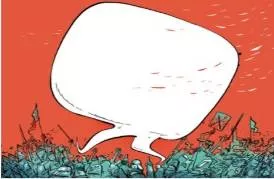
Tyranny of hurt sentiments
The needless controversy surrounding the Sanjay Leela Bhansali directed Padmavati is just an episode in the Indian saga of appeasement of the sanctimonious (hypocritically pious or devout), the mischievous (causing or intended to cause harm or trouble.) and the tetchy (irritable and bad-tempered.). For too long the enemies of liberty have been dealt with kid gloves (used in reference to careful and delicate treatment of a person or situation.). Filmmakers, authors, journalists and, most shamelessly, politicians have humored the self-appointed guardians of morality, public order, decency, etc.Therefore, the anti-freedom villains need to be confronted. This can be done by exposing the fallacy (a mistaken belief) of the concept of `hurting sentiments' and comprehending its baleful effects on a liberal democracy.
In our country, wrong questions are asked when somebody cries that their sentiments or feelings have been hurt because of some movie, song, book, etc. Public debate revolves around such questions as: Whether there is any merit in the protests? Did the artist or author actually do something offensive? Were sentiments really hurt? Were the demands made for a ban just? Why should a movie be banned when it has been cleared by the Central Board of Film Certification? But the fundamental question is: How valid are the demands for proscription (the action of forbidding something;) based on the principle of hurt sentiments or feelings? The Indian Constitution imposes “reasonable restrictions” on the fundamental right to freedom of expression. The restrictions can be imposed for the maintenance of “the security of the state, friendly relations with foreign states, public order, decency or morality, or in relation to contempt of court, defamation or incitement to an offence.”
But the restrictions ought to be reasonable; nowhere in the Constitution is it mentioned that hurting somebody's sentiments can be a ground for curtailment of the freedom of expression.
The grounds restricting the freedom of expression have to be reasonable and not sentimental, not only because it is the constitutional position but also because reasons can be objectively debated, while sentiments and feelings can't be. Merriam Webster describes `sentiment' as `an attitude, thought, or judgment prompted by feeling', `predilection (a preference or special liking for something; a bias in favour of something.)', `a specific view or notion', `opinion', `an idea colored by emotion', etc. Similarly, `feeling' is defined as, among other things, `an emotional state or reaction' and `often unreasoned opinion or belief '.
It is crystal clear that the defining feature of sentiments and feelings is subjectivity. This is the reason that while many Hindus say that some of MF Husain's paintings hurt their feelings and thus should be banned, many of their co-religionists don't feel offended by the paintings concerned. There is no objective standard that can lead to the decision that the feelings of the tetchy can be privileged over those of the tolerant.
It is true that there are legal provisions, for example Section 295A of the Indian Penal Code, that criminalise anything deliberately and maliciously “outraging (arouse fierce anger, shock, or indignation in (someone).) the religious feelings of any class”. But, as argued above, these sections militate against the spirit as well as letter of the Constitution.
The law and public administration are moulded, or should be moulded, by objective realities. Poetry is to sentiments and subjectivity what political philosophy is to statecraft, jurisprudence, and objectivity. In India, however, the founding principles of polity have grown poetic in nature since Independence.
It is not surprising that sentimentality and sanctimoniousness, those illegitimate children of poetry, figure highly in the manifestos, speeches, statements, and announcements of political parties. The upshot is that reason and informed arguments have taken a back seat in public discourse. It is sentimentalism all the way.
Without the ballasts of rationality, poise (composure) and gravity, sentiments behave like malfunctioning robots; fortuitous combinations of circuits make their working arbitrary and often dangerous. Unbridled sentimentalism occasions the basest human instincts, grossest emotions, and stupidest ideas; it promotes the proclivity (a tendency to choose or do something regularly; an inclination or predisposition towards a particular thing.) to capitulate (cease to resist) to the cantankerous (bad-tempered, argumentative, and uncooperative.) and the intractable; and it inevitably results in politicians' covenants with self-righteous charlatans (a person falsely claiming to have a special knowledge or skill.) and pious goons.
All in the name of not hurting sentiments. The biggest casualty, of course, is the freedom of expression. Sentimentalism also pollutes the public discourse; some stark facts are lost sight of.
For instance, millions of Indians have travelled to Western countries where they get exposed to writings and audiovisual depictions slamming, ridiculing and blaspheming (speak irreverently about God or sacred things.) all religions, often in the crudest manner. But there is hardly any report of any Indian Hindu, Muslim or Sikh vandalising a cinema hall, exhibition, or literary festival. Why is it that their sentiments ¬ which overwhelm them to the extent of provoking them to beat artists in India ¬ don't get hurt in the US, UK, or France?
The answer is simple: They know that there would be very unpleasant consequences. For the rule of law is a reality in Western countries ¬ not a slogan as in India. It is as it ought to be in a liberal democracy: anybody can say or do anything so long as they don't harm others.
In our country, on the other hand, democracy stands on its head: professional protesters can hurt a filmmaker or any other creative person physically and financially so long as they can convince the powers that be that the action was the result of `hurt sentiments'. It's worse than that: often, the enemies of freedom also get immunity and patronage from those who matter.
It's time democracy, as it exists, was turned upside down or more precisely right side up; it's time the concept of hurt sentiments and offended feelings was discarded.











Stay updated with The Hindu Editorial Vocab24 app, your definitive source for breaking news and comprehensive coverage from India and around the globe. Whether it's political developments, business updates, sports highlights, the latest technology trends, or current events, The Hindu brings live, accurate, and reliable news directly to your device.
Don’t fall for sensationalized or fake news shared online. Read and share accurate updates with friends and family through The Hindu Editorial Vocab24 app. Download it today!
News Coverage in The Hindu Editorial Vocab24 App
Breaking News: Receive instant notifications on breaking news stories as they unfold. Stay informed about major events and developments in India and around the world with live blogs, news in shorts videos, and concise articles.
Politics: Get the latest updates on Indian politics, including elections, policy changes, government decisions, and political events that shape the nation.
Business and Economy: Stay ahead in the economic landscape with detailed business news and market analysis. Learn about stock market trends, financial reports, corporate news, and economic developments to make informed investment decisions.
Current Events: Follow stories on social issues, policy changes, global events, and daily current affairs, tailored for UPSC and other competitive exam preparations.
Technology: Keep up with the latest gadgets, innovations, and tech trends. Read expert reviews and analyses in short, concise updates on cutting-edge technology from India and beyond.
Sports: Never miss a moment of your favorite sports. Get live scores, match reports, and expert analysis on cricket, football, tennis, and more.
International News: Stay informed about global events and geopolitical developments, including the Russia-Ukraine war, Israel-Palestine conflict, and other key international stories.
Local News: Stay connected to your community with the latest updates on city events, issues, and local news. Coverage includes hyperlocal updates from cities like Bangalore, Chennai, Delhi, Hyderabad, Mumbai, Kolkata, and more.
Trending Topics: Discover what's trending today with the most talked-about stories and hot topics across India and the world.
Experience journalism that values integrity, accuracy, and reliability. Download The Hindu Editorial Vocab24 app today and stay connected with the world.
Subscribe to our newsletter!







