

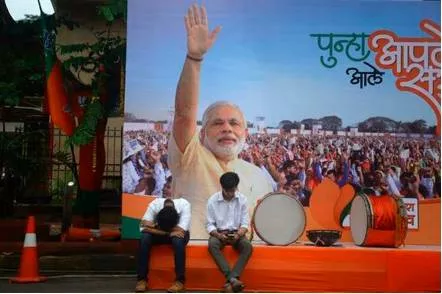
Two elections and a dent to a jingoistic edifice
The BJP’s pursuit of a hyper nationalist approach in Maharashtra and Haryana did not fetch it complete dividends.It is important to step aside and reflect on the enormous significance of the electoral outcomes to the Maharashtra and Haryana state Assemblies within six months of the thumping victory of the ruling Bharatiya Janata Party (BJP) and the NDA alliance in these States to the Lok Sabha. The strength of the BJP has declined decisively in both the States in the number of seats it has won. This is particularly the case if we compare it to the Lok Sabha elections of 2019, when the BJP-Shiv Sena alliance led in 230 Assembly segments out of 288 in Maharashtra and in 79 out of 90 in Haryana.
Impact on support base
All available evidence suggests that the BJP has suffered a dent with regard to its support base among the rural poor, the unemployed and informal labour as well as among a significant section of farmers. Those who moved over to the BJP looking for green pastures and who were derided by their former party colleagues as ‘turncoats’, have not fared well, unless there were other outwitting considerations. Dalits, the minorities and other marginal sections have also reasserted their political agency, although it may seem feeble at present. The All-India Majlis-e-Ittehadul (AIMIM) led by Asaduddin Owaisi, and the Vanchit Bahujan Aghadi led by Prakash Ambedkar seem to have consolidated their hold over their respective constituencies, which they also clearly demonstrated in the Lok Sabha election of 2019.
In the reserved constituencies of Haryana there appears to have been a shift away from the BJP to the Congress. The intimacies of one’s hearth and home represented by ethnic bonds and ties seem to have gotten off better than wider ideological appeals. At the same time, the middle class, distanced from their social attachments, as is the case in Gurgaon and the sprawling urban enclaves of Maharashtra, regions under the spell of the Sangh Parivar such as Konkan, and the non-agricultural upper castes in general seem to hold on to the BJP very ardently. It is important to point out that the ideological formation made up of Hindutva, national jingoism and majoritarianism (that has bonded the BJP and Shiv Sena) continues to appeal to significant sections in Maharashtra, although the mirage of instant jobs and riches, muscular nationalism and Pakistan-bashing did not invoke the same response in Haryana any longer. On the whole, in both the States, the difference between victory and defeat has narrowed down considerably in comparison to 2014 and 2019. Both States today have deeply divided polities with all their consequences.
This is not any State election in India: Maharashtra has the largest State GDP in India and continues to remain a major player at the Centre, a role that began right from Independence. Electoral outcomes to the State Assembly, therefore, have their ramifications on the everyday life of a wider public beyond the confines of the State. On the other hand, most of the leaders who campaigned in Haryana — this includes the Prime Minister in particular — made the Haryana elections a referendum to the dilution of Article 370 that pertained to the autonomy of Jammu and Kashmir. There was also generous anti-Pakistan rhetoric dished out from BJP platforms. Much of this rhetoric was clearly directed at the electorate of the State where a significantly larger proportion of young men are drawn to join the ranks of India’s defence forces. That this rhetoric eventually did not succeed to deliver a clear win gives hope that national security is not a wild card that can be employed anywhere and everywhere.
BJP, Congress strategies
The BJP has been pursuing a particular strategy in Maharashtra and Haryana — a strategy in tune with its overall jingoist approach. It wanted to break the hold of the dominant castes in the two States, the Marathas in Maharashtra who form over 30% of the State’s population and the Jats in Haryana, of almost the same proportion of that State’s population. Breaking the hold of dominant castes was seen as essential to reinforcing national identity and in securing a majority without the support of the minorities. In both the States, the BJP succeeded in weaning away a significant strata of dominant castes through rewards as well as using threats of deprivation. This strategy had its implications and has rebounded through new modes of political assertion by the dominant castes. They seem to have extended support to one another irrespective of the political party they belonged to.
The Congress has always worked on forging a winning combination of castes and communities for far too long and had become adept in the same. Its former president Rahul Gandhi attempted to break up this strategy of forging winning coalitions, and wanting to form an ideological platform for social transformation. It proved an oxymoron. On the one hand it required that the Congress changed its representative format at all levels, political and organisational, to make it attractive to the social constituencies concerned while on the other pursuing an ideological platform of the kind invariably involved alienating entrenched interests in the Congress.
The Rahul Gandhi strategy had much to gain by reaching out to the “Marathi manoos” plank, at present the unique selling point of the Maharashtra Navnirman Samiti (MNS), to the Vanchit Bahujan Aghadi (VBA) bloc of Dalits, Adivasis, Dhangars, Kolis, Agris, Banjaras, Malis and Kaikadis forged by Prakash Ambedkar by appealing to the Phule-Ambedkar mobilisational axis, and to Muslims under the AIMIM plank. In Haryana, his strategy was to forge a Dalit leadership under Ashok Tanwar which was rebuffed by Jat leadership. But with Rahul Gandhi’s exit from the party leadership, the party simply went back to its old ways of welding a winning combination by falling back on its traditional leadership. While there would be some comfort in certain circles within the party with the results of the election, the party strategy can hardly be a response in the longer run to its electoral woes. Sharad Pawar’s Nationalist Congress Party was mainly fighting to protect its turf, particularly in western Maharashtra, against the poaching of the BJP and attempts to discredit him, and the results show that he has succeeded in this limited objective credibly.
The media discourse
Much of the media and opinion polls in particular supported the BJP chorus in suggesting the triumph of the BJP and its allies in both the States. Even the exit polls could not shine through such blinkers. Among the major pollsters, except for one or two the rest forecast over 200 seats to the BJP-Shiv Sena alliance in Maharashtra and over 70 seats to the BJP in Haryana. While a few in this profession may be guilty of inducements, the same cannot be said about the entire trade. It may be that India’s public culture is increasingly getting attuned to accept the values and claims of the BJP as normal and those opposed to it as aberrations. Such distorted readings of what undoubtedly is the most important mode of reproducing our public life has invariably done much injustice to those deleteriously affected by them. It is quite possible to argue that a fairer and more critical stance of the media would have probably led to different results.



Top court quashes FIRs against Gen Z protesters
Sep 04, 2026






Stay updated with The Hindu Editorial Vocab24 app, your definitive source for breaking news and comprehensive coverage from India and around the globe. Whether it's political developments, business updates, sports highlights, the latest technology trends, or current events, The Hindu brings live, accurate, and reliable news directly to your device.
Don’t fall for sensationalized or fake news shared online. Read and share accurate updates with friends and family through The Hindu Editorial Vocab24 app. Download it today!
News Coverage in The Hindu Editorial Vocab24 App
Breaking News: Receive instant notifications on breaking news stories as they unfold. Stay informed about major events and developments in India and around the world with live blogs, news in shorts videos, and concise articles.
Politics: Get the latest updates on Indian politics, including elections, policy changes, government decisions, and political events that shape the nation.
Business and Economy: Stay ahead in the economic landscape with detailed business news and market analysis. Learn about stock market trends, financial reports, corporate news, and economic developments to make informed investment decisions.
Current Events: Follow stories on social issues, policy changes, global events, and daily current affairs, tailored for UPSC and other competitive exam preparations.
Technology: Keep up with the latest gadgets, innovations, and tech trends. Read expert reviews and analyses in short, concise updates on cutting-edge technology from India and beyond.
Sports: Never miss a moment of your favorite sports. Get live scores, match reports, and expert analysis on cricket, football, tennis, and more.
International News: Stay informed about global events and geopolitical developments, including the Russia-Ukraine war, Israel-Palestine conflict, and other key international stories.
Local News: Stay connected to your community with the latest updates on city events, issues, and local news. Coverage includes hyperlocal updates from cities like Bangalore, Chennai, Delhi, Hyderabad, Mumbai, Kolkata, and more.
Trending Topics: Discover what's trending today with the most talked-about stories and hot topics across India and the world.
Experience journalism that values integrity, accuracy, and reliability. Download The Hindu Editorial Vocab24 app today and stay connected with the world.
Subscribe to our newsletter!







