

Tipping point in west asia
So far, Iran’s response to U.S. provocation has been rhetorical but President Rouhani has little room for manoeuvre.The long-standing Palestinian-Israeli conflict in West Asia has been overshadowed by new flashpoints in the region, both internal and external, since the Arab Spring. The fight against the Islamic State and its offshoots, beginning with Iraq; the Syrian conflict that has drawn in the U.S., Russia, Iran and Turkey; renewed skirmishing between Israel and Iran across the Golan Heights; and the civil war in Yemen where the involvement of Saudi Arabia and Iran has heightened tensions, exposing old regional fault lines. Growing drumbeats of a wider conflict can threaten to overturn the boundaries imposed after World War I.
U.S. withdrawal
To this volatile mix, new uncertainty was added on May 8 when President Donald Trump announced that the U.S. was walking out of the Joint Comprehensive Plan of Action (JCPOA). A flurry of diplomatic activity followed with Iranian Foreign Minister Javad Zarif visiting Beijing, Moscow and Brussels. In Brussels, he met the E-3 (France, Germany and U.K.) Foreign Ministers and the European Union (EU) High Representative Federica Mogherini to explore how the deal could be salvaged. This was followed by a summit in Sofia later in May where the EU leaders directed the European Commission to activate the Blocking Statute which forbids European companies from complying with the extra-territorial effects of U.S. sanctions. It also asked the European Investment Bank to set up a special purpose vehicle to protect European companies’ investments in Iran.
Conceived in 1996, the Blocking Statute was a response to U.S. legislation imposing extra-territorial sanctions on companies engaging with Cuba. It empowered the EU to sequester assets of U.S. companies in Europe, equivalent to the penalties imposed on European companies. Eventually, the stand-off was resolved by introducing a waiver. The difference is that in 1996, the Clinton administration was sympathetic to the EU stand but in 2018, the Trump administration is prepared to be tougher than the U.S. Congress! This is clear from U.S. Secretary of State Mike Pompeo’s speech at the Heritage Foundation on May 21 that unveiled a dozen conditions for Iran to fulfil including a permanent end to uranium enrichment, unfettered access for the inspectors, end to missile proliferation, ending support to Hezbollah, Hamas, Houthi rebels (Yemen), Shia militias (Iraq) and Taliban and complete withdrawal from Syria. It is not a Plan B but an ultimatum, with no room for dialogue or diplomacy.
Rationale for the Iran deal
Moreover, it throws down the gauntlet not just to Iran but also to its European partners. Many Europeans have expressed support for curbing Iran’s missile proliferation and testing and finding a way to extend nuclear enrichment restrictions beyond the 15-year timeframe set by the JCPOA. However, rather than walk away while Iran remains in full compliance with its obligations, the E-3 and EU would like to preserve the JCPOA and build upon it. On the other hand, the Trump administration would like to tear up the JCPOA and push Iran to negotiate a new deal under pressure of stronger sanctions.
The push for JCPOA had come with the realisation by the Obama administration that Iran had successfully accelerated its uranium enrichment programme after the slowdown caused by the Stuxnet attack in 2009. By November 2013 when negotiations began and Iran agreed to freeze its programme, it was in a position to produce enough highly enriched uranium (25 kg) for one nuclear bomb within three months.
After Libya, Iraq and Afghanistan, kinetic options were off the table and there was no appetite for regime change. Post-Arab Spring, Barack Obama felt that the U.S.’s West Asia policy of dual containment served Israeli and Saudi interests but restricted American options in the region. He concluded that the JCPOA with its stringent verification provisions would slow down Iran’s nuclear programme, freezing it for 15 years, with accompanying sanctions relief strengthening the moderate elements in Iran represented by President Hassan Rouhani, and consequently increasing U.S. diplomatic options.
In the Trump administration, Defence Secretary Jim Mattis, Chairman of the Joint Chiefs of Staff Joseph Dunford, former Secretary of State Rex Tillerson and former National Security Adviser H.R. McMaster had pushed for retaining the JCPOA but with the induction of Secretary Pompeo and NSA John Bolton, the shift in the U.S. approach is apparent.
A coalition of the willing
Mr. Pompeo’s speech questions the achievements of the 1979 Iranian revolution and is a barely veiled suggestion for regime change. His speech is reminiscent of the then U.S. Vice President Dick Cheney’s speech in August 2002 when he made the case for a pre-emptive strike against Iraq because Saddam Hussein was a leading sponsor of terrorism, had lied and cheated about his nuclear programme, had oppressed his people who deserved a life of dignity and freedom and was behaving like bully seeking regional domination. In March the following year, the U.S. invaded Iraq.
Saudi Arabia and Israel had applauded Mr. Cheney’s speech then and today support Mr. Trump’s decision to dismantle the JCPOA. For both countries, the U.S. policy of dual containment (of Iran and Iraq) was a security bonus. They perceived the JCPOA as a move towards ending Iran’s isolation and Israeli Prime Minister Benjamin Netanyahu and Saudi Crown Prince Mohammed bin Salman are Mr. Trump’s original cheerleaders.
Since 2015, Saudi Arabia has been engaged in a costly adventure in Yemen heightening tensions with Iran. In Syria, Iran has built up its presence by bringing in Shia militias and Islamic Revolutionary Guard Corps advisers to support the Syrian army, leading to growing tensions with Israel. Earlier, Israeli forces would strike weapons locations or convoys in Syria intended for strengthening Hezbollah. Since February, there has been an escalation targeting Iranian efforts to build infrastructure close to Golan Heights. After the U.S. announced its decision to withdraw from the JCPOA, Iran retaliated with a rocket barrage on Golan Heights resulting in a massive Israeli response targeting more than 70 Iranian targets inside Syria.
A critical point
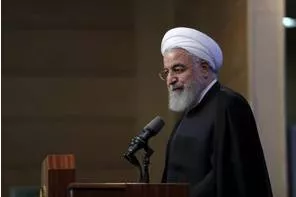
So far Iran’s response has been rhetorical but Mr. Rouhani has little room for manoeuvre as hardline elements in Iran critical of the deal are gaining ground. He is waiting to see if the Europeans, together with Russia and China, can save the JCPOA that has enabled oil exports to grow from 1 million barrels a day in 2015 to 2.6 million, and permitted access to western goods and technologies in sectors such as oil exploration, aviation, etc. In an address to Iranian officials, Supreme Leader Ayatollah Khamenei said he expected the E-3, Russia and China to take up the matter in the UN Security Council, for the E-3 to stop criticism of Iran’s missile tests and regional behaviour and ensure concrete economic guarantees.
However, the signs are not promising as large European companies cannot afford U.S. sanctions; Total and Airbus are already pulling out of their multibillion dollar deals. Iran does not want to be accused of killing the JCPOA but soon it will need to decide how long it will continue to abide with its intensive inspections regime. The day it issues that warning or ratchets up its responses in the region towards Israel and Saudi Arabia, it might be the proverbial straw that breaks the camel’s back. Just as it is more difficult to verify Iran’s full compliance with the Nuclear Non-Proliferation Treaty without the JCPOA’s enhanced verification provisions, it is more difficult to justify going to war with Iran when it is in full compliance with JCPOA. The U.S. decision may just have tipped the balance.



Top court quashes FIRs against Gen Z protesters
Sep 04, 2026





Stay updated with The Hindu Editorial Vocab24 app, your definitive source for breaking news and comprehensive coverage from India and around the globe. Whether it's political developments, business updates, sports highlights, the latest technology trends, or current events, The Hindu brings live, accurate, and reliable news directly to your device.
Don’t fall for sensationalized or fake news shared online. Read and share accurate updates with friends and family through The Hindu Editorial Vocab24 app. Download it today!
News Coverage in The Hindu Editorial Vocab24 App
Breaking News: Receive instant notifications on breaking news stories as they unfold. Stay informed about major events and developments in India and around the world with live blogs, news in shorts videos, and concise articles.
Politics: Get the latest updates on Indian politics, including elections, policy changes, government decisions, and political events that shape the nation.
Business and Economy: Stay ahead in the economic landscape with detailed business news and market analysis. Learn about stock market trends, financial reports, corporate news, and economic developments to make informed investment decisions.
Current Events: Follow stories on social issues, policy changes, global events, and daily current affairs, tailored for UPSC and other competitive exam preparations.
Technology: Keep up with the latest gadgets, innovations, and tech trends. Read expert reviews and analyses in short, concise updates on cutting-edge technology from India and beyond.
Sports: Never miss a moment of your favorite sports. Get live scores, match reports, and expert analysis on cricket, football, tennis, and more.
International News: Stay informed about global events and geopolitical developments, including the Russia-Ukraine war, Israel-Palestine conflict, and other key international stories.
Local News: Stay connected to your community with the latest updates on city events, issues, and local news. Coverage includes hyperlocal updates from cities like Bangalore, Chennai, Delhi, Hyderabad, Mumbai, Kolkata, and more.
Trending Topics: Discover what's trending today with the most talked-about stories and hot topics across India and the world.
Experience journalism that values integrity, accuracy, and reliability. Download The Hindu Editorial Vocab24 app today and stay connected with the world.
Subscribe to our newsletter!







