

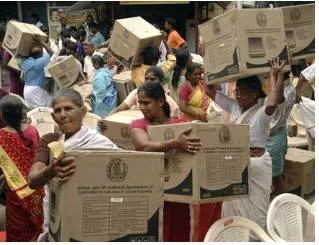
There are no easy answers to the freebies issue
The presumption that political parties are oriented towards short-termism without any thought for the future may be incorrect.When the then Tamil Nadu Chief Minister M.G. Ramachandran launched his now-famous mid-day meal scheme in 1982, it met with opposition both within his own party, the All India AnnaDravidaMunnetraKazhagam (AIADMK), and the Opposition. Within the party, there were concerns that it would result in leakages and corruption. The Opposition said it was intended mostly to bolster his personal image among the poor.
Parents saw merit in sending their children regularly to school. As a result, attendance at schools shot up. The benefits thus went beyond the immediate objective of providing adequate nutrition to children.
Merit versus non merit
The success of the scheme illustrates a broader point. It is hard to capture the total welfare effects of a given scheme at the outset and, therefore, hard to evaluate the merit of a given freebie (a word used to describe subsidised consumption). Bicycles for children may look like a cheap electoral bribe. But those familiar with rural areas would know that poor transport is a serious obstacle to attending school or college. Television sets may not be about recreation, they could be vehicles for imparting useful information or they could simply bring the family together, both of which have wider benefits for society.
Economists make a distinction between ‘merit’ goods and ‘non-merit’ goods. Merit goods, such as education and health care, have positive externalities, that is, the public benefit exceeds the private benefit. Such goods are worth subsidising. Not so ‘non-merit’ goods.
But what is ‘merit’ or ‘non-merit’ is not always readily discernible. With their acute appreciation of grassroots realities, politicians often have a better understanding than economists do of the ‘merit’ underlying certain freebies. They have a much better grasp of what it takes to change the lives of the disadvantaged or to bring about social transformation.
Court’s intervention
These considerations seem to underlie the Supreme Court of India’s decision to refer the matter of freebies to a three-judge Bench instead of to a panel of experts as indicated earlier. During the hearings, the then Chief Justice of India, N.V. Ramana, remarked, “A shaving kit for a barber, a bicycle for a student, equipment for a toddy tapper or an iron for a washerman change their lifestyle and uplift them… That is why, sorry to say, you elitelawyers cannot understand.” How true.
The Supreme Court has framed four questions for the three-judge Bench: What is the scope of judicial intervention? What should be the composition of the expert panel to examine the issue? Can the court pass any enforceable order? Does S. Subramaniam Balaji vs Government of Tamil Nadu and Others (2013) need reconsideration?
In its ruling in S. Subramaniam Balaji vs Government of Tamil Nadu and Others, the Supreme Court of India provided an emphatic answer to the third question and it also partially addressed the first question. The case arose out of the DravidaMunnetraKazhagam government’s election promise of colour TV sets for a specified group of individuals in 2006 and the decision of the AIADMK government in 2011 to distribute goodies such as blenders, grinders, electric fans, etc.
The Court addressed the argument that freebies are unproductive expenditure and hence must be frowned upon. The Court remarked, “Whether the State should frame a scheme, which directly gives benefits to improve the living standards or indirectly by increasing the means of livelihood, is for the State to decide and the role of the court is very limited in this regard.”
The top court’s observations on the specific issue of whether the distribution of blenders, grinders, fans, mangalsutras, etc. is a desirable form of expenditure are worth quoting at length. “The concepts of livelihood and standard of living are bound to change in their content from time to time. It is factual that what was once considered to be a luxury has become a necessity in the present day.... Hence, ... largesse in the form of distribution of colour TVs, laptops, etc. to eligible and deserving persons is directly related to the directive principles of the State policy... Judicial interference is permissible when the action of the government is unconstitutional and not when such action is not wise or that the extent of expenditure is not for the good of the State.”
Should the Supreme Court be issuing guidelines on a matter such as freebies? The Court observed that guidelines such as the Vishakha guidelines on sexual harassment could be issued where there was a legislative vacuum in respect of an issue. There was no such vacuum with respect to freebies: The Representation of the People Act dealt adequately with corrupt practices on the part of political parties.
Public finances and a cap
It does appear that the crucial questions on freebies have been answered substantially. However, in the present petition, a new issue has been posed, namely, the potential for freebies to undermine public finances. What is to stop a political party from promising freebies left, right and centre in order to get elected and leaving behind a bankrupt economy? That seems to be the motivation for having a three-judge Bench revisit S. Subramaniam Balaji.
The Supreme Court faces difficult questions. How do you rein in expenditure choices that are not responsible? Who makes the judgment on whether political parties are being responsible enough? Duvvuri Subbarao, former Governor of the Reserve Bank of India, has proposed a cap on freebies, suitably defined. Alas, political parties will find a way around caps on freebies just as they have found ways around caps on the fiscal deficit. Moreover, it is hard to argue that freebies are the sole or even primary cause of fiscal imbalances. There is no assurance, therefore, that a cap on freebies will mean a return to overall fiscal prudence.
It is also incorrect to suppose that political parties are entirely oriented towards short-termism and will indulge in spending without any thought for the future. Political parties view themselves as going concerns that are in the game for the long haul. They are unlikely to take decisions that will wreck an economy and discredit them in the eyes of the electorate forever.
About growth and equity Lastly, the issue is not expenditure on freebies per se but the choice of productive versus unproductive expenditure. It is all very well to say that we should be investing in job creation instead of blowing up scarce funds on freebies. But jobs in industry or services go to the relatively privileged, that is, those who have access to education and the means to afford it. A big chunk of freebies goes to those who will not be able to access the jobs created by productive expenditure.
So, how much to spend on freebies relative to productive expenditure is also a question of growth versus equity. It is a question that can be answered ultimately only by the electorate. They will do so by voting to power parties that they think have got the balance right. We may have no choice but to rely on democratic accountability to address the issue of freebies.
T.T. Ram Mohan is an academic, consultant and author.



Top court quashes FIRs against Gen Z protesters
Sep 04, 2026






Stay updated with The Hindu Editorial Vocab24 app, your definitive source for breaking news and comprehensive coverage from India and around the globe. Whether it's political developments, business updates, sports highlights, the latest technology trends, or current events, The Hindu brings live, accurate, and reliable news directly to your device.
Don’t fall for sensationalized or fake news shared online. Read and share accurate updates with friends and family through The Hindu Editorial Vocab24 app. Download it today!
News Coverage in The Hindu Editorial Vocab24 App
Breaking News: Receive instant notifications on breaking news stories as they unfold. Stay informed about major events and developments in India and around the world with live blogs, news in shorts videos, and concise articles.
Politics: Get the latest updates on Indian politics, including elections, policy changes, government decisions, and political events that shape the nation.
Business and Economy: Stay ahead in the economic landscape with detailed business news and market analysis. Learn about stock market trends, financial reports, corporate news, and economic developments to make informed investment decisions.
Current Events: Follow stories on social issues, policy changes, global events, and daily current affairs, tailored for UPSC and other competitive exam preparations.
Technology: Keep up with the latest gadgets, innovations, and tech trends. Read expert reviews and analyses in short, concise updates on cutting-edge technology from India and beyond.
Sports: Never miss a moment of your favorite sports. Get live scores, match reports, and expert analysis on cricket, football, tennis, and more.
International News: Stay informed about global events and geopolitical developments, including the Russia-Ukraine war, Israel-Palestine conflict, and other key international stories.
Local News: Stay connected to your community with the latest updates on city events, issues, and local news. Coverage includes hyperlocal updates from cities like Bangalore, Chennai, Delhi, Hyderabad, Mumbai, Kolkata, and more.
Trending Topics: Discover what's trending today with the most talked-about stories and hot topics across India and the world.
Experience journalism that values integrity, accuracy, and reliability. Download The Hindu Editorial Vocab24 app today and stay connected with the world.
Subscribe to our newsletter!







