

There are no detours in history
Pranab Mukherjee’s survey of history was at variance with his invocation of Nehruvian values.In his speech at the headquarters of the Rashtriya Swayamsevak Sangh at Nagpur earlier this month, at the function to mark the end of the Sangh’s annual training camp, former President Pranab Mukherjee referred to Jawaharlal Nehru and his book, The Discovery of India. The concluding part of Mr. Mukherjee’s speech touched upon the familiar Nehruvian values of tolerance, the equality of all citizens, and faith in India’s plurality.
If you looked at the lecture as a whole, you would have noticed a subtle disconnect between the survey of history presented in the first part of the speech and the values reaffirmed in the second. How we might interpret that disconnect depends on our view of Mr. Mukherjee’s aim at Nagpur. Perhaps his main concern was to propagate values he finds lacking in contemporary India. But if he was also interested in initiating a dialogue between two rival perspectives on India’s history, he pursued this aim hesitatingly. The reference to Nehru did not prove useful and remained mainly symbolic.
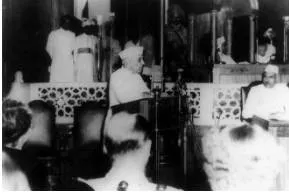
In his midnight speech in August 1947, Nehru said, “We end today a period of ill fortune and India discovers herself again.” These words are not as transparent as they seem. If you work with young people, you realise the difficulty Nehru’s idea of “discovery” presents. He uses it as a metaphor for something deeper that inspires India’s civilisation. For someone born in the late 19th century, discovery had a psychological connotation, verging on “re-discovery”. That is precisely what makes Nehru’s idea of India more paradoxical for our times than rationalist Nehruvians would like to accept. The paradox became quite apparent in Mr. Mukherjee’s survey of history.
Findings from a school survey
A colleague once suggested to me, around 2001, that we should try to find out how standard IX schoolchildren understood India’s freedom struggle. We did a survey with 600 children, from both government and private schools, who had finished standard VIII and were in standard IX. As history of the freedom movement is taught in standard VIII, we prepared a few questions based on the material in textbooks at that time.
In one of the questions, we cited Nehru’s speech: “When the world sleeps, India will awake to life and freedom.”The question was: “Who did India become free from?” We offered four possible options, namely: bondage to tradition, British rule, Muslim rule, and all foreigners. As many as 8% of the children choose the third option. That about 8% of children in standard IX thought that 1947 marked India’s independence from Muslim rule can startle those of us who believe that schooling brings universal enlightenment. The rest of us can find some relief that this percentage is not higher. Teaching history in schools is unsatisfactory as it appears that common social perceptions and prejudices still have a hold over a small proportion of schoolchildren.
The point of this incident is to show that not everyone believes that Independence meant a new start for India. The slate that free India started with was hardly clean. Very old prejudices had left a strong imprint on it. Caste prejudices were one instance while prejudice against Muslims was another. In the latter case, the prejudice had to do with the perception that they colluded with the British to divide India into two nations.
Leaders such as Nehru expected that such prejudiced views would weaken with time. That is probably what he meant by saying that India would “discover herself again”. Had he not said “again”, his meaning would have been unequivocal. The use of the word “again” might tempt someone to think that there could have been earlier instances of India discovering herself in the past. That interpretation strengthens the idea of a core that India must re-discover in order to feel strong. It also reinforces the view that India’s history is a continuous, linear and single story equally applicable to every part of its diverse geography. Some people believe that the values foregrounded in the Constitution were already a part of our culture. For them, values/ideas such as equality and justice, even social justice, are not new enough to mark a departure.
Rooted to the past
Anyone familiar with life at school knows how unpopular history is as a subject. A vast percentage of children and youth find history to be boring. They can’t see why history is necessary to espouse nationalism. Quite a few feel cynical when they notice the gap between the glorified past and the mundane present. Mr. Mukherjee’s speech at Nagpur used history to define and explain Indian nationalism. It revived the old question many children ask in their final years of elementary education: “Why is such a long story taught to us?” The conventional answer is that India as a modern nation is inseparable from its old civilisation. Its uniqueness must be established in the minds of children to make them proud as Indians.
This conventional view does not recognise the way that children today think about and respond to history when it presents a long story. Traditional textbooks and teachers inevitably start with pre-history and the ancient world. Then comes the medieval period. Finally, you are allowed to learn something about the modern period.
Mr. Mukherjee’s survey of India’s past followed this format, but it was remarkably skewed. After spending a considerable amount of time over the ancient period, he came to the 12th century. For the next seven centuries he had little to say except that India was under Muslim rule. This is true but surely this cannot be the only point for this period of time.
The former President’s brevity suggested that there was a break in India’s continuity during this period. The idea of “discovery” drawn from Nehru suggested that if we ignore the medieval aberration, we can appreciate the real potential that India’s ancient history signifies.
Unfortunately, when India’s past is viewed in this manner, we can’t fully appreciate the break brought about by Independence. If Nehru thought that India can now discover herself despite Partition, his meaning becomes hazy when we imagine our long past as a linear journey with a long detour in the middle. By following this familiar linearity, Mr. Mukherjee softened his own emphasis, towards the end, on equality and plurality, and the fundamentals of the new India encoded in the Constitution as a vision.




Top court quashes FIRs against Gen Z protesters
Sep 04, 2026







Stay updated with The Hindu Editorial Vocab24 app, your definitive source for breaking news and comprehensive coverage from India and around the globe. Whether it's political developments, business updates, sports highlights, the latest technology trends, or current events, The Hindu brings live, accurate, and reliable news directly to your device.
Don’t fall for sensationalized or fake news shared online. Read and share accurate updates with friends and family through The Hindu Editorial Vocab24 app. Download it today!
News Coverage in The Hindu Editorial Vocab24 App
Breaking News: Receive instant notifications on breaking news stories as they unfold. Stay informed about major events and developments in India and around the world with live blogs, news in shorts videos, and concise articles.
Politics: Get the latest updates on Indian politics, including elections, policy changes, government decisions, and political events that shape the nation.
Business and Economy: Stay ahead in the economic landscape with detailed business news and market analysis. Learn about stock market trends, financial reports, corporate news, and economic developments to make informed investment decisions.
Current Events: Follow stories on social issues, policy changes, global events, and daily current affairs, tailored for UPSC and other competitive exam preparations.
Technology: Keep up with the latest gadgets, innovations, and tech trends. Read expert reviews and analyses in short, concise updates on cutting-edge technology from India and beyond.
Sports: Never miss a moment of your favorite sports. Get live scores, match reports, and expert analysis on cricket, football, tennis, and more.
International News: Stay informed about global events and geopolitical developments, including the Russia-Ukraine war, Israel-Palestine conflict, and other key international stories.
Local News: Stay connected to your community with the latest updates on city events, issues, and local news. Coverage includes hyperlocal updates from cities like Bangalore, Chennai, Delhi, Hyderabad, Mumbai, Kolkata, and more.
Trending Topics: Discover what's trending today with the most talked-about stories and hot topics across India and the world.
Experience journalism that values integrity, accuracy, and reliability. Download The Hindu Editorial Vocab24 app today and stay connected with the world.
Subscribe to our newsletter!







