

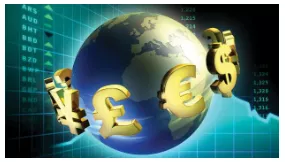
The world is still flat
Cheer up, prospects for the world economy have improved. This seems to be the headline message from the International Monetary Fund’s (IMF) World Economic Outlook (April 2017). However, the caveats (a warning or proviso of specific stipulations, conditions, or limitations.) to the message — or “downside risks” as the IMF puts it — are so many that any celebration would be premature. The IMF sees world economic growth accelerating from 3.1% in 2016 to 3.5% in 2017, and 3.6% in 2018. Both advanced and emerging economies are poised (assured) to do better. Growth in advanced economies is projected to rise from 1.7% in 2016 to 2% in 2017 and 2018. Emerging markets will grow at 4.5% in 2017, and 4.8% in 2018, compared with growth of 4.1% in 2016. China will see growth decelerating from 6.7% in 2016 to 6.6% and 6.2% in 2017 and 2018, respectively. India’s growth, in contrast, will accelerate from 6.8% in 2016 to 7.2% and 7.7% over the next two years. Years of secular stagnation These are modest rates of growth compared to the record before the financial crisis of 2007. In 1999-2008, the world economy grew at 4.2%, with emerging markets firing away at 6.2%. But the IMF’s projections do hold out the hope that the world economy may emerge from the prolonged slump it has seen consequent to the financial crisis of 2007. This is a bit of a surprise considering that, until very recently, many economists had come to believe that the world economy was in the grip of ‘secular stagnation’, an expression coined by the economist Alvin Hansen in the 1930s. Hansen argued that where savings substantially exceed investment, the real interest rate tends to drop to a very low level. Conventional monetary policy operates by reducing nominal interest rates in order to stimulate growth. Where the nominal interest rate is already close to zero, there isn’t much scope for cutting interest rates. In conditions of ‘secular stagnation’, conventional monetary policy is doomed to be ineffective. The burden of reviving growth in such a situation falls on fiscal policy. This means running up large government deficits and increasing public debt. But markets will finance government borrowings only up to a point, and there is also resistance among policymakers to increased government spending. This seemed to be an accurate description of the world economy in recent years. Economists underlined that the real interest rate had indeed been falling for several years. This was because savings were rising and investment was falling. Higher savings flowed from factors such as greater inequality (the rich can spend only so much), and greater life expectancy and reduced post-retirement benefits (which means people have to save more to provide for retirement). Investment had fallen because capital goods had become cheaper, the new economy did not require a great deal of capital and population growth had slowed (which meant lower demand for goods down the road). With decreased spending, inflation rates also fell in the advanced world. Winds of recovery? But the situation has changed quite a bit in recent months. Inflation is trending upwards. The IMF expects the inflation rate in the U.S. to rise from 1.3% in 2016 to 2.7% in 2017. In the Euro area, it sees inflation rising from 0.2% to 1.7%. The spectre (खतरा/आशंका) of a deflationary spiral has thus been dispelled (make disappear) . Does the incipient (आरंभिक/प्रारंभी) revival of the world economy disprove the ‘secular stagnation’ hypothesis (परिकल्पना) ? It’s too early to tell. We have not seen big increases in private or public investment in the advanced economies. Instead, the stock markets have soared (बहुत वृद्धि होना) consequent to the election of Donald Trump as U.S. President, and household debt is once again rising in the advanced world. We cannot be certain, therefore, that the projected acceleration in growth in the medium term is based on a solid recovery. It could well be the result of speculative (engaged in, expressing, or based on conjecture rather than knowledge.) excess which cannot be sustained for long. The IMF warns that high income inequality is likely to persist. This means that an important cause of ‘secular stagnation’ will remain unaddressed. All eyes on the U.S. Much of the boost to market sentiment has to do with expectations that the U.S. will see a strong fiscal stimulus through the combination of tax cuts and massive infrastructure spending that Mr. Trump promised during his election campaign. His flip-flops (an abrupt reversal of policy.) on foreign policy in the first 100 days, however, raise doubts over his ability to follow through on his campaign pledges. The IMF suggests that the U.S. policy agenda could unfold in ways that could derail its forecasts. It factors in a widening of the fiscal deficit by 2 percentage points by 2019. This could have either of two outcomes. It could cause output to rise while leading to a moderate rise in interest rates. Or it could cause a sharp rise in interest rates without any significant increase in output. The world economy would benefit in the first scenario but not in the second. The uncertainties in the U.S. policy agenda are not confined to fiscal policy. The Trump administration has promised to roll back financial regulation put in place after the financial crisis, saying these are coming in the way of efficiency and innovation in the financial sector. Such deregulation would lead to imitation elsewhere, jeopardizing (खतरे में डालना) the hard-won gains in ensuring financial sector stability. Dip for emerging economies The IMF warns that emerging markets, including India, will find the external conditions for growth less supportive than in the post-2000 period thus far. Slower growth in the developed world means lesser demand for emerging market goods and services. Tightening monetary conditions in the advanced world spell lower capital flows (although foreign investors will still be attracted to emerging markets with sound fundamentals). Subdued commodity prices mean that terms of trade improvements will be limited. Emerging markets accounted for 70% of global growth in purchasing power parity terms in 2000-08, nearly double their contribution in the 1980s. Following the global economic crisis, as growth in advanced economies dipped sharply, the contribution of emerging markets rose even further to 80% in 2010-15. With external conditions now turning adverse, the IMF sees the contribution of emerging markets and developing economies (EMDEs) to global growth in 2016-21 falling. The fall is quite small but it may mark the reversal of a benign trend. China faces the problem of a large expansion in credit which has sustained growth in recent years. The other big emerging market, India, too is wrestling with a huge debt overhang (a quantity of securities or commodities large enough to make prices fall if offered for sale.) . So are large parts of Europe. Excessive debt in many parts of the world could undermine the IMF’s upbeat forecasts. The threat of protectionism and anti-globalisation sentiments in the U.S. and Europe pose bigger risks than many of the factors mentioned above, although it is not yet clear how these risks will play out. It is significant that at the IMF meeting this month, finance ministers and central bankers refrained from commitments to resist protectionism out of deference to America’s preferences. They pledged instead to promote “a level playing field in international trade”, a term that is open to multiple interpretations. Finally, there are rising geopolitical tensions. U.S.-Russia relations have touched a new low. There is a real prospect of confrontation (टकराव/आमना-सामना) between the U.S. and Russia over the conflict in Syria. Tensions over North Korea have reached a flashpoint. The U.S. and China are at loggerheads (असहमति पर होना) over maritime rights in the South China Sea. To believe that these add up to brighter economic prospects requires more than ordinary optimism. Do not be surprised if the IMF comes up with a ‘downgrade’ in the months ahead — it’s happened before.Poise (noun)
Be ready and prepared to do something. तैयार होना या करना
Synonyms: Position Oneself, Ready Oneself, Prepare Oneself, Brace Oneself, Get Into Position, Gear Oneself Up
Example: Despite the chaos around her, the flight attendant remained poised and calm as she directed the passengers through the emergency exits.
Dispel (verb)
Make disappear हटाना/दूर करना
Synonyms: Banish, Eliminate, Dismiss, Dissipate, Disappear
Example: The director of the disease center gave a press conference to dispel the myths about the threatening virus.
Incipient (adjective)
Beginning to happen or develop./ developing into a specified type or role. आरंभिक/प्रारंभी
Synonyms: Developing, Inceptive, Growing, Emergent, Dawning, Inchoate
Example: The best way to stop the disease from spreading is by identifying it while it is incipient.
Soar (verb)
Increase rapidly above the usual level. बहुत वृद्धि होना
Synonyms: Increase Rapidly, Shoot Up, Escalate, Surge, Arise Sharply
Example: In summer the temperature soared to 50 degree, creating problems for public.
Jeopardize (verb)
Put (someone or something) into a situation in which there is a danger of loss, harm, or failure. खतरे में डालना
Synonyms: Threaten, Endanger, Imperil, Menace, Put At Risk, Put In Danger
Example: Since I do not want to jeopardize my employment, I always complete my daily goals.
At loggerheads (iIdiom)
In violent dispute or disagreement. असहमति पर होना
Synonyms: In disagreement, At odds, At variance, In opposition, At cross purposes, Wrangling, At daggers down.
Flip-flop (noun)
An abrupt reversal of policy. उलटाव/पलटाव/उत्क्रमण
Synonyms: Reversal, Turnabout, Changeover, Volte-Face
Example: In a sudden flip-flop, the mayor has decided not to run for reelection.
Hypothesis (noun)
A supposition or proposed explanation made on the basis of limited evidence as a starting point for further investigation. परिकल्पना
Synonyms: Theory, Thesis, Conjecture, Supposition, Postulation
Example: The researcher sets up experiments to test the hypothesis.
Confrontation (noun)
A hostile or argumentative situation or meeting between opposing parties. टकराव/आमना-सामना
Synonyms: Conflict, Clash, Face-Off, Skirmish, Dispute
Example: It took a lot of courage for the victim to confront her attacker in court.
Speculative (adjective)
(Engaged in, expressing, or based on conjecture rather than knowledge.) अनुमानित/विचारमान
Synonyms: Conjectural, Suppositional, Theoretical, Hypothetical, Based On Guesswork, Putative
Example: After conducting the experiment, the researcher realized his speculative assumption was indeed a fact.



Economic Survey promises, impact of new labour codes
Mar 16, 2026
Preparing India for a true innovation-led economy
Mar 15, 2026
Cheaper loans likely as repo rate cut by 25 bps
Dec 08, 2025
Iip growth dips to three month low of 4 in sept
Oct 31, 2025





Stay updated with The Hindu Editorial Vocab24 app, your definitive source for breaking news and comprehensive coverage from India and around the globe. Whether it's political developments, business updates, sports highlights, the latest technology trends, or current events, The Hindu brings live, accurate, and reliable news directly to your device.
Don’t fall for sensationalized or fake news shared online. Read and share accurate updates with friends and family through The Hindu Editorial Vocab24 app. Download it today!
News Coverage in The Hindu Editorial Vocab24 App
Breaking News: Receive instant notifications on breaking news stories as they unfold. Stay informed about major events and developments in India and around the world with live blogs, news in shorts videos, and concise articles.
Politics: Get the latest updates on Indian politics, including elections, policy changes, government decisions, and political events that shape the nation.
Business and Economy: Stay ahead in the economic landscape with detailed business news and market analysis. Learn about stock market trends, financial reports, corporate news, and economic developments to make informed investment decisions.
Current Events: Follow stories on social issues, policy changes, global events, and daily current affairs, tailored for UPSC and other competitive exam preparations.
Technology: Keep up with the latest gadgets, innovations, and tech trends. Read expert reviews and analyses in short, concise updates on cutting-edge technology from India and beyond.
Sports: Never miss a moment of your favorite sports. Get live scores, match reports, and expert analysis on cricket, football, tennis, and more.
International News: Stay informed about global events and geopolitical developments, including the Russia-Ukraine war, Israel-Palestine conflict, and other key international stories.
Local News: Stay connected to your community with the latest updates on city events, issues, and local news. Coverage includes hyperlocal updates from cities like Bangalore, Chennai, Delhi, Hyderabad, Mumbai, Kolkata, and more.
Trending Topics: Discover what's trending today with the most talked-about stories and hot topics across India and the world.
Experience journalism that values integrity, accuracy, and reliability. Download The Hindu Editorial Vocab24 app today and stay connected with the world.
Subscribe to our newsletter!







