

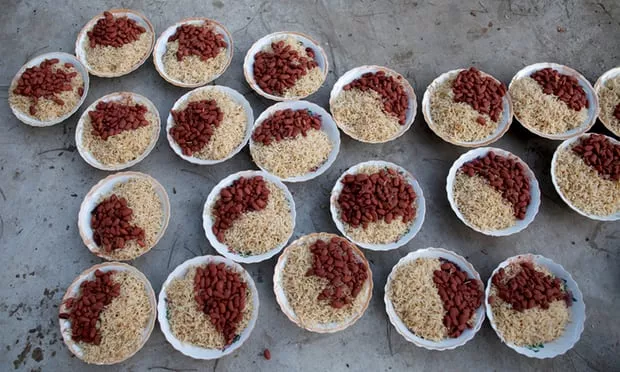
The true cost of a plate of food $1 in new york $320 in south sudan
Research reveals the stark inequality that drives the global hunger crisis, with the poorest people paying more than they earn in a day for a single mealThe world’s poorest pay more than a day’s wages for a single plate of food, according to a report from the World Food Programme, which reveals that the same bean stew can cost the average consumer in New York just $1.20, while the price tag is more than $320 in South Sudan.
The research, released to coincide with World Food Day on Monday, underlines the sheer discrepancy of consumers’ purchasing power around the world by measuring the relative cost of food in various countries against a single baseline.
“By adjusting for purchasing power, we shine a stark light on inequalities in the affordability of food,” said WFP’s executive director, David Beasley. “The results are, in many cases, staggering: if you thought a meal was expensive in, say, Norway – well, try Malawi.”
Economists at WFP took a standard meal of beans and pulses, paired with a locally preferred carbohydrate such as rice or cassava, priced it on a local scale, then compared it with the average daily budget derived from national GDP per capita figures. Using this as a baseline, WFP was then able to determine how much an average person in New York state would have to pay for the stew if they spent the same proportion of their daily income as people in other countries.
That $1.20 (90p) plate of rice and beans in New York, which is just 0.6% of the New Yorker’s average daily income, costs $8.27 in Guatemala, $27.77 in Nepal, and $72.65 in Haiti.
In South Sudan, the worst-ranking country in the study, the meal costs $321.70, or 155% of a person’s daily wages.
Beasley points to the sheer unaffordability of food – rather than the absence of it – to explain why hunger rages on, particularly in the developing world. Some 795 million people went hungry in 2016, according to WFP, a figure expected to rise this year, due to factors including conflict, political instability, poor infrastructure and climate change.
“Nearly 800 million people went hungry on the planet last year because they simply could not afford to feed themselves, yet we have enough food to feed everyone worldwide: the food we waste could actually feed 2 billion people,” said Francis Mwanza, a London-based spokesperson for the WFP.
“Unless we stop the conflicts, unless we stop the migration of people from their homelands into neighbouring states, unless people have the means to either grow their own food or be able to afford to buy it, people will continue going hungry.”
Even in relatively stable countries, food systems can still be subject to poor communications, transport and storage facilities, the report says. But in nations ravaged by war and instability, drought and famine, food systems can all too easily be at risk because of oppression and abuse of power.
Nearly 50% of Syria’s population needed food assistance in 2016, according to the report, with a basic bean stew estimated at $190.11. Prior to the conflict starting in 2011, Syria was a middle-income country; just five years later, four out of five Syrians are living in poverty, with 75% of the population needing humanitarian assistance.
In Yemen, where conflict has been raging for the past two years, more than two-thirds of the population are struggling to feed themselves. Cereal production currently provides less than 20% of the nation’s needs, while crop and livestock diseases are going untreated for lack of money and supplies, the report claims.
“These are sobering figures, and I welcome the attempt at simple accountancy to allow such comparisons to be made – it highlights some crucial areas where there is very little resilience to shock,” said Chris Gilligan, co-chair of the Strategic Initiative in Global Food Security at Cambridge University, of the report.
“I’m very concerned that each time we have an epidemic in Africa, or a pest infestation, there is a danger that we start from scratch each time in terms of how we react. We need to get ahead, work out where the infection is likely to come from and where it will go, so that we can … prevent severe losses.”











Stay updated with The Hindu Editorial Vocab24 app, your definitive source for breaking news and comprehensive coverage from India and around the globe. Whether it's political developments, business updates, sports highlights, the latest technology trends, or current events, The Hindu brings live, accurate, and reliable news directly to your device.
Don’t fall for sensationalized or fake news shared online. Read and share accurate updates with friends and family through The Hindu Editorial Vocab24 app. Download it today!
News Coverage in The Hindu Editorial Vocab24 App
Breaking News: Receive instant notifications on breaking news stories as they unfold. Stay informed about major events and developments in India and around the world with live blogs, news in shorts videos, and concise articles.
Politics: Get the latest updates on Indian politics, including elections, policy changes, government decisions, and political events that shape the nation.
Business and Economy: Stay ahead in the economic landscape with detailed business news and market analysis. Learn about stock market trends, financial reports, corporate news, and economic developments to make informed investment decisions.
Current Events: Follow stories on social issues, policy changes, global events, and daily current affairs, tailored for UPSC and other competitive exam preparations.
Technology: Keep up with the latest gadgets, innovations, and tech trends. Read expert reviews and analyses in short, concise updates on cutting-edge technology from India and beyond.
Sports: Never miss a moment of your favorite sports. Get live scores, match reports, and expert analysis on cricket, football, tennis, and more.
International News: Stay informed about global events and geopolitical developments, including the Russia-Ukraine war, Israel-Palestine conflict, and other key international stories.
Local News: Stay connected to your community with the latest updates on city events, issues, and local news. Coverage includes hyperlocal updates from cities like Bangalore, Chennai, Delhi, Hyderabad, Mumbai, Kolkata, and more.
Trending Topics: Discover what's trending today with the most talked-about stories and hot topics across India and the world.
Experience journalism that values integrity, accuracy, and reliability. Download The Hindu Editorial Vocab24 app today and stay connected with the world.
Subscribe to our newsletter!







