

The statesman
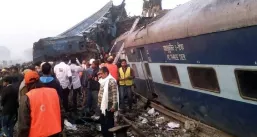
A series of train accidents have raised considerable public concern The issue needs to be examined from two critical aspects of cardinal importance: one, for the Railways, an organisation engaged in 24X7 operations amidst challenging circumstances, safety is integral to its general efficiency. This necessitates consistent diligence (careful and persistent work or effort.) and discipline from the entire workforce.It must probe why its inspection and monitoring systems have become slack over the years. Second, the creaking (weak) infrastructure reflects inevitable retribution (punishment inflicted on someone as vengeance for a wrong or criminal act.) ~ accumulated wages of sin perpetrated in varying degrees by political deities reigning in Rail Bhawan during the last three decades. Some of them, brazenly arrogant and narcissistic, had regarded the Railways as their fiefdom (a territory or sphere of operation controlled by a particular person or group.) while doling out budgetary largesse (generosity ). The timidity and pusillanimity (lacking courage) of top managers by and large didn’t deter myopic political masters from window-dressing the financial aspect, thereby denying even the minimum wherewithal for essential maintenance of assets.
Of late, the Railways had its energy dissipated on a minutiae (the small, precise, or trivial details of something.) of routine amenities euphemistically (by means of a mild or indirect word or expression instead of one considered too harsh or blunt.) termed ‘projects’, that were inaugurated with fanfare. True, there is no magic bullet. The Indian Railways have been diagnosed and scanned extensively as no other organisation, and cures have been prescribed. As the country’s most important enterprise, it needs to heed how some of the most successful companies were reduced to irrelevance because they were complacent and had failed to adapt their enterprises to market disruptions, trends and technologies. As regards safety, the failure of assets and operational efficiency reinforces each other.
The Railways ought to accord the highest priority to address deficiencies in the maintenance of assets, and simultaneously launch a crusade that is needed for ‘zero defect’/’zero failure’ of assets. At least 10 per cent of the existing network capacity can be unlocked by ensuring a zero-failure of fixed and mobile assets and, more importantly, enhanced safety. It must stringently monitor the performance and quality of work at workshops, depots, sheds, yards, and tracks. The asset-failures that impact train operations indicate a disturbing trend.
Rail track fractures and weld failures increased from 3,237 in 2015-16 to 3,546 in 2016- 17; diesel and electric locomotives failures remained at about the level of 4,500 in the same year, and detachment of passenger coaches from trains exceeded 810; failures of overhead electric wires increased from 378 in 2015-16 to 447 in 2016-17; signalling equipment failures were of the order of 130,200 in 2016-17. It is essential to disaggregate the system ~ freight, passenger, infrastructure, other activities ~ supported by changes in organization and upgrading of operational processes. For far too long, the Railways have been stuck at one per cent of the national GDP; its potential and expectations require that it ought to attain at least two per cent of GDP, a tough call in a growing economy.
Its key objectives as the economy’s lifeline are an exponential capacity enhancement for traffic growth; realistic passenger fares; freight tariff reduction. It is essential to reorganize the management structure in terms of business ~ segregating freight from passenger business to improve customer focus, market response, and profitability; ensure quality in investments and project execution; drastically cut costs; corporatize development and manufacture of railway equipment and construction as well as suburban and regional passenger services; reform its accounting and costing systems; emphasize the role of finance as in a corporate enterprise.
Freight is the Railways’ bread and butter and a crucial factor for industry and commerce. Large organizations have a strong tendency to overexploit existing business models instead of exploring opportunities for the future. The dynamics of competitiveness in the marketing of products is now a new theory of development.
High-capacity trucks carry goods door-to-door, and this is convenient and economical. The 96,000 km highways, that carry 40 per cent of India’s road traffic, is being expanded to 200,000 km with a capacity to carry 80 per cent of goods traffic. Trucks will clock much higher mobility, further facilitated by the GST regime. The 2014 National Transport Development Policy Committee had set for the Railways the target of achieving a market-share of no less than 50 per cent by 2031-32.
But to retain its current share of 30-35 per cent, the Railways will have to increase its volume of freight by more than 10 per cent a year.
Long-distance transportation of coal by train will keep declining. Which makes it imperative for the Railways to look for life beyond coal, currently accounting for half of its total freight business. The Railways has less than two per cent share in the FMCG segment, and one per cent in auto and textiles. For weaning away (To detach from that to which one is strongly habituated or devoted:) high-value non-bulk sector from road transport, the Railways will have to produce wagons/ containers, in partnership with other players. It may well optimise double-stack container train operations, conducive to economies of scale.
The annual loss of more than Rs. 1,100 crore on the parcel and luggage segment should compel it to forge partnerships with established road network operators/integrators to develop a door-to-door multimodal product.
Tectonic changes in the Railways of the US, China and Russia for high velocity, price-competitive overnight inter-city parcel and freight delivery transport systems would be worthy of emulation. The Railways operate a daily average of over 13,300 passenger trains, including about 3,500 long-distance inter-city mail and express services, 4,700 short-distance “regional” trains, besides around 5,100 suburban ‘locals’, mainly in Mumbai and Kolkata.
The “regional” services are at the root of the maximum loss in passenger business and consume a substantial portion of scarce movement capacity, even on high-density routes. An autonomous corporate entity, under the umbrella of the Indian Railways, will coordinate better with respective state government authorities and provide for multimodal transport, involving road services, especially where rail services make no sense, economically and rationally.
The demand for rail travel far outstrips (exceeds) supply, and remains set to grow substantially in view of country’s “continental distances”, its rapidly growing middle class, social and religious mores that keep the foot-loose population on the move.
The steadily growing services sector continues to trigger high mobility and demand for passenger travel, generally among upper classes. Further, regional imbalances in economic growth leading to migration of workers from poorer regions to more promising areas, would perforce (used to express necessity or inevitability.) generate considerable travel.
The Railways will have to compete with budget airlines and the high-capacity Volvo and Leyland vehicles, that are as fast as they are frequent. The number of air passengers, which constituted just about one per cent of upper class rail passengers in 1950-51, now exceeds 75 per cent, and is poised to surpass the share of the Railways before 2020. The rail network must aim at high-capacity, speedy intercity passenger trains with hassle (irritating inconvenience.) free booking and reservation on demand, clean platforms, coaches and toilets, standardised packaged food, trains running on time, along with a concerted programme to reduce travel time.
Some trains can run end-to-end with minimum intermediate halts. The dubious label of “super fast” must be binned (discard or reject.). Of late, the Railways have spoken of Tejas, Humsafar, Antyodaya, Uday, et al. as its new pantheon of passenger services.
For instance, Uday (Utkrisht Double Decker Air conditioned Yatri express) should be pursued for popular and dense routes in order to overcome the capacity crunch.






Stay updated with The Hindu Editorial Vocab24 app, your definitive source for breaking news and comprehensive coverage from India and around the globe. Whether it's political developments, business updates, sports highlights, the latest technology trends, or current events, The Hindu brings live, accurate, and reliable news directly to your device.
Don’t fall for sensationalized or fake news shared online. Read and share accurate updates with friends and family through The Hindu Editorial Vocab24 app. Download it today!
News Coverage in The Hindu Editorial Vocab24 App
Breaking News: Receive instant notifications on breaking news stories as they unfold. Stay informed about major events and developments in India and around the world with live blogs, news in shorts videos, and concise articles.
Politics: Get the latest updates on Indian politics, including elections, policy changes, government decisions, and political events that shape the nation.
Business and Economy: Stay ahead in the economic landscape with detailed business news and market analysis. Learn about stock market trends, financial reports, corporate news, and economic developments to make informed investment decisions.
Current Events: Follow stories on social issues, policy changes, global events, and daily current affairs, tailored for UPSC and other competitive exam preparations.
Technology: Keep up with the latest gadgets, innovations, and tech trends. Read expert reviews and analyses in short, concise updates on cutting-edge technology from India and beyond.
Sports: Never miss a moment of your favorite sports. Get live scores, match reports, and expert analysis on cricket, football, tennis, and more.
International News: Stay informed about global events and geopolitical developments, including the Russia-Ukraine war, Israel-Palestine conflict, and other key international stories.
Local News: Stay connected to your community with the latest updates on city events, issues, and local news. Coverage includes hyperlocal updates from cities like Bangalore, Chennai, Delhi, Hyderabad, Mumbai, Kolkata, and more.
Trending Topics: Discover what's trending today with the most talked-about stories and hot topics across India and the world.
Experience journalism that values integrity, accuracy, and reliability. Download The Hindu Editorial Vocab24 app today and stay connected with the world.
Subscribe to our newsletter!







