

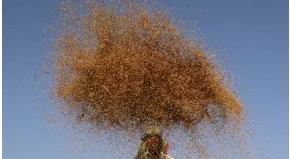
The seeds of discontent
Amongst the images of agitating farmers in Madhya Pradesh, it was striking to see how many were youngsters dressed in jeans and shirts — they were clearly not all farmers, but also farmers’ sons, unhappy with jobless growth. We are facing not just a farmers’ crisis today, but also a crisis of farming families, whose children want non-farm jobs. Have we ever seriously asked farmers if they like farming? Only once, as far as surveys go. A Situation Assessment Survey (SAS) by the National Sample Survey Organisation (NSSO) several years ago asked over 50,000 farmers across India: “Do you like farming as a profession?” Forty per cent said they did not. Ankush Agrawal (IIT-Delhi) and I analysed the SAS data. In our paper, “Do farmers really like farming? Indian Farmers in Transition” (Oxford Development Studies, 2017), we compared farmers who liked farming with those who did not. We found that dissatisfied farmers included both the most vulnerable and the well-off (संपन्न/समृद्ध) — the former due to low production, the latter due to higher aspirations. The resource-poor farmers who disliked farming owned smaller plots (0.85 ha on average), compared to the 1.4 ha owned by those who liked farming; they had less access to irrigation, credit and crop insurance; they were less aware of minimum support prices (MSPs) and tended not to be members of farmers’ groups. All these factors matter for raising productivity and lowering risk, the two factors farmers emphasised: Two-thirds cited low profits and one-fifth cited riskiness for disliking farming. Irrigation is central to production. Crop insurance (only 3.8 per cent of all farmers had any) is key for protection against crop failure. Awareness of MSPs brings better returns. Access to cheaper credit encourages investment. Membership in farmers’ groups can reduce distress by providing support when farmers face indebtedness. (Ironically, loan waivers will not help the most vulnerable farmers — many çan’t access bank credit anyway and depend on moneylenders). Age and gender also affect farmer satisfaction — younger farmers tended to be more dissatisfied, and women farmers more than men, understandably since few women own land and most face difficulties accessing irrigation, credit, inputs and markets. This has implications for productivity, since at least 35 per cent of our agricultural work force is female and likely to grow. And it has implications for food security since 75 per cent of rural women workers, versus 59 per cent of rural male workers, depend mainly on agriculture for a living (NSSO 2011-12). Indeed, unless we alleviate (घटाना/कम करना) women’s constraints, future farmer agitations may be led by women. Notably, dissatisfied farmer households had more working age members per acre (6.6 relative to 4.2 among satisfied farmers). The benefit of having more working adults is overridden (लंघन करना/अधिरोहण करना) by disaffection (असंतोष) if these are children who don’t want to farm. This highlights the second major category of farmers who disliked farming, those owning more land, educated above middle school, living in pucca homes — but unable to fulfil aspirations. Location also matters. A larger proportion of farmers were dissatisfied in states with low rainfall, less urbanisation, low per capita incomes and largely subsistence (निर्वाह) farming, compared to farmers in richer states, with favourable climates and mixed farming (ie, subsistence plus commercial crops). Some argue that dissatisfied farmers should be encouraged to seek non-farm jobs. But this fails to recognise that one section of the dissatisfied — the resource-poor, little educated — have few options outside agriculture except casual work, which would leave them poorer, while the better-educated, younger farmers want regular jobs, which are sparse (अपर्याप्त/कम) . Also, employment prospects differ between the rural and urban. Many studies find that moving from farms to mega cities does not reduce poverty — it may even increase it. For poverty reduction, the best route is raising farm productivity, the next being non-farm jobs in villages or secondary towns. Within non-farm employment, the main benefits come from skilled regular jobs, which are few in number, but which are precisely the jobs the educated youth of farm households want. Most farmers themselves want their children to leave farming and educate them for exit options — but a desire to quit does not match the ability to quit. Occupational mobility is lowest in agriculture: An all-India survey by Motilal and Singh (EPW 2010) found that almost 50 per cent of farmers’ children end up as farmers. We need a multi-pronged (बहु आयामी) strategy to help both resource-poor farmers and the educated better-off ones. For the majority, raising farm yields and diversifying (विविध करना) livelihoods would be the best way. Many experts provide long lists of recommendations for raising output; let me mention just two. The foremost is irrigation, and a judicious (बुद्धिमान/अक़्लमंद) use of groundwater. Only 44 per cent of our cropland is irrigated — this needs priority expansion. We have also used our groundwater recklessly. In Punjab, with drastic overdrawing, the water table has been falling by 2.6 feet annually since 2000. Instead of diesel and electricity subsidies, which encourage excessive pumping, we must strictly regulate extraction (say, by meters), conserve water use by techniques like drip irrigation, expand rainwater harvesting, etc. A second strategic need is for institutional innovation, especially promoting cooperation in production and linking farmers to higher value chains. Pooling land, labour and capital can help small farmers expand farm size, enjoy scale economies, share risks, improve input access, upscale technology and enlarge the skill pool — small owners can thus become medium-sized producers. This has worked especially well for Kerala’s women farmers under Kudumbashree; today, 2.6 lakh women, constituting 54,000 groups, are doing group farming. As my ongoing research shows, in districts like Thrissur, groups cultivating vegetables and specialised bananas are making substantial profits, rarely possible under individual farming. Increasing the profitability and reliability of returns, and giving production incentives would make farming more attractive, even to the educated youth. Unhappy farmers cannot be made happy through loan waivers. Sustainable agriculture cannot be promoted by subsidising chemical fertilisers. The rural crises will not disappear by shooting farmers. We need economically viable, not populist (लोकवादी) , policies for happier farmers, who would prefer to be in their fields rather than on the streets.Well-off (adjective)
In a favourable situation or circumstances. संपन्न/समृद्ध
Synonyms: Fortunate, Lucky, Comfortable, Well Placed, In A Fortunate Position, In A Privileged Position
Example: After her grandparents died, she received a lot of money, so now she is really well off.
Alleviate (verb)
Make (suffering, deficiency, or a problem) less severe./ to make something less painful, severe, or serious घटाना/कम करना
Synonyms: Allay, Assuage, Ease, Mitigate, Lighten, Mollify
Example: Scared of heights all her life, nothing would alleviate Ruth's fear of flying.
Disaffection (noun)
A state or feeling of being dissatisfied, especially with people in authority or a system of control. असंतोष
Synonyms: Dissatisfaction, Disgruntlement, Discontent, Resentment
Example: The troops were disaffected by the extension of their tours of duty.
Subsistence (noun)
The action or fact of maintaining or supporting oneself, especially at a minimal level. निर्वाह
Synonyms: Maintenance, Upkeep, Livelihood, Living, Sustenance
Example: The church was accepting donations of food and clothing for community members in need of subsistence.
Sparse (adjective)
Scanty; in short supply. अपर्याप्त/कम
Synonyms: Meager, Scant, Minimal, Limited, Restricted
Example: With only a sparse supply of weapons, the villagers were worried they would not survive the attack.
Diversify (verb)
Make or become more diverse or varied. विविध करना
Synonyms: Branch Out, Vary, Expand, Make Diverse, Assort
Example: With the advent of e- marketing many publishing companies have diversified into online services.
Judicious (adjective)
Having, showing, or done with good judgement or sense. बुद्धिमान/अक़्लमंद
Synonyms: Wise, Sensible, Prudent, Shrewd, Astute, Canny, Sagacious
Example: Judicious investors will only put their money into stocks which will provide them with hefty profits.
Populist (noun)
A person seeking to represent the interests of ordinary people. लोकवादी
Synonyms: Egalitarian, Even Handed, Non-Partisan, Non-Discriminatory, Impersonal
Example: Characterized by her populistnature, he was elected as the president of the organization.
Override (verb)
To prevail over लंघन करना/अधिरोहण करना
Synonyms: Supersede, Take Precedence Over, Take Priority Over, Be More Important Than
Example: Don't let anger override common sense.
Multipronged (adjective)
Having several distinct aspects or elements बहु आयामी
Synonyms: Several Sides, Many Aspects, Multi Dimensional
Example: Since the problem had multiprongedsolutions, it was solved immediately.












Stay updated with The Hindu Editorial Vocab24 app, your definitive source for breaking news and comprehensive coverage from India and around the globe. Whether it's political developments, business updates, sports highlights, the latest technology trends, or current events, The Hindu brings live, accurate, and reliable news directly to your device.
Don’t fall for sensationalized or fake news shared online. Read and share accurate updates with friends and family through The Hindu Editorial Vocab24 app. Download it today!
News Coverage in The Hindu Editorial Vocab24 App
Breaking News: Receive instant notifications on breaking news stories as they unfold. Stay informed about major events and developments in India and around the world with live blogs, news in shorts videos, and concise articles.
Politics: Get the latest updates on Indian politics, including elections, policy changes, government decisions, and political events that shape the nation.
Business and Economy: Stay ahead in the economic landscape with detailed business news and market analysis. Learn about stock market trends, financial reports, corporate news, and economic developments to make informed investment decisions.
Current Events: Follow stories on social issues, policy changes, global events, and daily current affairs, tailored for UPSC and other competitive exam preparations.
Technology: Keep up with the latest gadgets, innovations, and tech trends. Read expert reviews and analyses in short, concise updates on cutting-edge technology from India and beyond.
Sports: Never miss a moment of your favorite sports. Get live scores, match reports, and expert analysis on cricket, football, tennis, and more.
International News: Stay informed about global events and geopolitical developments, including the Russia-Ukraine war, Israel-Palestine conflict, and other key international stories.
Local News: Stay connected to your community with the latest updates on city events, issues, and local news. Coverage includes hyperlocal updates from cities like Bangalore, Chennai, Delhi, Hyderabad, Mumbai, Kolkata, and more.
Trending Topics: Discover what's trending today with the most talked-about stories and hot topics across India and the world.
Experience journalism that values integrity, accuracy, and reliability. Download The Hindu Editorial Vocab24 app today and stay connected with the world.
Subscribe to our newsletter!







