

The scope of constitutional morality
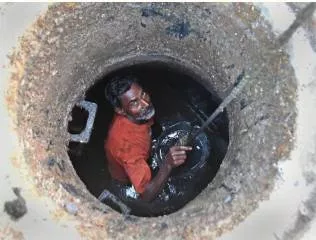
ABOLITION OF UNTOUCHABILITY IN ALL ITS FORMS, INCLUDING SCAVENGING, REMAINS AN UNREALISED CONSTITUTIONAL RIGHT.“The issue of the rights of sweepers and scavengers has never entered the mainstream legal consciousness in the country,” wrote Upendra Baxi in Law and Poverty: Critical Essays. “Nor have the Bar and the Bench, and the mushrooming legal aid and advice programmes shown any awareness of the exploitative conditions of work imposed upon the scavengers and sweepers under the employment of municipal corporations or related local bodies… [T]he exploitative conditions of work constitute governmental defiance of the law and the Constitution, which can be best summed up as a crucial component of overall governmental lawlessness in the country since Independence.”
Written in 1988, Prof. Baxi’s lines remain disconcertingly (Making you feel confused or anxious) relevant today. We struggle against the caricaturing (A picture, description, or imitation of a person in which certain striking characteristics are exaggerated in order to create a comic or grotesque effect) of this extremely stigmatising, violently exploitative and degrading form of forced labour by a government and civil society that showcases empty rhetoric and ceremony around “cleanliness”, while decimating an entire class of citizens through callous neglect with impunity.
There has been a steady rise in deaths of conservancy workers, and a steadier normalisation of the risks to life they bear on a daily basis. Why don’t sewer deaths bring the country to a grinding halt, as they should? Will a general strike of all conservancy workers across the country bring the country to its knees? Because then, it will not be a question of prime-time jingles on a clean India; the focus will shift on each of us to take the moral and physical responsibility of cleaning our own sewers and keeping ourselves free of the risk of toxic death.
FLOUTING LAWS
To return to Prof. Baxi’s concerns on the place of law: Article 17 of the Constitution of India states: “Untouchability is abolished and its practice in any form is forbidden. The enforcement of any disability arising out of Untouchability shall be an offence punishable in accordance with law.” This is a fundamental right and therefore justiciable and enforceable by courts, which shall call governments to account.
In 2009, the Delhi High Court, in Naz Foundation v. NCT of Delhi, invoked Babasaheb Ambedkar’s delineation (The action of describing or portraying something precisely) of constitutional morality in asserting the urgency of decriminalising consensual sexual relations proscribed by Section 377 of the Indian Penal Code. The court cited a second provision as well: Article 15(2) which prohibits any form of horizontal discrimination drawing again from the experience of untouchability that obstructed the universal use of public places, restaurants, water sources, etc. We witnessed last month a triumphal return of constitutional morality as a guiding principle for constitutional interpretation. A five-judge bench of the Supreme Court of India, in Navtej Singh Johar v. Union of India, deployed this framework to reaffirm the rights of LGBTQ and all gender non-conforming people to their dignity, life, liberty, and identity.
The genealogy (A line of descent traced continuously from an ancestor) of Ambedkar’s signposting of constitutional morality may be traced to the strength of anti-caste resistance and the abolition of untouchability. It is from this context that constitutional wisdom was applied to analogous situations of oppressions based on sexuality. It is time to call the government to account through a recursive method that takes us to the original constitutional proscription of untouchability, armed with the wisdom of the Navtej Singh Johar case.
JUDICIAL EMPATHY
The first aspect is the importance of judicial empathy. In a violently exclusionary society, the application of the Constitution to lives as lived is an extremely emotional moment. We have people from India’s most oppressed castes dying painful deaths without dignity in the sewers of the same city where the court sits. There is neither accountability nor due diligence on the part of the state. The time for the expression of judicial empathy is now. Justice Indu Malhotra’s lines in Johar are apposite: “History owes an apology to the members of this community and their families, for the delay in providing redressal for the ignominy and ostracism (Exclusion from a society or group.) that they have suffered through the centuries.”
Given the urgency, with people dying daily despite constitutional and statutory protections, how do we right these historical wrongs, or at least “set the course for the future”? We are all agreed that the de minimis approach is bad law — rule by law rather than rule of law, as it should be, to echo Justice D.Y. Chandrachud. The fact that it is still possible for people to be sent into sewers without protection, and to be forced to perform degrading labour is enough for us to sit up and take note. Outgoing Chief Justice of India Dipak Misra set out four cardinal corners of the Constitution: Individual autonomy and liberty; equality sans discrimination; recognition of identity with dignity; right to privacy. He also underscored the centrality of fraternity to the constitutional value system. These signposts require us to contemplate and act on the meanings and expressions of “intrinsic dignity” for conservancy workers and safai karamcharis.
If “self-determination and the realisation of one’s own abilities” lie at the core of personhood, how would forced, unsafe and degrading labour, and persistent untouchability figure in this new constitutional imaginary? In the case of safai karamcharis, we are today witness to the “violation of fundamental rights that strikes at the root of their existence” (Justice Misra), and there are no visible pathways to freedom in this virulent caste society. Lest we forget, untouchability is a crime under the Constitution.
PRINCIPLE OF NON-RETROGRESSION
Important for citizen consideration today is the fact that the Supreme Court, in deciding on the unconstitutionality of Section 377, recognised that the four corners of the Constitution rest on a social reality steeped in prejudice, stereotypes, parochialism, bigotry, social exclusion, and segregation. If decriminalising “unnatural” sex is one of the “necessary steps on the road to democracy”, abolition of untouchability in all its forms remains an unrealised constitutional right.
The lesson on the importance of intersections in constitutional reasoning today is brought home to us in this case in yet another way. There is recognition by the court that majoritarian governments/sections work hard to keep oppressive structures in place, and that it is the duty of the court to place questions of liberty, equality, and dignity out of the reach of majoritarian impulses. The sanction for manual scavenging lies at the heart of majoritarian mindsets and structures. It is part of an ideological framework that permeates the institutional apparatus of government. If, as Justice Misra observes, “the sustenance of fundamental rights does not require majoritarian sanction”, can we call for some constitutional-procedural deliberation on the “progressive realisation of rights” in this instance? The principle of non-retrogression in the matter of fundamental rights has now been unequivocally stated. But on our streets, we only observe it in the breach especially in the case of manual scavengers.
To end with Ambedkar: “We must remove this contradiction at the earliest possible moment or else those who suffer from inequality will blow up the structure of political democracy.”




Top court quashes FIRs against Gen Z protesters
Sep 04, 2026







Stay updated with The Hindu Editorial Vocab24 app, your definitive source for breaking news and comprehensive coverage from India and around the globe. Whether it's political developments, business updates, sports highlights, the latest technology trends, or current events, The Hindu brings live, accurate, and reliable news directly to your device.
Don’t fall for sensationalized or fake news shared online. Read and share accurate updates with friends and family through The Hindu Editorial Vocab24 app. Download it today!
News Coverage in The Hindu Editorial Vocab24 App
Breaking News: Receive instant notifications on breaking news stories as they unfold. Stay informed about major events and developments in India and around the world with live blogs, news in shorts videos, and concise articles.
Politics: Get the latest updates on Indian politics, including elections, policy changes, government decisions, and political events that shape the nation.
Business and Economy: Stay ahead in the economic landscape with detailed business news and market analysis. Learn about stock market trends, financial reports, corporate news, and economic developments to make informed investment decisions.
Current Events: Follow stories on social issues, policy changes, global events, and daily current affairs, tailored for UPSC and other competitive exam preparations.
Technology: Keep up with the latest gadgets, innovations, and tech trends. Read expert reviews and analyses in short, concise updates on cutting-edge technology from India and beyond.
Sports: Never miss a moment of your favorite sports. Get live scores, match reports, and expert analysis on cricket, football, tennis, and more.
International News: Stay informed about global events and geopolitical developments, including the Russia-Ukraine war, Israel-Palestine conflict, and other key international stories.
Local News: Stay connected to your community with the latest updates on city events, issues, and local news. Coverage includes hyperlocal updates from cities like Bangalore, Chennai, Delhi, Hyderabad, Mumbai, Kolkata, and more.
Trending Topics: Discover what's trending today with the most talked-about stories and hot topics across India and the world.
Experience journalism that values integrity, accuracy, and reliability. Download The Hindu Editorial Vocab24 app today and stay connected with the world.
Subscribe to our newsletter!







