

The roots of the agricultural crisis run deep
Declining agricultural incomes and flagging state support to agriculture are some of the key structural issues.The standoff between farmers and the government continues even after a few rounds of discussion and more than a fortnight of protest at the Delhi border by the farmers. The latest proposal by the government indicates its willingness to amend the three agriculture-related Acts passed in September. On the contentious issues of registration of private traders, levy of taxes on trade outside the Agricultural Produce Market Committee (APMC) mandis, the government has proposed amendments which will empower the States to frame rules on these issues. Similar assurances have been given on access to the judiciary for dispute resolution and continuation of the Minimum Support Price (MSP) mechanism. However, farmer unions have rejected the proposal and continue to demand complete withdrawal of the three Acts along with making MSP a guarantee.
Many protests, one thread
It is likely that the issue may ultimately get resolved and an amicable solution is found to resolve the impasse. However, this will only be a temporary reprieve from the vexatious issue of declining farmer income and the nature of state support to agriculture.
The last four years have seen a series of large protests in most of the States. While a group of farmers from Tamil Nadu camped in Delhi for over 100 days, Maharashtra was witness to the ‘Kisan Long March’ of farmers on more than one occasion. Similar protests have erupted in Rajasthan, Uttar Pradesh, Haryana, Gujarat, Karnataka and Chhattisgarh. At least five farmers were killed in police firing in Mandsaur in Madhya Pradesh three years ago. Clearly, farmers’ unrest is not new and has been building up for quite some time. The latest round of protests may have seen spirited protests from farmers from Punjab and Haryana but has found the support of farmers from the other States as well. While they may appear to be fragmented and localised, the issues concerning these instances of unrest have a common thread — of declining agricultural incomes, stagnant wages and withdrawal of state support to agriculture.
The immediate trigger for the current protests is the enactment of the three Acts, on agricultural marketing, contract farming and stocking of agricultural produce, which deregulates the existing Acts on these. The farmers see them as an attempt to dilute the nature of these safeguards provided to them — by providing unfair advantage to the private sector, read corporate sector, vis-à-vis APMC mandis.
The current crisis is entirely a creation of the government at a time when the country was struggling with novel coronavirus-caused lockdowns, supply disruptions, job losses and falling incomes in an economy which was already slowing down even before the pandemic. While the reforms embedded in the three Acts are unlikely to help resolve the structural issues facing Indian agriculture, even their withdrawal is unlikely to change the ground reality which has existed even before the Acts were passed. It is precisely because of this that withdrawal of the three Acts by the government will only offer a temporary truce. Such a step is unlikely to contain farmers’ anger and unrest which is likely to increase with a slowing economy and falling demand for agricultural commodities.
Changing face of agriculture
The real issue is the lack of remunerative prices for a majority of agricultural commodities, a sharp increase in price variability in recent years, and an unpredictable and arbitrary government policy regime, none of which is likely to change in the near future. It is these which have led to a recurrence of distress in the agricultural sector with regular farmers’ protests which have only grown in frequency in recent years.
Part of the problem is the changing nature of agriculture which has seen increased dependence on markets, increasing mechanisation along with increasing monetisation of the agrarian economy. The increased dependence on markets has contributed to increasing variability in output prices. With limited intervention by the government in protecting farmers’ income and stabilising prices through MSP-led procurement operations, the variability has increased in frequency as well as the spread of it. Other than rice and wheat — and to some sporadic instances, of pulses — most crops suffer from inadequate intervention from MSP operations.
However, even these procurement operations are unable to stabilise prices with falling demand and a slowing economy. A perfect example of this is wheat which has seen a steady decline in year-on-year inflation based on Wholesale Price Index (WPI) since July and is negative for the last three months of August, September and October despite record procurement by the government. Not only has the procurement operation failed to arrest the decline in prices, the uneven nature of procurement has meant that in many States of eastern India, wheat is sold at 20-40% lower prices compared to MSP.
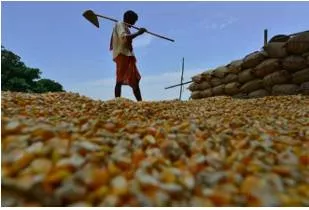
It is the same in the case of paddy where most States have seen market prices significantly lower than the MSP. The situation is far more worrying for crops such as maize which sold at 40-60% lower than the MSP in most States. Unfortunately, none of this is new. In the last five years, three years have witnessed negative inflation for cereals. While the withdrawal of the Acts is unlikely to ensure price stability, even the demand of making MSP a guarantee for private trade is meaningless if the government is unable to ensure procurement for a majority of the 23 crops for which it announces MSP. Even for crops such as wheat and paddy for which there is procurement, the regional concentration makes it irrelevant for most of the eastern and southern States.
Factors behind vulnerability
While output prices continue to show high variation with frequent spells of low prices, increasing mechanisation and monetisation have led to an increase in cash requirement. Most of these are met by non-institutional sources including middlemen which has contributed to the rising cost of cultivation and increase in loan defaults. The demand for loan waivers is unlikely to subside with rising cost of inputs. Some of these trends have accentuated after 2010-11 when the Nutrient Based Subsidy (NBS) for fertilizers regime led to an increase in fertilizer prices. But the withdrawal of diesel subsidy and rise in electricity prices also contributed to making agriculture unviable. With agricultural investment declining in the first four years of this government, the result was rising input costs and falling output prices. Not to mention, the shocks such as demonetisation and the lockdown imposed after the pandemic broke out which only increased the uncertainty and vulnerability in the agricultural sector both on input and output prices.
Policy overhaul needed
Even if the current impasse due to the farmers’ agitation gets resolved, there is no certainty that the structural factors which have contributed to the farmers’ unrest will get resolved. The existing policy framework with excessive focus on inflation management and obsession with fiscal deficit will likely lead to lower support from the government either in price stabilisation or reduction in cost of cultivation through fiscal spending. The agricultural sector needs comprehensive policy overhaul to recognise the new challenges of agriculture which is diversifying and getting integrated with the non-agricultural sector. This not only entails a better understanding of the structural issues but also innovative thinking to protect farmers’ livelihood from the uncertainty of these changes. Above all, it requires fiscal support and institutional structures to support the agricultural sector and protect it. In the absence of these, any rhetoric of doubling farmers’ income is only wishful thinking.




Top court quashes FIRs against Gen Z protesters
Sep 04, 2026







Stay updated with The Hindu Editorial Vocab24 app, your definitive source for breaking news and comprehensive coverage from India and around the globe. Whether it's political developments, business updates, sports highlights, the latest technology trends, or current events, The Hindu brings live, accurate, and reliable news directly to your device.
Don’t fall for sensationalized or fake news shared online. Read and share accurate updates with friends and family through The Hindu Editorial Vocab24 app. Download it today!
News Coverage in The Hindu Editorial Vocab24 App
Breaking News: Receive instant notifications on breaking news stories as they unfold. Stay informed about major events and developments in India and around the world with live blogs, news in shorts videos, and concise articles.
Politics: Get the latest updates on Indian politics, including elections, policy changes, government decisions, and political events that shape the nation.
Business and Economy: Stay ahead in the economic landscape with detailed business news and market analysis. Learn about stock market trends, financial reports, corporate news, and economic developments to make informed investment decisions.
Current Events: Follow stories on social issues, policy changes, global events, and daily current affairs, tailored for UPSC and other competitive exam preparations.
Technology: Keep up with the latest gadgets, innovations, and tech trends. Read expert reviews and analyses in short, concise updates on cutting-edge technology from India and beyond.
Sports: Never miss a moment of your favorite sports. Get live scores, match reports, and expert analysis on cricket, football, tennis, and more.
International News: Stay informed about global events and geopolitical developments, including the Russia-Ukraine war, Israel-Palestine conflict, and other key international stories.
Local News: Stay connected to your community with the latest updates on city events, issues, and local news. Coverage includes hyperlocal updates from cities like Bangalore, Chennai, Delhi, Hyderabad, Mumbai, Kolkata, and more.
Trending Topics: Discover what's trending today with the most talked-about stories and hot topics across India and the world.
Experience journalism that values integrity, accuracy, and reliability. Download The Hindu Editorial Vocab24 app today and stay connected with the world.
Subscribe to our newsletter!







