

The politics of a minimum support price
Facilitating a bargain between wealth accumulators and welfare seekers seems to have become the key function of politics.A new election season is around. Five States (Uttar Pradesh, Uttarakhand, Manipur, Goa and Punjab) will elect new Assemblies and Chief Ministers in the coming weeks. Parties are wooing voters with dazzling new promises. The Aam Aadmi Party leader, Arvind Kejriwal, is offering ₹1,000 a month to all adult women (above age 18); the Shiromani Akali Dal’s offer is ₹2,000 for poor women, which is matched by the Congress, in Punjab. The Samajwadi Party is promising 300 units of free electricity in Uttar Pradesh, and the Centre has extended its free foodgrain programme (the Pradhan Mantri Garib Kalyan Anna Yojana, or PMGKAY), across the country, until March 2022.
More such measures and promises can be expected as campaigning picks up. Campaigns are made of pageantry around big projects and enumeration of welfare schemes. This emphasis on redistribution corresponds with a de-emphasis on job creation in political rhetoric, the promises of which still exist but only as feeble addendums. There is a synchronous celebration of ‘job creators,’ often juxtaposed with ‘job seekers,’ by governments that subtly absolve themselves. If you cannot find a job, why not create a few?
A new constituency
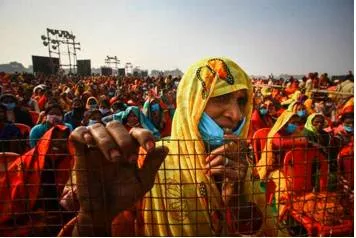
In fact, the current wave of competitive welfarism disconnects Indian politics from the middle class that believed in, and cheerfully ushered in, a majoritarianism-market compact. A section of them may be frustrated over stunted material progress as they were during the last years of the United Progressive Alliance government. But politics is now being litigated lower down in the social and economic ladder by those who are desperate to get by. The slew of welfare schemes, which often includes a few hundred rupees in cash doles, creates a massive political constituency. Politics seems less about aspiration and more about desperation.
It is easy to blame individual leaders or natural disasters such as the COVID-19 pandemic for this knot. The mismanagement and the incompetence of individual leaders may aggravate it, but the fundamental puzzle is the friction between the dictates of democratic politics and market-driven development. The divergence between the principles of market economy and imperatives of a democratic society is the core dilemma of liberalism. The entrenched liberal notion that market and democracy are integral to each other is being questioned by leaders of both.
For instance, in the United States, popular leader Bernie Sanders calls himself a ‘democratic socialist’, while Peter Thiel, one of its reigning capitalist moguls, fears that democracy will stall human progress and derail order. The trajectory of technological and economic progress is making this divergence increasingly stark.
A conflict arises
More than the question of inequality, the conflict between the political and economic orders arises out of the shrinking ability of the latter to fulfil the basic aspirations of the masses through market mechanisms. The interests of the consumer and the investor conflicts with those of the citizen and the labour, Robert Reich points out in Supercapitalism. A politician facing the electorate has to create and protect jobs and build public amenities; incentives for job creation, if at all, are indirect and distant for the investor, who is ever looking for reducing the workforce or moving work to cheaper places and workers. Politicians are trying to restrict the mobility of capital through measures such as global minimum tax, etc. Capitalism, meanwhile, is trying to escape the planet itself, and in the interim, to free itself from state authority through technological routes such as cryptocurrencies.
‘Jobless growth’ is accepted
As the composition of the economy shifts in favour of activities that require little labour, the same amount of growth creates fewer jobs. More than a decade ago, ‘jobless growth’ had become a talking point in Indian political debates. Nobody talks about it today — not because the problem has been resolved but because everyone has accepted it as the normal. The downward trickle has become feeble. Politicians respond to this reality. For instance, Mr. Kejriwal told a gathering in Uttarakhand on Monday that he would create lakhs of jobs once in power, but it could take time. “…in the interim, we will pay ₹5,000 to every unemployed person.” A universal basic income is an idea that is now being discussed globally. Barons such as Elon Musk and Bill Gates support a universal basic income for the entire population in the days to come.
A conflict arises
More than the question of inequality, the conflict between the political and economic orders arises out of the shrinking ability of the latter to fulfil the basic aspirations of the masses through market mechanisms. The interests of the consumer and the investor conflicts with those of the citizen and the labour, Robert Reich points out in Supercapitalism. A politician facing the electorate has to create and protect jobs and build public amenities; incentives for job creation, if at all, are indirect and distant for the investor, who is ever looking for reducing the workforce or moving work to cheaper places and workers. Politicians are trying to restrict the mobility of capital through measures such as global minimum tax, etc. Capitalism, meanwhile, is trying to escape the planet itself, and in the interim, to free itself from state authority through technological routes such as cryptocurrencies.
Welfarism, redistribution
This is turning the ‘there is no free lunch’ bombast (which politicians and business leaders mouthed in unison in the early 1990s) on its head. Subsidies were then rolled back, and people were asked to compete for sustenance and success. Pushed to the wall, they revolted and voted out government after government. Welfarism returned, and how. Not only that, the Mahatma Gandhi Employment Guarantee Act — a rural employment scheme that provides 100 days of employment/jobs a year at a minimum wage to anyone who asks for it — survived, and grew by four times between 2014 and now. It was ridiculed as a monument to the failure of the predecessor regime but today, it is the lifeline of the current regime, alongside add-ons such as free cooking gas and cash incentives to farmers. Welfarism is secular — all parties, from the Bharatiya Janata Party to the CPI(M); and all leaders, from Pinarayi Vijayan (Kerala) to Mamata Banerjee (West Bengal) to Prime Minister Narendra Modi are looking for new opportunities for compassion signalling. In Kerala, the free ration kit, last Onam, came with a sweet and vermicelli among its items. In other places, free laptops, bicycles and smartphones seem to be a part of the welfare mix.
Redistribution has become critical for the survival of democratic politics everywhere — the United States or India. Smarter politicians know that men do not live by bread alone. So, several State governments in India now offer free pilgrimages! Far from outraging over the Haj subsidy, voters now have a catalogue of free pilgrimages to choose from, suitable for a range of beliefs and superstitions. A politician’s success is figuring out the minimum price to be paid to garner sufficient voter support to hold on to power, and the fundamentals of the social and the economic order intact. The threshold is not very high. Two-thirds of voters voted in India and the U.S. in their latest elections; 37% voted for the current regime in India; in the U.S., the regime has the support of more than half, which is more due to the country’s two-party system than its popularity. Political stability in democratic societies is contingent on the continuing confidence of the threshold population in the system.
More generosity now
Welfare schemes have created significant development outcomes in the long and short term, as experience from many Indian States over the decades shows. They were seen as the deepening of democracy. When welfare is weaponised to mute substantive political questions, its impact on democracy is less reassuring. The current generation of welfare schemes do not come as a right of citizens but as the generosity of the individual leader. Similarly, while promotion of entrepreneurship by the government is laudable, turning it into a call to the people to create jobs rather than seek them, redefines aspiration as an individual burden and responsibility.
Facilitating a bargain between wealth accumulators and welfare seekers appears to have become the primary function of politics. But it is unclear whether this will remain an infinitely sustainable lubricant that mitigates the fundamental friction, and whether the state might fall back on coercion. For now, there will be free lunches, and suppers for a song. Or a vote.



Top court quashes FIRs against Gen Z protesters
Sep 04, 2026






Stay updated with The Hindu Editorial Vocab24 app, your definitive source for breaking news and comprehensive coverage from India and around the globe. Whether it's political developments, business updates, sports highlights, the latest technology trends, or current events, The Hindu brings live, accurate, and reliable news directly to your device.
Don’t fall for sensationalized or fake news shared online. Read and share accurate updates with friends and family through The Hindu Editorial Vocab24 app. Download it today!
News Coverage in The Hindu Editorial Vocab24 App
Breaking News: Receive instant notifications on breaking news stories as they unfold. Stay informed about major events and developments in India and around the world with live blogs, news in shorts videos, and concise articles.
Politics: Get the latest updates on Indian politics, including elections, policy changes, government decisions, and political events that shape the nation.
Business and Economy: Stay ahead in the economic landscape with detailed business news and market analysis. Learn about stock market trends, financial reports, corporate news, and economic developments to make informed investment decisions.
Current Events: Follow stories on social issues, policy changes, global events, and daily current affairs, tailored for UPSC and other competitive exam preparations.
Technology: Keep up with the latest gadgets, innovations, and tech trends. Read expert reviews and analyses in short, concise updates on cutting-edge technology from India and beyond.
Sports: Never miss a moment of your favorite sports. Get live scores, match reports, and expert analysis on cricket, football, tennis, and more.
International News: Stay informed about global events and geopolitical developments, including the Russia-Ukraine war, Israel-Palestine conflict, and other key international stories.
Local News: Stay connected to your community with the latest updates on city events, issues, and local news. Coverage includes hyperlocal updates from cities like Bangalore, Chennai, Delhi, Hyderabad, Mumbai, Kolkata, and more.
Trending Topics: Discover what's trending today with the most talked-about stories and hot topics across India and the world.
Experience journalism that values integrity, accuracy, and reliability. Download The Hindu Editorial Vocab24 app today and stay connected with the world.
Subscribe to our newsletter!







