

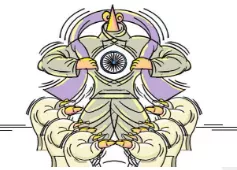
The loss of innocence
The unprofessional behaviour of the young — perhaps even well-meaning — Army Major in the Kashmir Valley is proof of how an aggressive political establishment, and the ‘popular’ support it enjoys, can transform the unlawful act into a nationalist issue. Otherwise, how is it that pinning a civilian to the bonnet of a jeep as a grim warning to the stone-pelting local population, reminiscent (संस्मरणशील) of what conquering militaries often do in vanquished lands, becomes an act worthy of praise? Such a brazen display of aggression is also an unmistakable indication of the ongoing transformation of India’s self-image. The conventional self-image of civilisational India as an inclusive, liberal and relatively non-violent polity with a strong urge to be a global success story may be fast changing, quicker than we realise — and for the worse. No doubt, political and social change is inevitable in a country with a multitude of sociopolitical realities, more so when the erstwhile Congress system is being replaced with an equally overbearing, but far more ideologically zealous (उत्साही/जोश से) , Hindutva system of things. But to what end? “Secularism is derided (उपहास के योग्य) . Liberalism is challenged. Dissent is sedition (राजद्रोह) . Questioning the government is anti-national” — not a cliché from some ‘naïve armchair human rights activist’, these are words of former Home Minister P. Chidambaram. The Gandhian-Nehruvian India is losing its innocence, abandoning a self-definition of romantic idealism to embrace brash realism, and in the process confronting a few ugly truths about itself. We always had that dark side to our socio-political self: the current political environment has merely enabled those dark forces to unveil our pretensions of civilisational sanctimoniousness (दिखावटी नैतिकता) . Aggression as strength There is a great deal more unabashed aggression and hostility in the collective life of our nation today than ever before: the language of aggression is unmissable (न चूकने योग्य) , be it in our political discourse, TV studios, passenger buses or marketplaces. At a certain level, the aggression of the post-colonial underdog is understandable. Having been victimised — imagined, real or due to sheer incompetence — and undervalued, the ‘subaltern’ (अधीनस्थ) has finally decided to speak out. The problem, however, is that it is speaking the wrong language, of violence and otherisation, not of justice, strength and a rightful place in the comity (शिष्टता/भद्रता) of nations. Prime Minister Narendra Modi’s evocative assertion, “earlier you felt ashamed of being born Indian,” is symbolic of this new-found sense of strength. But then, the Hindutva faithful erroneously and often deliberately translates strength as aggression against fellow subalterns. As a result, our great tradition of argument, public debate, intellectual pluralism and generosity (Amartya Sen, The Argumentative Indian) is transforming into a culture of violence, bullying and pettiness. Our ‘fiercely independent’ media used to go after (to pursue) corrupt politicians and inept governments. Today, many of them prefer to preach down (to oppress) to us the virtues of nationalism and uses of brute force: prove your nationalism before you speak, they say! Human rights and rule of law There was a time we were ‘reasonably’ confident about the human rights record of our country, despite the aberrations in Kashmir and elsewhere, and would put up a genuine defence of it. We would reason that we were a new democracy, a state in the making, there had been imperfections, but these were no systematic human rights violations, and, in any case, many of those inadequacies would get self-corrected in due course. Is that the case any more? We seem to have assumed a new cloak (आवरण /आड़) of nationalist indifference today. We have given up paying lipservice to the ideals of human rights, we do not even bother pretending that their violations don’t exist: the new tendency is to justify human rights violations for the greater glory of the nation. “What’s so wrong about tying a civilian to the bonnet of an army vehicle in a last act of self-defence?” goes the argument. Hence, rule of law can be made flexible in the service of what is represented as national interest: a mere mention of nationalism would do. When our neighbours — Sri Lanka, Myanmar, Pakistan and others — were struggling with democracy, and getting individual liberty and religious freedom wrong, India, despite its many inadequacies, was widely seen as a regional hub of modern liberal values and social and religious inclusion. In the past, we provided refuge to the persecuted: today some of us are busy sending others to Pakistan, the country our founding fathers didn’t want us to become. Weren’t we all proud to belong to a multicultural India where we could eat, wear, speak and write what we wanted, with some reasonable restrictions? Everyone had his/ her own space there. We knew we belonged here, and that was a settled matter. I am not so confident about that any more. Today we hesitate before taking positions on issues ranging from national security to eating habits. We had a reputation for being a peace-loving nation. Our foreign policy, defensive military posture, and grand strategic behaviour displayed a strong desire for peaceful coexistence, stability and order in the region and a multipolar world. When in 1971, India aided the creation of Bangladesh (by breaking up Pakistan), world opinion was willing to live by India’s declared peaceful intentions, and the international community did not go overboard when India conducted nuclear tests in 1998. The reason was simple: Notwithstanding India’s nuclear weapons and the third largest army in the world, the world didn’t think India harboured aggressive intentions. There was a time when India played with terror outfits, and a former Prime Minister was killed when the Frankenstein that we created came back to haunt us. We learned our lesson then: are we now unlearning those lessons? In today’s India, how my opinion is viewed depends on who I am and which god I worship — not on the merit of what I say. A nation divided For an avowedly peaceful country towards the outside world, we seem to make up by displaying a lot of aggression and fighting among ourselves, just as we were doing when the European colonisers arrived at our shores centuries ago. The process of cultural-nationalist purification underway in contemporary India will end up making a lot more ‘others’ within the confines of our nation. Who needs a Pakistan to bleed us through a thousand cuts if we end up hating each other with the Hindutva zealots fanning the fires? Such aggression and consequent otherisation along caste, religious and political lines, masquerading (स्वाँग करना) as nationalism, in a country with rising unemployment, youth bulge (an unusual temporary increase in number or size.) , disturbingly skewed sex ratio and existing social anxieties could prove to be a recipe for disaster. Consider this, India ranks 141 on a Global Peace Index making it far less peaceful than several war-torn African nations. Not that India has always been a peaceful country. However, we had our own indigenous ways of dealing with those conflicts, albeit not all of them noble. There was an underlying belief that domestic conflict resolution is a political project, not a terrorist menace. The Central government’s muscular policy in Kashmir today, for instance, reflects how far our polity has moved away from traditional conflict resolution models based on negotiations, concessions and assimilation (अनुकूलता) : violence seems to be the preferred instrument of our statecraft today, as India gets ready to mark the seventieth anniversary of Independence.Reminiscent (adjective)
Tending to remind one of something. संस्मरणशील
Synonyms: Evocative, Remindful, Redolent, Bringing To Mind
Example: As Jason grew older, he started to exhibit behaviors my mother said were reminiscent of our deceased father's personality.
Zealous (adjective)
Feeling or showing strong and energetic support for a person, cause, etc. उत्साही/जोश से
Synonyms: Fervent, Ardent, Fervid, Passionate, Devout, Fanatical
Example: When the zealous missionary talks about his religious beliefs, he actually glows with enthusiasm.
Deride (verb)
Express contempt for/ to subject to bitter ridicule. उपहास करना
Synonyms: Ridicule, Mock, Jeer At, Scoff At, Jibe At, Make Fun Of
Example: If the police do not intervene, the fans of the winning team will deride the losing players as they leave the arena.
Sedition (noun)
Insurrection against lawful authority/ the crime of saying, writing, or doing something that encourages people to disobey their government. राजद्रोह
Synonyms: Agitation, Revolt, Insurrection
Example: The rebels were arrested for sedition when they protested outside of the dictator’s palace.
Sanctimonious (adjective)
Making a show of being morally superior to other people/ hypocritically pious or devout. दिखावटी तौर पर नैतिक
Synonyms: Holier-Than-Thou, Pharisaic, Hypocritical, Pietistic
Example: My sanctimonious aunt tends to look down upon people who do not go to church every Sunday.
Subaltern (adjective)
Of lower status. अधीनस्थ
Synonyms: Inferior, Subordinate, Second-Fiddle, Subservient
Example: A Subaltern is never provided an authority to make critical decisions in any organizations.
Comity (noun)
Courtesy and considerate behaviour towards others. शिष्टता/भद्रता
Synonyms: Harmony, Compatibility, Concord, Courtesy, Moral Behavior
Example: A team must be characterized by comity.
Cloak (noun)
Something serving to hide or disguise something. आवरण /आड़
Synonyms: Cover, Camouflage, Shield, Veneer, Veil, Mantle, Shroud
Example: The robbers wore large coats to cloak their weapons from the security guards.
Bulge (noun)
An unusual temporary increase in number or size. अस्थाई वृद्धि
Synonyms: Surge, Upsurge, Rise, Increase, Escalation, Boost, Intensification
Example: Because of low supply and high demand, there is a bulge in the price of natural oil.
Assimilation (noun)
The process of taking in and fully understanding information or ideas./ the process of becoming similar to something. अनुकूलता
Synonyms: Adoption, Taking In, Acculturation
Example: Because I am not good with math, I find it difficult to assimilate most of the geometry formulas.








Stay updated with The Hindu Editorial Vocab24 app, your definitive source for breaking news and comprehensive coverage from India and around the globe. Whether it's political developments, business updates, sports highlights, the latest technology trends, or current events, The Hindu brings live, accurate, and reliable news directly to your device.
Don’t fall for sensationalized or fake news shared online. Read and share accurate updates with friends and family through The Hindu Editorial Vocab24 app. Download it today!
News Coverage in The Hindu Editorial Vocab24 App
Breaking News: Receive instant notifications on breaking news stories as they unfold. Stay informed about major events and developments in India and around the world with live blogs, news in shorts videos, and concise articles.
Politics: Get the latest updates on Indian politics, including elections, policy changes, government decisions, and political events that shape the nation.
Business and Economy: Stay ahead in the economic landscape with detailed business news and market analysis. Learn about stock market trends, financial reports, corporate news, and economic developments to make informed investment decisions.
Current Events: Follow stories on social issues, policy changes, global events, and daily current affairs, tailored for UPSC and other competitive exam preparations.
Technology: Keep up with the latest gadgets, innovations, and tech trends. Read expert reviews and analyses in short, concise updates on cutting-edge technology from India and beyond.
Sports: Never miss a moment of your favorite sports. Get live scores, match reports, and expert analysis on cricket, football, tennis, and more.
International News: Stay informed about global events and geopolitical developments, including the Russia-Ukraine war, Israel-Palestine conflict, and other key international stories.
Local News: Stay connected to your community with the latest updates on city events, issues, and local news. Coverage includes hyperlocal updates from cities like Bangalore, Chennai, Delhi, Hyderabad, Mumbai, Kolkata, and more.
Trending Topics: Discover what's trending today with the most talked-about stories and hot topics across India and the world.
Experience journalism that values integrity, accuracy, and reliability. Download The Hindu Editorial Vocab24 app today and stay connected with the world.
Subscribe to our newsletter!







