

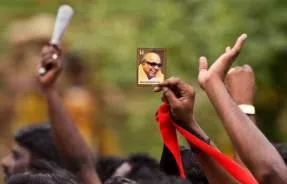
The last anchor the legacy of m karunanidhi
The modernising legacy of M. Karunanidhi will continue to shape the destiny of Tamil Nadu. The passing of Muthuvel Karunanidhi, president of the Dravida Munnetra Kazhagam (DMK) and titan (A person who is very important, powerful, strong, big, clever, etc.) of the Dravidian movement, has come at a critical juncture in the politics of Tamil Nadu. On the one hand, he leaves a power vacuum in his party that mirrors the space vacated by the late Jayalalithaa of the All India Anna Dravida Munnetra Kazhagam (AIADMK) in December 2016. On the other, his death heralds a deeply troubling time for Tamil Nadu, which has seen what some describe as a secular decline in governance quality in recent years. Both dimensions of the current scenario must be studied to better understand the prognosis for the State.Art of politics
Consider first what his passing means for the future of the DMK and the broader ripple effect on State politics. Historically and in the present day, there have always been vast complexities in the political mechanics of the DMK, and Karunanidhi was integral to every turn of its screw. From the early years of the Dravidian movement, when C.N. Annadurai and Periyar E.V. Ramasamy recognised their young protégé’s talent for firing up people through his mastery of Tamil and his fearlessness in pushing back on hegemonic (Leadership or dominance, especially by one state or social group over others) Brahminism, to the later years when after his meteoric rise to Chief Ministership of the State, he was noticed on the national stage for his brilliance as a party organiser, Karunanidhi’s identity was inseparable from his party’s for half a century.
Yet it was the subtle art of compromise that marked the ascendancy of the DMK for the best part of nearly 20 years in government, ever since it seized control from the Congress juggernaut in 1967. It was compromise that enabled Karunanidhi to hold the party together after the debilitating split with M.G. Ramachandran and the subsequent emergence of its arch-rival in 1972. It was compromise that deepened the DMK’s electoral grip in constituencies across 32 districts, each with a different caste group dominating it, the leaders of each such middle and backward caste group clamouring for a share of the spoils of power. What immense knowledge of local issues and traditions, what a profound negotiating ability, and what a decisive personality it must take to bring together Mudaliars, Gounders, Pillais, Chettiars, and a smattering of Dalits and Thevars together into a veritable rainbow coalition of castes.
Effects of compromise
Later, the acknowledged heavyweight of southern politics made his presence felt on the national scene in a similar manner – with firm moral conviction in his vision of Tamil rights and welfare, but the flexibility to be accommodative toward that end. His most drastic compromise came in 1999, when he entered into an alliance with the Bharatiya Janata Party (BJP), which stood for everything that the radical phase of Dravidianism militated against: Hindu nationalism, North India-based political vision, Hindi roots and hegemony of upper castes. That was a short-lived foray and, some argue, the result of expediency as he otherwise risked having his government dismissed for the third time by the Central government.
Whatever the faults of this open-ended approach to compromise, it resulted in a key differentiating factor for the DMK vis-à-vis the AIADMK — the party leadership structure under Karunanidhi did not get eroded to the extent that it did under both MGR and Jayalalithaa. Thus, today, the power vacuum of the DMK is mitigated to the extent that it had a formal succession plan in appointing Karunanidhi’s son M.K. Stalin as working president, even if he remains untested at the helm in State and national elections. Jayalalithaa, contrarily, degraded at least four rungs of leadership beneath her, with the consequence that multiple vectors of contested power — a quelled rebellion led by O. Panneerselvam, a persistent, deep-pocketed challenge by T.T.V. Dhinakaran — have riven her party asunder, and bitter factionalism has filled the space her unvarnished ((of a statement or manner) plain and straightforward) authoritarianism had held captive.
With this asymmetric balance of power in the two major Dravidian parties, the inevitable has happened: the door has opened for opportunistic “outside” parties with long-term ambitions of breaching the Dravidian dam to start meddling in Tamil Nadu’s affairs. For the BJP, this could be achieved by funnelling enormous amounts of money to finance the campaigns and coffers of parties and individuals with whom it could potentially form alliances. Similarly, the long arm of federal enforcement agencies, such as the CBI and the Income Tax department, may be used to punish and reward as required. Even the office of Governor may not be beyond the pale in a politically fraught climate, where procedural delays or discretionary actions can materially affect power outcomes.
Needs of Tamil people
This politically fluid situation brings us to the second dimension of the broader impact of Karunanidhi’s passing: the needs of the common Tamil man and woman today. It is highly unlikely that they still require the same basket of welfare goods that the Dravidian movement leaders decided to provide them with in the late 1960s. Do they need State autonomy for fear of a distant New Delhi running roughshod over ethnic Tamil rights? Not any more. Do they require an ever-expanding offering of mass welfare policies mimicking the mid-day meal scheme, and giveaways of subsidised rice, colour television sets, bicycles and more? That space has already been saturated, often to the point of bankrupting the State, as it nearly happened around the turn of the century.
What has changed over recent decades, however, is the quality of governance. Under Jayalalithaa and Karunanidhi, benevolent autocracy went hand-in-hand with the relentless pursuit of rent-seeking opportunities. During years of AIADMK rule this meant unhinged grand larceny (Theft of personal property) and extortion of private capital across the State — often at the behest of the rapacious V.K. Sasikala clan. When the DMK governed, it took a slightly less brazen, but equally damaging, form of shadowy nepotism of the “First Family” giving them control over gargantuan resources in telecom and other sectors.
Unsurprising then, that this has deepened the systemic institutional rot and contributed to a deterioration of the policy environment to the point where numerous industries have fled to other States. Simultaneously the weakening of government institutions has meant that the State’s response to multiple socio-political crises has been lacklustre, if not utterly inadequate. The long list here would include the bumbling approach to the Jallikattu and Sterlite protests, mismanagement of water resources resulting in floods in Chennaiand periodic drought-like conditions elsewhere, disparate crises facing sectors such as sand and electric power, and the cloud of collective uncertainty that all of these vagaries engender, putting a question mark on the economic future of Tamil Nadu.
Call for stability
The answer to the question of what the people of Tamil Nadu need today is thus a simple one: stability and the return of good governance. Yet that requires a wounded, limping AIADMK to have the foresight to set aside personal rivalries and hatred and pull itself together under one leader for the greater good; or if that is looking unlikely, it requires an aspirational Stalin to seize the day, infuse newfound energy into his party cadres and mobilise his constituents like never before. He can only steer the DMK ship through the choppy waters of Tamil Nadu’s turmoil if he recasts the Dravidian movement’s commitment to the Tamil ethos in a modern mould, reinventing the very design of his vehicle and charting a new course. It is here that the legacy of Karunanidhi matters most, as he was the last anchor to a political tradition that will continue to shape the destiny of the State.



Top court quashes FIRs against Gen Z protesters
Sep 04, 2026






Stay updated with The Hindu Editorial Vocab24 app, your definitive source for breaking news and comprehensive coverage from India and around the globe. Whether it's political developments, business updates, sports highlights, the latest technology trends, or current events, The Hindu brings live, accurate, and reliable news directly to your device.
Don’t fall for sensationalized or fake news shared online. Read and share accurate updates with friends and family through The Hindu Editorial Vocab24 app. Download it today!
News Coverage in The Hindu Editorial Vocab24 App
Breaking News: Receive instant notifications on breaking news stories as they unfold. Stay informed about major events and developments in India and around the world with live blogs, news in shorts videos, and concise articles.
Politics: Get the latest updates on Indian politics, including elections, policy changes, government decisions, and political events that shape the nation.
Business and Economy: Stay ahead in the economic landscape with detailed business news and market analysis. Learn about stock market trends, financial reports, corporate news, and economic developments to make informed investment decisions.
Current Events: Follow stories on social issues, policy changes, global events, and daily current affairs, tailored for UPSC and other competitive exam preparations.
Technology: Keep up with the latest gadgets, innovations, and tech trends. Read expert reviews and analyses in short, concise updates on cutting-edge technology from India and beyond.
Sports: Never miss a moment of your favorite sports. Get live scores, match reports, and expert analysis on cricket, football, tennis, and more.
International News: Stay informed about global events and geopolitical developments, including the Russia-Ukraine war, Israel-Palestine conflict, and other key international stories.
Local News: Stay connected to your community with the latest updates on city events, issues, and local news. Coverage includes hyperlocal updates from cities like Bangalore, Chennai, Delhi, Hyderabad, Mumbai, Kolkata, and more.
Trending Topics: Discover what's trending today with the most talked-about stories and hot topics across India and the world.
Experience journalism that values integrity, accuracy, and reliability. Download The Hindu Editorial Vocab24 app today and stay connected with the world.
Subscribe to our newsletter!







