

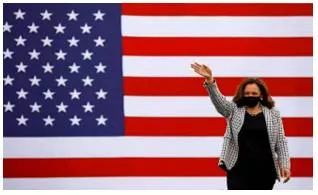
The kamala moment in indian american politics
Attempts to shape the disapora’s politics as an extension of the BJP’s cultural nationalism in India have hit a barrier.The media attention on Indian Americans is disproportionate to their numerical strength due to their mobilisation by Prime Minister Narendra Modi. The spotlight became sharper with the rise of Kamala Harris, as the vice-presidential candidate of the Democratic Party. Mr. Modi raised the tempo of Indian American politics to unprecedented highs; the rise of Ms. Harris shows the limits of India’s diaspora politics.
A red shift, but more blue
Mr. Modi’s camaraderie with U.S. President Donald Trump, in isolation, could be considered tactical. When taken together with India’s refusal to engage with the Indian American lawmakers on the Democratic side, it became a public signalling of preference for the Republicans over the Democrats.
Surveys suggest a shift of Indian Americans from the Democratic camp to the Republican side, though an overwhelming majority continues to be with the first. Around 22% of Indian Americans support Mr. Trump, according to the Indian American Attitudes Survey (IAAS), while 68% (or 72% of the registered voters in the study) support Democrat Joe Biden. Compared with the 2016 post-poll National Asian American Survey (NAAS), Mr. Biden is at nine points lower than Hillary Clinton’s 77%; and Mr. Trump is at six points higher than his 16% in 2016. The 2020 Asian American Voter Survey shows Mr. Trump at 28% among Indian Americans, a 12 point jump from the 2016 post-poll survey. The ambiguity towards Ms. Harris is louder. Only less than half, 49%, are “more enthusiastic” about the Democratic ticket because of her candidacy, while 15% are “less enthusiastic” because of her candidacy; and only 45% Indian Americans are “more likely” to vote because one among them is a candidate. All this in a cohort in which support for Democrats is overwhelming otherwise.
Diaspora activists, groups
Whether this is an outcome of any campaign by Hindutva diaspora groups is a more complicated question. Only 51% of Indian Americans are Hindus; and the support for Mr. Trump is highest among the 18% Christians. A survey among 520 randomly selected Indian Americans by Prof. Amitabh Mattoo suggests everything else being equal, up to 40% would vote for a candidate endorsed by Mr. Modi, while 20% disagreed with the idea.
Indian American politics has elements of nostalgia and grievance (the self-perception of being exiled by appeasement politics) with regard to India, and victimhood (racist experiences) and exceptionalism (claims of ‘the model minority’) in the U.S. Diaspora politics of Hindutva groups has reinforced these sentiments since 2014. Simplistic and ignorant American views of India as Hindu, vegetarian and a place ruined by socialism of the past are lapped up and relayed back by Hindutva diaspora activists.
Indian American politicians, both Democrats and Republicans, are difficult to fit in the Hindutva straitjacket. On the Republican side, Nikki Haley and Bobby Jindal are Christians and the former also ‘white.’ Democrats Ro Khanna and Pramila Jayapal are practising Hindus but critical of Hindutva.
The same groups that were celebrating the fact that Ms. Jayapal took oath of office on the Bhagavad Gita in 2017 now oppose her for expressing concerns regarding Indian policies; Ms. Harris was attacked for a poster that depicted her as a Hindu goddess, though Indian leaders routinely appear as gods and goddesses.
Hyphenated identities
The IAAS shows younger Indian Americans have more liberal views than their parents. Keeping the new generation on a tight leash is a key focus of Indian American activism, across all religious groups. At the World Hindu Congress (WHC) in Chicago in 2018, an exhibition that was pulled out after outrage, was titled ‘Interfaith marriages: Silent Holocaust of Hindus’. It warned youngsters of the dangers of such marriages — a topic that triggers intense reaction among cultural warriors at home and abroad.
Ms. Harris was born to parents who married interfaith, and she herself has married interfaith. India’s official policy has also leaned towards narrowing ‘Indian American’ to ‘Hindu American’, going against the grain of the Democratic Party which prefers wider categories to negotiate a landscape of increasing diversity. The Democrats underscore Ms. Harris’ identities as African American and South Asian, a category that Hindutva groups abhor. ‘Indian American’, as a typical hyphenated American identity, assumes a certain homogeneity across diverse linguistic and religious groups from India, and adds respectability to dual national loyalties, which is an accusation against minorities in India. However, double hyphenated identities throw not only diaspora politics but even India’s visa policy into a tailspin. Ms. Harris is African-Indian-American, or African-South Asian-American. American citizens of India-Pakistan mixed parentage find it impossible to travel to India, due to visa restrictions put in place during the United Progressive Alliance government, after the David Headley episode. The efforts to tap diaspora resources for advancing India-U.S. ties, also sought to streamline the community as an extension of the domestic cultural nationalism, by emphasising its Hindu identity. The Indian Embassy in Washington DC stopped celebrating Muslim festivals. The Chicago WHC had the Vice-President of India in attendance and the wholesome participation of Indian missions in the U.S.
It is damaging at two levels at least. First, it accentuated the pre-existing divisions within the Indian American community on religious, caste and generational lines, in part mirroring trends within India, besides pushing it to delink from the larger south Asian identity. Second, the attempts by groups to corner Indian American lawmakers on Hindutva questions and the India-Pakistan conflict have created a self-defeating dynamics. If their careers are harmed, it is a net loss for the community. If they come to power, there is damage control to be done. At any rate, American-born Indian Americans appear to be taking a hard look at developments in India in light of the nativist politics around them.
A soft touch might work
Indian Americans may well be culturally rooted, but that does not automatically make them puppets of Hindutva cultural politics in the U.S. Those who might gladly support cultural nationalism in India need cultural diversity in the U.S. for self-preservation, and ally with the Democrats. Biden supporters are largely Modi supporters too. They might occasionally find common cause with the Republicans on the question of Islam, but will remain suspects in the highly Judeo-Christian world. In an inverse situation, Christians who are unlikely supporters of the majority cultural politics in India, appear to be enthusiastic about it in the U.S. Engagement with the diaspora can be beneficial for India, but aggressive efforts to navigate it can be counterproductive. Indian Americans will increasingly be like Kamala Harris — impossible to fit in any straightjacket.



Top court quashes FIRs against Gen Z protesters
Sep 04, 2026






Stay updated with The Hindu Editorial Vocab24 app, your definitive source for breaking news and comprehensive coverage from India and around the globe. Whether it's political developments, business updates, sports highlights, the latest technology trends, or current events, The Hindu brings live, accurate, and reliable news directly to your device.
Don’t fall for sensationalized or fake news shared online. Read and share accurate updates with friends and family through The Hindu Editorial Vocab24 app. Download it today!
News Coverage in The Hindu Editorial Vocab24 App
Breaking News: Receive instant notifications on breaking news stories as they unfold. Stay informed about major events and developments in India and around the world with live blogs, news in shorts videos, and concise articles.
Politics: Get the latest updates on Indian politics, including elections, policy changes, government decisions, and political events that shape the nation.
Business and Economy: Stay ahead in the economic landscape with detailed business news and market analysis. Learn about stock market trends, financial reports, corporate news, and economic developments to make informed investment decisions.
Current Events: Follow stories on social issues, policy changes, global events, and daily current affairs, tailored for UPSC and other competitive exam preparations.
Technology: Keep up with the latest gadgets, innovations, and tech trends. Read expert reviews and analyses in short, concise updates on cutting-edge technology from India and beyond.
Sports: Never miss a moment of your favorite sports. Get live scores, match reports, and expert analysis on cricket, football, tennis, and more.
International News: Stay informed about global events and geopolitical developments, including the Russia-Ukraine war, Israel-Palestine conflict, and other key international stories.
Local News: Stay connected to your community with the latest updates on city events, issues, and local news. Coverage includes hyperlocal updates from cities like Bangalore, Chennai, Delhi, Hyderabad, Mumbai, Kolkata, and more.
Trending Topics: Discover what's trending today with the most talked-about stories and hot topics across India and the world.
Experience journalism that values integrity, accuracy, and reliability. Download The Hindu Editorial Vocab24 app today and stay connected with the world.
Subscribe to our newsletter!







