

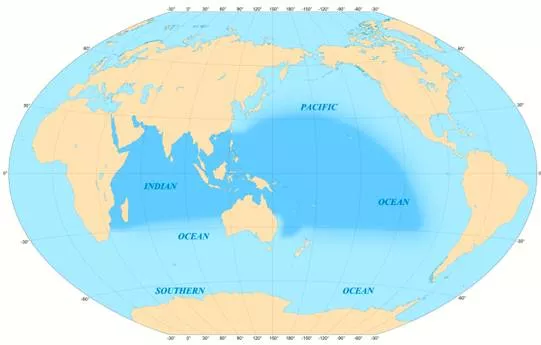
The indo > pacific ocean initiative
At the 14th E. Asia Summit Prime Minister Narendra Modi has proposed a new and secure maritime zone in the Indo Pacific region indicating a bigger role for India to play and countering the hegemonic and expanding role of China. The East Asia summit is a premium forum in the Asia-Pacific region dealing with the issues of security and defence, consisting countries of 10 ASEAN and India, China, Republic of Korea, Australia, New Zealand, Japan, USA and Russia. The initiative was immediately welcomed by countries like Australia and New Zealand.Indo-Pacific : What it is The Indo-Pacific region always has a meaning of different natures for different countries. Geographically it comprises the tropical waters of the Indian Ocean, the western and central Pacific Ocean, and the seas connecting the two in the general area of Indonesia.
The Indo-Pacific region has gained currency in recent times. Like every imagined space, there is disagreement over what characterizes the space and who imagines it. In terms of geo-spatiality, the Indo-Pacific is broadly to be understood as an interconnected space between the Indian Ocean and the Pacific Ocean. Its expanse is debated to be ranging from the eastern shores of Africa to the western coast of the United States, albeit with variations in definitions depending on each actor and their own geographic positioning in the vast expanse. In a more functional understanding, the interconnectedness and the interdependence of the two oceans is a product of growing forces of globalization, trade and changing equations between various actors which has broken down older boundaries and opened up new avenues. Growing mobility across the oceans has helped formulate an integrated approach. Given that it contains the world’s most crucial sea routes, the world’s most populous nations fueling high energy demands on its rims and a stretch encapsulating finest global commons, the Indo-Pacific is adjudged to be the center of the globe in terms of politics and economics.
Strategically, the Indo-Pacific has been seen as a continuum across the two oceans joined together by its main trading channel, the straits of Malacca. Two broad reasons explain the rise of a strategic imagination of the Indo-Pacific. First, the growing footprint of China across the length and breadth of the region and second, the relative decline of the U.S. alliance system and its strive for resurgence.
Beijing’s maritime advances have sprawled across the two oceans in a bid to secure its energy requirements and boost its trading ties. China’s rise has taken multiple forms. In the South China Sea, its irredentist claims have been showcased through territorial advances. Its growing strides in South Asian waters alongside the “string” of port facilities across the Indian Ocean is likely to make it a resident power. In terms of connectivity and infrastructure, the Belt and Road Initiative puts forward the Chinese-led plan to bind the geopolitical space. Economically, China is a crucial trading partner for all the major states in the region and also taking active interests to lead the economic partnerships of the region.
The rise of China is to be read alongside a relative decline of the U.S. presence in the region. While the United States still is a net-security provider in the region for its allies and possesses the most potent navy, its strategies have left the door open for China in some cases and harmed its own allies in the rest. Although the United States has accorded renewed importance to the Indo-Pacific by a significant renaming of the U.S. Pacific Command to the Indo-Pacific command, its unilateral withdrawal from the Trans-Pacific Partnership and continuous calls for equitable burden-sharing for its allies has left its alliance system in limbo. Added to that, it has been unable to blow steam into the Quad grouping of like-minded democracies, comprised also of Australia, Japan and India in order to build the much touted “free and open Indo-Pacific.”
India and The Region: India’s efforts to advance its Indo-Pacific vision can be traced in the following spheres:
Maritime Domain Awareness: The induction of the P8-I long-range maritime patrol aircraft in 2015 at INS Rajali, Arakkonam, and the inauguration of the Information Fusion Centre at Gurugram, in December 2018 clearly reflect India’s aims to collaborate with partner countries and multinational agencies to develop maritime awareness, share information on commercial cargo vessels, and strengthen inter-navy linkages through training and professional interactions.
Operational outreach of the Indian Navy: In July 2018, the Indian Navy put forward “new mission based deployment” in the Indian Ocean, involving mission-ready ships and aircraft along critical sea-lanes of communication. The access given to the port of Sabang by Indonesia last year is already improving the outreach of the Navy.The commissioning of a new air base—INS Kohassa in the Andaman and Nicobar Islands—by the Indian Navy in January 2019 to expand operational presence in the Indian Ocean is also significant.
Strategic coherence: In March 2015, Prime Minister Modi put forward the concept of ‘SAGAR’ (Security and Growth for All in the Region), a maritime initiative aimed at enhancing a range of capacities, engaging with other countries, and fostering greater cooperation in the littoral. Worth mentioning in this context are the dialogues that have been conducted between India and other countries—like the 2+2 dialogue with the US, Japan, and Australia, the trilateral dialogues between India-Japan and US, India-Japan-Australia (JAI), Russia-India-China, India-Australia-Indonesia, and the Quadrilateral meetings between India, Japan, Australia and the US. The signing of the Shared Vision Statement of India-Indonesia Maritime Cooperation in the Indo-Pacific during Modi’s first visit to Indonesia in May 2018 is notable.Modi also visited Myanmar and Malaysia in 2018. The invitation to the 2018 Indian Republic Day celebrations—extended to the leaders of all ten ASEAN countries—underscored the significance of India’s Act East policy. In April 2019, India set up an Indo-Pacific wing in the Ministry of External Affairs. The division will integrate the IORA, ASEAN region, and the Quad to the Indo- Pacific table.
Joint exercises for better interoperability: The Indian Navy has been part of coordinated patrols with Indonesia (Ind-Indo CORPAT), and joint naval (AUSINDEX) and air (Pitch Black) exercises with Australia. The first ever India-Myanmar bilateral joint military exercise (IMBAX) took place in November 2017, and in 2018 the first bilateral naval exercise (IMNEX) was held. The first bilateral naval exercise between India and Indonesia—named Samudra Shakti—was conducted in 2018.
Capacity Building: In August 2018, India was given the status of STA-1 (Strategic Trade Authorisation) from the US for hi-tech product sales, particularly in the civil space and defence sectors. Furthermore, India will start defence component manufacturing for the F-16 and C-130 aircraft. India has also provided training to Vietnamese combat pilots and given technical support to the Myanmar Navy.
Maritime infrastructure: India is developing Sittwe port in Myanmar’s Rakhine State and implementing the US$484 million Kaladan transport project to connect Rakhine State with India’s northeast state of Mizoram.
Trade: Trade and economic relations between ASEAN and India have seen a rise, and the two-way trade between India and ASEAN has risen from US$35 billion in 2007 to US$65 billion in 2016. Both exports and imports almost doubled over the same period, from US$14 billion and US$21 billion respectively in 2007, to US$26 billion and US$38 billion respectively in 2016 (See Figure 13). India stands as ASEAN’s 11th largest trading partner in the year 2016.
The way forward:
Indo-pacific region has its own importance in terms of strategic geopolitics, resources and security aspects. Since China is big guerrilla in the room. Instead of countering the hegemonic superpower India needs to build its own strength. Being the fastest growing economy since last few years we have to maintain that, an alternative to china rather than a competitor will be best strategy to go forward.
Further withdrawing from RCEP may create a distrust for ASEAN towards India but still there is enough room to grow for India. We need to build the relations with each of the countries First individually, then at the joint level and finally at the regional level as China has played earlier.
What we need to focus is substance based supply, maintaining that supple and exploring the new avenues.
Indo german economic ties
Nov 05, 2019
A new dawn – jammu & kashmir and ladakh
Nov 02, 2019





Stay updated with The Hindu Editorial Vocab24 app, your definitive source for breaking news and comprehensive coverage from India and around the globe. Whether it's political developments, business updates, sports highlights, the latest technology trends, or current events, The Hindu brings live, accurate, and reliable news directly to your device.
Don’t fall for sensationalized or fake news shared online. Read and share accurate updates with friends and family through The Hindu Editorial Vocab24 app. Download it today!
News Coverage in The Hindu Editorial Vocab24 App
Breaking News: Receive instant notifications on breaking news stories as they unfold. Stay informed about major events and developments in India and around the world with live blogs, news in shorts videos, and concise articles.
Politics: Get the latest updates on Indian politics, including elections, policy changes, government decisions, and political events that shape the nation.
Business and Economy: Stay ahead in the economic landscape with detailed business news and market analysis. Learn about stock market trends, financial reports, corporate news, and economic developments to make informed investment decisions.
Current Events: Follow stories on social issues, policy changes, global events, and daily current affairs, tailored for UPSC and other competitive exam preparations.
Technology: Keep up with the latest gadgets, innovations, and tech trends. Read expert reviews and analyses in short, concise updates on cutting-edge technology from India and beyond.
Sports: Never miss a moment of your favorite sports. Get live scores, match reports, and expert analysis on cricket, football, tennis, and more.
International News: Stay informed about global events and geopolitical developments, including the Russia-Ukraine war, Israel-Palestine conflict, and other key international stories.
Local News: Stay connected to your community with the latest updates on city events, issues, and local news. Coverage includes hyperlocal updates from cities like Bangalore, Chennai, Delhi, Hyderabad, Mumbai, Kolkata, and more.
Trending Topics: Discover what's trending today with the most talked-about stories and hot topics across India and the world.
Experience journalism that values integrity, accuracy, and reliability. Download The Hindu Editorial Vocab24 app today and stay connected with the world.
Subscribe to our newsletter!







