

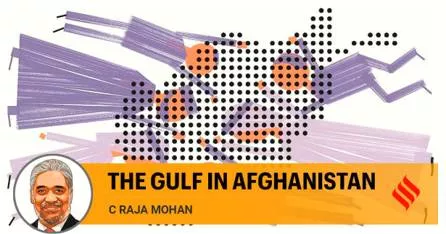
The importance of the gulf in shaping the geopolitics of afghanistan
The meetings of the “extended troika” this week in Doha, Qatar, are apparently aimed at reversing the current dangerous turn towards anarchy in Afghanistan. The US-Russia-China troika was set up in 2019 at Moscow’s initiative to support the negotiations for a peace settlement between the Afghan government and the Taliban. It has taken an “extended” form with the inclusion of Pakistan this year.Not everyone is sure if the “extended troika” has the political will to arrest the current military momentum in favour of the Taliban and Pakistan in Afghanistan. China and Russia are supporting Pakistan’s plans to reinstall the Taliban. Washington was indeed aware of the prospects of the Taliban regaining control of Afghanistan after it ended two decades of military presence in Afghanistan.
But President Joe Biden was as keen as his predecessor Donald Trump on ending America’s prolonged and costly military intervention in Afghanistan. But as the ugly consequences of the US retreat have come quickly into view, there is growing domestic criticism, across the political aisle, of Biden’s decision.
The foreign policy establishment is offering a critique of its own. In a statement issued last Friday, five former US envoys to Afghanistan warned of a “catastrophic outcome” triggered by US withdrawal and urged the White House to “reconsider the decision”.
They pointed to a truth about the Taliban that has been staring at the world for a while: “In consistently failing to engage the Afghan government in good-faith negotiations, the Taliban has signalled that it is going for all-out victory.”
They also called for the appointment of a new US representative for the Afghan talks — in a polite way asking for the replacement of current envoy, Zalmay Khalilzad, who is accused by some in Washington as giving away the store to the Taliban. The next few days could reveal if the domestic pressure is strong enough to persuade the Biden administration to take a fresh look at its Afghan policy.
But the Afghan story is not just about the great power rivalries. Any discussion of Afghanistan invokes two common metaphors — the “great game” or the “graveyard of empires”. These common tropes, however, tend to mask the significant role of the regional actors in Afghanistan’s evolution.
That Doha, the capital of the tiny state of Qatar, is now the main venue for the so-called peace talks on Afghanistan is a useful reminder of the regional role. Doha’s activism also underscores the importance of the Gulf in shaping the geopolitics of Afghanistan.
Over the decades, different nations from the Gulf have sought to influence the outcomes in Afghanistan. For now, it is Doha’s moment in the Afghan sun. Since 2011, it has formally hosted the Taliban delegation in Doha and taken the lead in promoting the so-called peace process in Afghanistan.
A decade later, it is quite clear, Qatar’s “peace project” in Afghanistan was about legitimising the Taliban at the expense of the current political order in Afghanistan. For Qatar, this is not a whimsical decision. It is very much part of its promotion of political Islam in the Greater Middle East and the subcontinent. It has also aligned with Turkey president Recep Tayyip Erdogan’s similar objectives in the region.
Qatar and Turkey are also locked in a regional rivalry with Saudi Arabia and the United Arab Emirates. Doha and Ankara’s support for political Islam is seen in Riyadh and Abu Dhabi as a deliberate effort to undermine their governments. That also brings us to the fact that before Qatar, it was Saudi Arabia and the UAE that played an important role in Afghanistan.
After the Soviet occupation of Afghanistan at the end of 1979, Saudi Arabia poured in significant resources to support the US-Pak mobilisation of a jihad in the 1980s against the godless communists in Kabul. And when the Taliban took charge of Afghanistan in 1996, Saudi and UAE were the only countries, other than Pakistan, to recognise the new political dispensation.
Saudi Arabia and the UAE have taken a back seat in the current regional diplomacy on Afghanistan. In recent years, Saudi Arabia and the UAE had sought to promote political reconciliation in Afghanistan but had little success in nudging the Taliban towards moderation. But there was a world before the Gulf Arabs became prominent in Afghanistan.
That world belonged to the Shah of Iran, whose close ties with the United States, growing oil revenues, and expansive ambition had made him the main regional actor in South West Asia. Well before the oil boom, the Shah sought to build a federation of Iran, Afghanistan and Pakistan, promote regional connectivity, and lead the economic modernisation of South West Asia.
The Shah’s efforts to draw Afghanistan into Tehran’s orbit in the 1970s triggered the 1978 coup in Kabul by Afghan communists, Moscow’s support for them, and the eventual Soviet military occupation. The tumultuous developments in Iran — ouster of the Shah and the founding of the Islamic Republic in 1979 — and the Iran-Iraq war of 1980-88 marginalised Iran from the Afghan geopolitics in the 1980s.
But not for long. Iran was back in the game during the 1990s as it worked with Russia and India to back the anti-Taliban coalition. Tehran also extended support for Washington’s efforts to oust the Taliban from power after the 9/11 attacks. But once the US declared Iran as part of the “axis of evil” in 2002, Tehran and Washington have been at odds in Afghanistan.
Although the monarchy and the Islamic republic are of a very different political colour, their regional ambitions in Afghanistan are quite similar and express the logic of Iran’s geography as well as Tehran’s enduring religious, cultural, and political interests.
Russia had invited Iran to join the extended troika meeting in Doha this week, but Tehran was unwilling. According to Zamir Kabulov, the Russian special envoy on Afghanistan, Iran did not want to sit at the same table with the US. It is entirely possible that Tehran does not want to be complicit in the political marketing of the Taliban.
Kabulov also explained Moscow’s decision not to invite India to the Doha talks this week. Kabulov said the extended troika meetings involve only those countries that have “unequivocal influence on both sides” of the Afghan divide, Russian news agency Tass reported.
Besides India’s lack of a Taliban connection, Kabulov said, Delhi’s presence will bring in the baggage of Indo-Pak rivalry into the Afghan talks. “A plague on both your houses”, Kabulov concluded. Kabulov suggested India could be invited to the troika talks when they arrive at the stage of post-conflict economic reconstruction.
But the idea that great powers can shepherd the regional actors towards pre-defined goals in Afghanistan is an illusion. American abandonment of Afghanistan and the promotion of the Taliban by Russia and China will inevitably set off a chain of regional reactions that are not amenable to the troika’s control.
There are too many independent actors in the region with high stakes in Afghanistan. They will figure out ways and means to cope with the new Afghan dynamic. India’s intensifying consultations with Iran is one example. Saudi Arabia and the UAE, whose interests are threatened by Taliban’s religious extremism, are not going to sit back forever. Integration of the Gulf into India’s regional security calculus is now likely to be a permanent feature.










Stay updated with The Hindu Editorial Vocab24 app, your definitive source for breaking news and comprehensive coverage from India and around the globe. Whether it's political developments, business updates, sports highlights, the latest technology trends, or current events, The Hindu brings live, accurate, and reliable news directly to your device.
Don’t fall for sensationalized or fake news shared online. Read and share accurate updates with friends and family through The Hindu Editorial Vocab24 app. Download it today!
News Coverage in The Hindu Editorial Vocab24 App
Breaking News: Receive instant notifications on breaking news stories as they unfold. Stay informed about major events and developments in India and around the world with live blogs, news in shorts videos, and concise articles.
Politics: Get the latest updates on Indian politics, including elections, policy changes, government decisions, and political events that shape the nation.
Business and Economy: Stay ahead in the economic landscape with detailed business news and market analysis. Learn about stock market trends, financial reports, corporate news, and economic developments to make informed investment decisions.
Current Events: Follow stories on social issues, policy changes, global events, and daily current affairs, tailored for UPSC and other competitive exam preparations.
Technology: Keep up with the latest gadgets, innovations, and tech trends. Read expert reviews and analyses in short, concise updates on cutting-edge technology from India and beyond.
Sports: Never miss a moment of your favorite sports. Get live scores, match reports, and expert analysis on cricket, football, tennis, and more.
International News: Stay informed about global events and geopolitical developments, including the Russia-Ukraine war, Israel-Palestine conflict, and other key international stories.
Local News: Stay connected to your community with the latest updates on city events, issues, and local news. Coverage includes hyperlocal updates from cities like Bangalore, Chennai, Delhi, Hyderabad, Mumbai, Kolkata, and more.
Trending Topics: Discover what's trending today with the most talked-about stories and hot topics across India and the world.
Experience journalism that values integrity, accuracy, and reliability. Download The Hindu Editorial Vocab24 app today and stay connected with the world.
Subscribe to our newsletter!







