

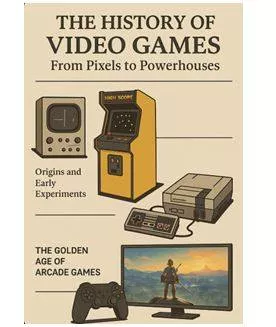
The history of video games from pixels to powerhouses
IntroductionThe video game industry, now a multi-billion-dollar global enterprise, began humbly with experiments in electronic entertainment in the mid-20th century. What started as a few lines of code and blinking dots on a screen has transformed into hyper-realistic, immersive worlds enjoyed by billions. The history of video games is a fascinating journey through innovation, cultural shifts, and technological revolutions, tracing how interactive digital entertainment evolved into a dominant force in modern media.
________________________________________ Origins and Early Experiments (1940s–1960s)
The roots of video gaming can be traced back to the late 1940s and 1950s, during the rise of computing technology. In 1947, Thomas T. Goldsmith Jr. and Estle Ray Mann patented the Cathode Ray Tube Amusement Device, often considered the earliest interactive electronic game.
However, the first true step toward what we now recognize as video games came in 1958, when physicist William Higinbotham created Tennis for Two. Displayed on an oscilloscope, it allowed two players to volley a dot back and forth, simulating tennis. Another landmark came in 1962 with MIT student Steve Russell’s Spacewar!, a two-player spaceship combat game developed on a PDP-1 mainframe computer.
Though these games were not commercial products, they laid the groundwork for interactive gameplay and influenced future developers.
________________________________________ The Birth of the Industry (1970s)
The 1970s marked the commercialization of video games. In 1971, Computer Space—the first coin-operated video arcade game—was released by Nolan Bushnell and Ted Dabney. It was based on Spacewar! but proved too complex for casual players. Learning from this, Bushnell founded Atari in 1972 and released Pong, a table tennis-style game that became a massive hit and the first commercially successful arcade video game.
The same year, Magnavox released the Odyssey, the first home video game console. Though primitive, it brought interactive entertainment into living rooms for the first time.
By the mid-70s, the industry saw rapid growth. Atari, Taito, and Midway began producing arcade hits like Breakout (1976) and Space Invaders (1978), the latter sparking an arcade boom and laying the foundation for gaming as a mainstream entertainment form.
________________________________________ The Golden Age of Arcade Games (Late 1970s–Mid-1980s)
The period from the late '70s to mid-'80s is known as the Golden Age of Arcade Games. Titles like Pac-Man (1980), Donkey Kong (1981), Frogger (1981), and Galaga (1981) became cultural icons. These games introduced characters, storylines, and gameplay mechanics that would influence future generations.
Arcades became social hotspots, and competitive gaming emerged with players vying for high scores. This era saw the rise of game developers like Namco, Capcom, and Konami, whose games became household names.
Meanwhile, home consoles also began evolving. Atari’s 2600, launched in 1977, popularized interchangeable cartridges and brought arcade-like experiences home. However, an oversaturated market with poor-quality games eventually led to the 1983 video game crash in North America.
________________________________________ The Console Renaissance and Nintendo's Rise (Mid-1980s–1990s)
The video game market rebounded dramatically in 1985 with the launch of the Nintendo Entertainment System (NES). Nintendo revived the industry with polished titles like Super Mario Bros., The Legend of Zelda, and Metroid. These games featured memorable characters, deeper gameplay, and quality controls.
Nintendo's dominance was challenged in the early 1990s by Sega's Genesis console and its edgier mascot, Sonic the Hedgehog. This sparked the first major ‘console war,’ pushing innovation in graphics, gameplay, and marketing.
Meanwhile, handheld gaming emerged with the Game Boy (1989), bringing hits like Tetris and Pokémon to portable devices.
________________________________________ The 3D Revolution and Rise of Sony (Mid-1990s–2000s)
The fifth generation of consoles, including the Sony PlayStation (1994), Nintendo 64 (1996), and Sega Saturn, ushered in 3D graphics. This era changed how games were designed and experienced, with titles like Final Fantasy VII, Tomb Raider, Super Mario 64, and Metal Gear Solid pushing storytelling, design, and technical boundaries.
Sony’s PlayStation was particularly influential, introducing CD-ROMs over cartridges and appealing to older, more mature audiences. This helped video games transition from being ‘for kids’ to a more diverse and accepted entertainment medium.
In the 2000s, the sixth generation introduced consoles like the PlayStation 2 (the best-selling console of all time), Xbox, and GameCube, expanding graphics, AI, and multiplayer capabilities. Microsoft’s Halo franchise made online multiplayer a standard feature on consoles, especially with the launch of Xbox Live in 2002.
________________________________________ Online Gaming and Mobile Revolution (2000s–2010s)
With the rise of broadband internet, online multiplayer gaming flourished. Games like World of Warcraft (2004), Counter-Strike, and Call of Duty changed how players interacted globally.
Meanwhile, casual gaming exploded with the rise of mobile phones and social media platforms. Titles like Angry Birds, Candy Crush, and Clash of Clans brought gaming to a broader, non-traditional audience.
Nintendo’s Wii (2006) introduced motion controls and emphasized family-friendly gaming, becoming a surprise hit with non-gamers and elderly players alike. The DS and later 3DS handhelds also cemented Nintendo’s strength in the mobile gaming sector.
________________________________________ The Era of Streaming, eSports, and Virtual Worlds (2010s–Present)
Recent years have seen a convergence of gaming, streaming, and social media. Platforms like Twitch and YouTube Gaming allow players to broadcast their gameplay to millions, creating celebrity streamers and entire communities around games.
eSports has grown into a professional and lucrative industry. Games like League of Legends, Dota 2, and Valorant now host international tournaments with millions in prize money and viewership rivaling traditional sports.
Technologies like VR (Virtual Reality) and AR (Augmented Reality) have added new layers of immersion. Games such as Beat Saber and Pokémon Go show how interactivity is evolving again.
Cloud gaming (like Google Stadia and Xbox Cloud Gaming) is attempting to remove the barrier of hardware entirely, allowing users to stream high-quality games on almost any device.
________________________________________ Conclusion
From blinking dots on radar screens to lifelike digital worlds, the history of video games is a story of imagination, persistence, and revolution. What began as niche experiments by engineers has evolved into one of the most powerful mediums for storytelling, community-building, and global interaction.
As technology continues to advance with AI-driven design, neural input, and augmented realities, the future of gaming is bound to be just as dynamic and transformative as its past. Video games are no longer mere play—they are culture, economy, art, and identity.






Stay updated with The Hindu Editorial Vocab24 app, your definitive source for breaking news and comprehensive coverage from India and around the globe. Whether it's political developments, business updates, sports highlights, the latest technology trends, or current events, The Hindu brings live, accurate, and reliable news directly to your device.
Don’t fall for sensationalized or fake news shared online. Read and share accurate updates with friends and family through The Hindu Editorial Vocab24 app. Download it today!
News Coverage in The Hindu Editorial Vocab24 App
Breaking News: Receive instant notifications on breaking news stories as they unfold. Stay informed about major events and developments in India and around the world with live blogs, news in shorts videos, and concise articles.
Politics: Get the latest updates on Indian politics, including elections, policy changes, government decisions, and political events that shape the nation.
Business and Economy: Stay ahead in the economic landscape with detailed business news and market analysis. Learn about stock market trends, financial reports, corporate news, and economic developments to make informed investment decisions.
Current Events: Follow stories on social issues, policy changes, global events, and daily current affairs, tailored for UPSC and other competitive exam preparations.
Technology: Keep up with the latest gadgets, innovations, and tech trends. Read expert reviews and analyses in short, concise updates on cutting-edge technology from India and beyond.
Sports: Never miss a moment of your favorite sports. Get live scores, match reports, and expert analysis on cricket, football, tennis, and more.
International News: Stay informed about global events and geopolitical developments, including the Russia-Ukraine war, Israel-Palestine conflict, and other key international stories.
Local News: Stay connected to your community with the latest updates on city events, issues, and local news. Coverage includes hyperlocal updates from cities like Bangalore, Chennai, Delhi, Hyderabad, Mumbai, Kolkata, and more.
Trending Topics: Discover what's trending today with the most talked-about stories and hot topics across India and the world.
Experience journalism that values integrity, accuracy, and reliability. Download The Hindu Editorial Vocab24 app today and stay connected with the world.
Subscribe to our newsletter!







