

The green doctor who restored delhi’s lungs
When CR Babu was given the charge to make a biodiversity park on the banks of the Yamuna in Delhi in 2001, he was appalled that the 156 acres of land only had some salt-loving bushes and common weeds.Babu, then Delhi University pro-vice-chancellor and head of the Centre for Environment Management of Degraded Ecosystems (CMEDE) under the university, found the underground water to be highly saline even at the depth of 20 feet at Jagatpur village, where the park was supposed to be made.
The nilgai have found a home in Yamuna biodiversity park
Today, looking at the Yamuna Biodiversity Park, it is hard to imagine that it is man-made and it came out of such barrenness. The park is the first of its kind globally. Babu took up the project as a challenge and an opportunity. It has paid off.
: The biodiversity parks developed by CR Babu now attract a variety of wildlife, including birds
The park is now home to thousands of forest communities, fruit-yielding species and medicinal herbs, biologically rich wetlands and hundreds of animals, birds, butterflies and insects.
‘We recruited scientists with the help of the Delhi Development Authority and studied the river basin stretch from Allahabad in Uttar Pradesh to Haridwar in Uttarakhand to identify plant species along the stretch,’ Babu said.
‘After 40-45 plant communities were identified, their saplings were planted at the site,’ he said. For two years, success eluded the team as ‘most of the plant species died because of the excessive salt’.
‘We then found some grass species in a saline area and the grass improved the soil from 12 pH to 7 pH. It made the soil neutral. It took almost 10 years to develop these three-storey forest communities with a tree canopy as high as 45 feet,’ Babu said. ‘We desilted the wetlands and used the material for landscaping and introduced aquatic plant species. In the first year of restoration of the wetlands, thousands of migratory birds arrived here,’ Babu added.
The park now attracts a large number of wild animals, birds and insects. Species of birds that were given up as lost have returned to the park, such as the black crowned night heron that has reappeared in the Tamarix and Phragmites plantations on the shallow wetland.
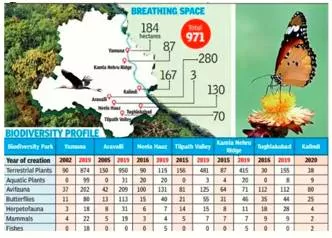
The restored Tamarix-Sacchharaum community also attracted a leopard in 2016. Hog deer, which was abundant in Delhi but lost, has made the park its home. Similarly, the Seibold snake Ferania sieboldii, lost some 70-80 years ago, was seen in the wetlands. The national capital now has seven biodiversity parks, which have been developed on such barren land. ‘It was a difficult task to create these parks. The Aravalli Biodiversity Park has been developed on a rocky habitat. Similarly, the Kamla Nehru Ridge, Tughlakabad Biodiversity Park and others had a lot of challenging problems such as monkey menace, invasive species and human disturbances,’ Babu, who is 81 and continues to steer the Biodiversity Parks Programme, said.
These biodiversity parks are the lungs of Delhi, one of the world’s most polluted cities. The three-storey-forest canopy helps in filtering pollutants, particularly PM1 and PM2. 5, from both point and nonpoint sources. They buffer the local weather conditions and help in carbon sequestration as a huge quantity of carbon is stored in the soil.
They also recharge groundwater and store floodwater: 1. 4 million gallons of rain was harvested by the seven biodiversity parks during the monsoon last year.
‘The plant resources can be used for drug development. They provide recreation to the public and students get practical environmental education at these parks,’ Babu said. Other states have started following the biodiversity park model for their cities.
‘The Union ministry of environment and forest and climate change has directed all chief ministers to create biodiversity parks in each state capital and all district head- quarters. Many states, including Uttar Pradesh, Bihar, Madhya Pradesh and Chhattisgarh have started making the parks. Our staff in the biodiversity parks are providing guidance to officials of these states,’ Babu said.
‘Sri Lanka and Bangladesh have also developed biodiversity parks,’ he added. The idea of the biodiversity park was born in 2001 when at a conference organised by the Delhi environment department, Babu threw light on the acute loss of biodiversity. His speech on the extinction of local species attracted the attention of then Lieutenant Governor Vijai Kapoor.
Faiyaz Khudsar, the scientist in charge of the Biodiversity Parks Programme at CMEDE, said maintaining biodiversity parks is an uphill task. ‘After restoration, it requires long-term monitoring for its survival. For instance, if any of the species is increasing in number, it is necessary to address the issue. It is difficult as one has to monitor it early in the morning and late in the night,’ he said.
Strike rate: 7 parks in 20 years
* Delhi Development Authority (DDA) in collaboration with Centre for Environment Management of Degraded Ecosystems (CMEDE) has developed seven biodiversity parks in Delhi in the past two decades.
* The model of biodiversity parks of Delhi is being adopted in different states of the country and in the Indian sub-continent
Why Delhi needs these parks
Many reasons, including urban sprawl, climate change, air and water pollution, population pressure, habitat loss, land degradation & deforestation
Valuable ecological services on offer
* Effective filter for both point and nonpoint source of air pollution
* Recharge ground water and store flood water. Contribute to rejuvenation of rivers
* Major sink for carbon dioxide and store huge carbon stocks. Buffer local weather conditions
* Serve as a natural habitat for vanishing flaura and fauna. Harbour a rich environment microbiome
* Rich plant resources can be used for developing drugs
* Platform for research on ecosystem, environmental education
* Recreation to public and promote eco-tourism












Stay updated with The Hindu Editorial Vocab24 app, your definitive source for breaking news and comprehensive coverage from India and around the globe. Whether it's political developments, business updates, sports highlights, the latest technology trends, or current events, The Hindu brings live, accurate, and reliable news directly to your device.
Don’t fall for sensationalized or fake news shared online. Read and share accurate updates with friends and family through The Hindu Editorial Vocab24 app. Download it today!
News Coverage in The Hindu Editorial Vocab24 App
Breaking News: Receive instant notifications on breaking news stories as they unfold. Stay informed about major events and developments in India and around the world with live blogs, news in shorts videos, and concise articles.
Politics: Get the latest updates on Indian politics, including elections, policy changes, government decisions, and political events that shape the nation.
Business and Economy: Stay ahead in the economic landscape with detailed business news and market analysis. Learn about stock market trends, financial reports, corporate news, and economic developments to make informed investment decisions.
Current Events: Follow stories on social issues, policy changes, global events, and daily current affairs, tailored for UPSC and other competitive exam preparations.
Technology: Keep up with the latest gadgets, innovations, and tech trends. Read expert reviews and analyses in short, concise updates on cutting-edge technology from India and beyond.
Sports: Never miss a moment of your favorite sports. Get live scores, match reports, and expert analysis on cricket, football, tennis, and more.
International News: Stay informed about global events and geopolitical developments, including the Russia-Ukraine war, Israel-Palestine conflict, and other key international stories.
Local News: Stay connected to your community with the latest updates on city events, issues, and local news. Coverage includes hyperlocal updates from cities like Bangalore, Chennai, Delhi, Hyderabad, Mumbai, Kolkata, and more.
Trending Topics: Discover what's trending today with the most talked-about stories and hot topics across India and the world.
Experience journalism that values integrity, accuracy, and reliability. Download The Hindu Editorial Vocab24 app today and stay connected with the world.
Subscribe to our newsletter!







