

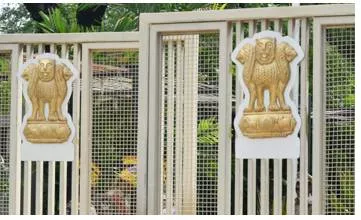
The extra constitutional delusions of raj bhavan
A tweet put out recently by the office of the Kerala Governor evoked nationwide attention for all the wrong reasons. It said: ‘... the statements of individual Ministers that lower the dignity of the office of the Governor can invite action including withdrawal of pleasure’. Raj Bhavan did not explicitly say that such Ministers would be expelled. But, going by the text of Article 164(1) of the Constitution — that the ‘Ministers shall hold office during the pleasure of the Governor’ — the indication was clear. This was made even more apparent when the Governor sent a letter to the Kerala Chief Minister asking him to act against the State Finance Minister, who, according to the Governor, had ‘ceased to enjoy’ the Governor’s ‘pleasure’. The Chief Minister declined to do so.There are political, constitutional facets
This unprecedented and curious gubernatorial gesture has political and constitutional facets. The Governor’s other move, in the meantime, for ousting Vice-Chancellors of universities in the State, alleging deficits in their appointment process, is purported to be in exercise of his statutory power as Chancellor. As against the Ministers, he has no such special power. He can only act within the bounds of the Constitution.
The function of the appointed Governor is always subject to the policies of the elected government, and not vice-versa. This is a foundational theory of India’s constitutional democracy. Constitutional provisions cannot be read in isolation. Article 163(1) says that the Council of Ministers must aid and advise the Governor. However, according to Article 163(2), the Governor can act in his discretion in certain matters as permitted by the Constitution. This would mean that the Governor is generally bound by the Cabinet decision except when he has a legitimate right to invoke his discretion, say, for example, in deciding on sanction to prosecute a Cabinet Minister or in his decisions as Administrator of a Union Territory, as per the orders of the President of India, etc. Article 164, which contains the provision relevant in the context of the Kerala Governor’s tweet and letter is inseparable from Article 163. Therefore, it follows that unless the Cabinet or the Chief Minister advises the expulsion of a Minister, the Governor cannot cause the exit of a particular Minister by ‘withdrawing pleasure’.
The jurist H.M. Seervai gave an explanation about the spirit of Article 163, which, in a way, is a prologue to Article 164(1) dealing with ‘pleasure’. He said, ‘if Governors have discretion in all matters under Article 163(1), it would be unnecessary to confer on Governors an express power to act in their discretion in a few specified matters (by way of Article 163(2))’ (Constitutional Law of India, Vol.2, Universal, 1993, page 2,037).
One finds a democratic reading of Article 164 in the Constitution Bench judgment of the Supreme Court of India in Shamsher Singh vs State of Punjab (1974). In Shamsher Singh, for the purpose of comparison, the Supreme Court extracted Dr. B.R. Ambedkar’s introductory statement made on November 4, 1948 in the Constituent Assembly, which said: ‘The President of the United States is not bound to accept any advice tendered to him by any of his secretaries. The President of the Indian Union will be generally bound by the advice of his Ministers. He can do nothing contrary to their advice nor can he do anything without their advice. The President of the United States can dismiss any Secretary at any time. The President of the Indian Union has no power to do so, so long as his Ministers command a majority in Parliament’.
The same principles apply to the Governors as well, since the Union Minister also holds the office ‘during the pleasure of the President’ as in Article 75(2) of the Constitution. ‘Withdrawal of pleasure’, without advice from the Council of Ministers, as indicated by Raj Bhavan is a misconception.
A titular head
Understanding the constitutional meaning of Article 164(1), which is different from its literal meaning, requires a historical reading of the provision. The draft Constitution, prepared by the Constitutional Adviser in October 1947, contained Article 126, according to which, ‘Governor’s Ministers shall be chosen and summoned by (the Governor) and shall hold office during his pleasure’. This Article, which was made part of the draft of the erstwhile Article 144, was discussed at length in the Constituent Assembly. The general discretion with the Governor was taken away, and the Cabinet was given the authority to rule. Amendment to the draft Article 144 moved by B.R. Ambedkar resulted in the present constitutional scheme of Articles 163 and 164.
Referring to the speech of Ambedkar, scholar Subhash C. Kashyap has put it pithily, ‘The words ‘during pleasure’ were, always understood to mean that the ‘pleasure’ should not continue when the Ministry had lost the confidence of the majority; and the moment the Ministry lost the confidence of the majority, the Governor would use his ‘pleasure’ in dismissing it’ (Constitutional Law of India, Vol. 2., Universal, 2015, page 1,249). Therefore, the Article implies that the Governor is only a titular head of the State and that if the Cabinet has majority, the Governor cannot act against the Cabinet.
Addressing a concern
The Governor’s office has a colonial origin. The Government of India Act, 1858 situated the post of Governor under the supervision of the Governor General. The subsequently promulgated Government of India Act, 1935 was enforced with effect from April 1, 1937. Even as per this act, Governors were to act based on the advice of the provincial Government.
The potential danger that could be posed by continuation of the colonial institution was a matter of concern for the makers of the Constitution. During the deliberations, H.V. Kamath asked if there was any guarantee against abuse of power by the Governor. The immediate reaction by P.S. Deshmukh, another prominent member was: ‘the guarantee…. is the Governor’s wisdom and the wisdom of the authority that will appoint the Governor’ (Constituent Assembly Debates, June 2, 1949).
But this romanticism of the Constitution was to be translated to a level of judicial realism and pragmatism, which the Supreme Court did in Shamsher Singh. Justice V.R. Krishna Iyer, in that judgment, and in his characteristic style, has given the best possible response to the extra-constitutional delusions of the Raj Bhavans: ‘The omnipotence of the President and of the Governor at State level is…. with the obvious intent that even where express conferment of power or functions is written into the Articles, such business has to be disposed of decisively by the Ministry answerable to the Legislature and, through it, vicariously to the people, thus vindicating our democracy instead of surrendering it to a single summit soul, whose deification is incompatible with the basics of our political architecture....’
So, the Constitution Bench has to prevail over the Governor’s tweet and letter.



Top court quashes FIRs against Gen Z protesters
Sep 04, 2026






Stay updated with The Hindu Editorial Vocab24 app, your definitive source for breaking news and comprehensive coverage from India and around the globe. Whether it's political developments, business updates, sports highlights, the latest technology trends, or current events, The Hindu brings live, accurate, and reliable news directly to your device.
Don’t fall for sensationalized or fake news shared online. Read and share accurate updates with friends and family through The Hindu Editorial Vocab24 app. Download it today!
News Coverage in The Hindu Editorial Vocab24 App
Breaking News: Receive instant notifications on breaking news stories as they unfold. Stay informed about major events and developments in India and around the world with live blogs, news in shorts videos, and concise articles.
Politics: Get the latest updates on Indian politics, including elections, policy changes, government decisions, and political events that shape the nation.
Business and Economy: Stay ahead in the economic landscape with detailed business news and market analysis. Learn about stock market trends, financial reports, corporate news, and economic developments to make informed investment decisions.
Current Events: Follow stories on social issues, policy changes, global events, and daily current affairs, tailored for UPSC and other competitive exam preparations.
Technology: Keep up with the latest gadgets, innovations, and tech trends. Read expert reviews and analyses in short, concise updates on cutting-edge technology from India and beyond.
Sports: Never miss a moment of your favorite sports. Get live scores, match reports, and expert analysis on cricket, football, tennis, and more.
International News: Stay informed about global events and geopolitical developments, including the Russia-Ukraine war, Israel-Palestine conflict, and other key international stories.
Local News: Stay connected to your community with the latest updates on city events, issues, and local news. Coverage includes hyperlocal updates from cities like Bangalore, Chennai, Delhi, Hyderabad, Mumbai, Kolkata, and more.
Trending Topics: Discover what's trending today with the most talked-about stories and hot topics across India and the world.
Experience journalism that values integrity, accuracy, and reliability. Download The Hindu Editorial Vocab24 app today and stay connected with the world.
Subscribe to our newsletter!







